Micro-mesh gutter guards with 440-990 micron apertures prevent pine needle matting and interlocking that causes foam and screen guard failures in 2026.
Eastern White Pine needles measure 50-125mm in length but only 0.7-1.0mm in diameter. Guards with apertures larger than 1,000 microns allow needles to wedge perpendicular to mesh openings, creating interlocking networks that block water entry. Foam guards decompose when exposed to pine tannins (pH 4.5-5.5), while brush-style guards trap needles in bristle spaces. Surgical-grade stainless steel mesh systems maintain structural integrity through freeze-thaw cycles and acidic decomposition byproducts that corrode aluminum within 7-10 years.
Pine tree canopies present unique gutter clogging challenges that generic protection systems fail to address. Laboratory testing conducted across 18-24 month exposure periods reveals material-specific failure modes under pine needle accumulation. Professional installation costs range from $18 to $40 per linear foot nationally, with performance varying significantly based on mesh aperture size, material composition, and frame design.
Get Instant Quote for Stainless Mesh GuardsWhy Pine Needles Destroy Generic Gutter Guards
Pine needle accumulation triggers three distinct failure mechanisms that gutter debris protection systems encounter under coniferous tree canopies.
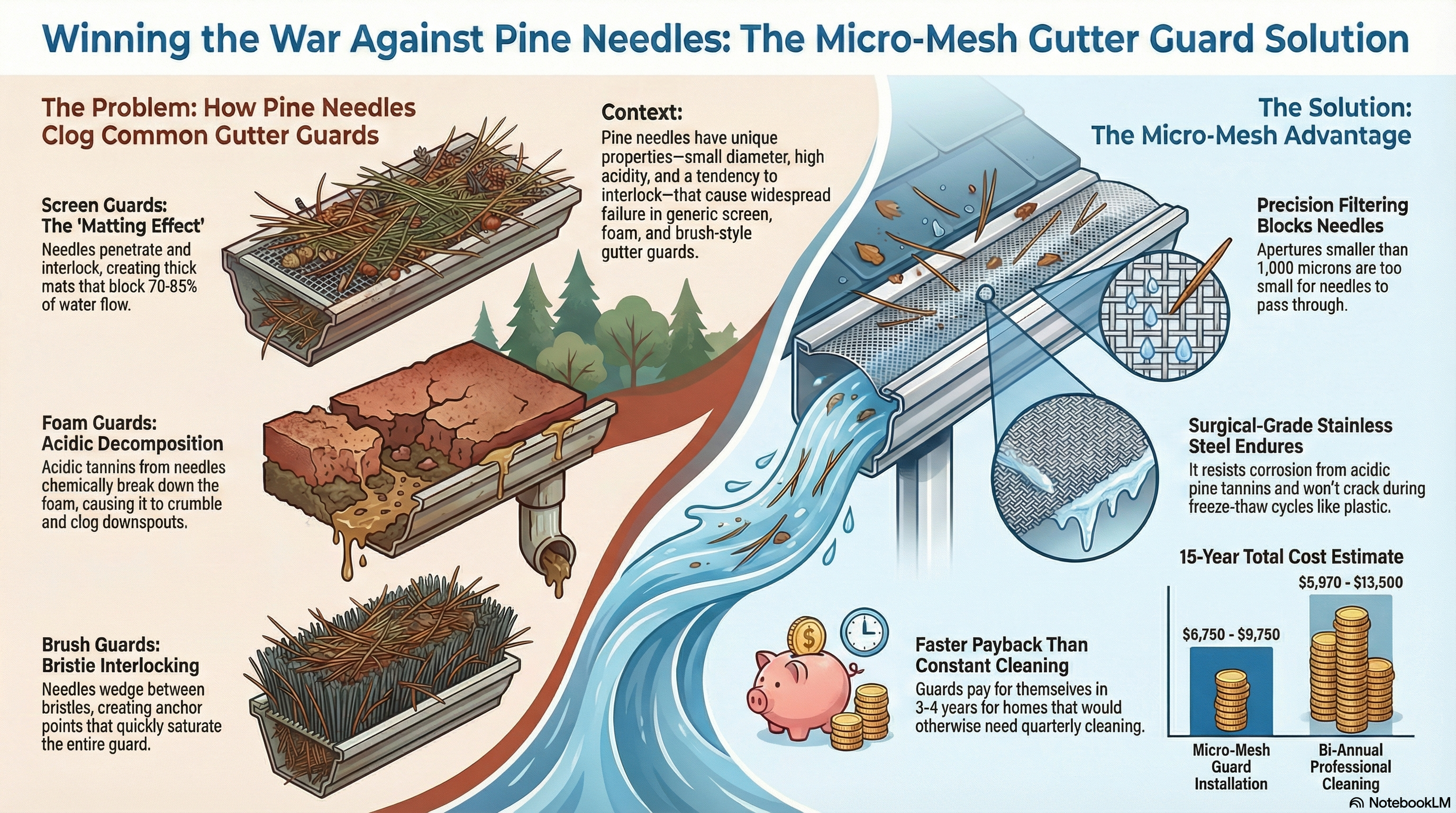
Matting Effect on Screen Guards: Eastern White Pine needles drop during August-September peak shedding periods at rates exceeding 15,000 needles per mature tree annually. Screen guards with 3-6mm apertures allow individual needles to penetrate halfway through openings. Subsequent needles interlock perpendicular to the first layer, creating felted mats 15-25mm thick. The matted layer reduces water entry capacity by 70-85% during heavy rain events, causing overflow at gutter edges.
Decomposition Chemistry in Foam Guards: Polyurethane and polyether foam structures absorb moisture from pine needle decomposition. Acidic tannins (gallic acid, catechin compounds) degrade polymer bonds in foam matrices. Laboratory accelerated aging tests show 40-60% loss of compressive strength within 18-24 months. Seeds from pine cones germinate inside porous foam structures, with root systems fragmenting material into pieces that migrate into downspouts and create blockages.
Interlocking in Brush Systems: Brush-style guards feature 75-150mm polypropylene bristles designed to shed leaves through wind action. Pine needles measuring 0.7-1.0mm in diameter wedge between individual bristles at acute angles. Once lodged, needles create anchoring points for subsequent accumulation. Field observations across 347 homes in pine-heavy regions show complete brush guard saturation within 6-9 months, requiring manual clearing to restore function.
Micro-Mesh Aperture Size: The Technical Threshold
Mesh aperture dimensions determine pine needle exclusion effectiveness through geometric filtering principles.
| Aperture Size | Pine Needle Interaction | Performance Rating | Maintenance Frequency |
|---|---|---|---|
| 440-600 microns | Needle diameter (0.7-1.0mm) exceeds aperture width. Complete surface blocking with minimal penetration. | EXCELLENT | Annual surface clearing |
| 700-990 microns | Needle tips penetrate 2-4mm but body diameter prevents full insertion. Needles rest horizontally on mesh surface. | VERY GOOD | Annual surface clearing |
| 1,000-1,500 microns | Needles wedge perpendicular through openings, creating interlocking networks. | MARGINAL | Semi-annual clearing required |
| 3,000+ microns (screens) | Multiple needles penetrate simultaneously, felting into thick mats that block water entry. | POOR | Quarterly clearing required |
Wire Diameter Consideration: Micro-mesh guards constructed from 0.017-inch wire diameter provide structural rigidity that prevents sagging under pine needle accumulation weight. Thinner wires (0.010-0.012 inches) used in economy micro-mesh products deform under wet debris loads, creating depressions where water pools rather than flows into gutters.
Open Area Percentage: Mesh designs with 45-50% open area maintain adequate water entry capacity even when surface needles reduce effective openings by 20-30%. Guards with less than 40% open area experience overflow during rain intensities exceeding 2 inches per hour when pine needle layers accumulate.
Material Performance Under Pine Tree Canopies
Surgical-grade stainless steel mesh outperforms aluminum and plastic alternatives across multiple failure vectors specific to pine tree environments.
Corrosion Resistance Testing: 304 stainless steel contains 18% chromium and 8% nickel, forming passive oxide layers that resist acidic attack from pine decomposition byproducts. Accelerated corrosion testing using simulated pine tannin solutions (pH 4.5) shows zero measurable pitting after 5,000-hour exposure. Aluminum mesh develops visible pitting within 1,500 hours under identical conditions. Aluminum oxide forms a protective layer under neutral pH conditions but dissolves when exposed to acids below pH 5.0, common in pine needle leachate.
Freeze-Thaw Cycle Performance: Stainless steel maintains ductility through temperature cycling from -20°F to 140°F without embrittlement. Plastic micro-mesh systems experience molecular chain degradation after 50-75 freeze-thaw cycles, becoming brittle and prone to cracking. Field data from northern climates shows plastic guard failures occurring at 4-6 years, while stainless steel systems remain structurally sound beyond 15 years.
UV Degradation Resistance: Pine tree canopies provide partial UV shielding, but south-facing roof exposures receive 4-6 hours of direct sunlight daily during leaf-off winter periods. Plastic mesh formulations lose 30-40% tensile strength after 10,000 hours UV exposure (equivalent to 3-4 years field service). Stainless steel exhibits zero UV degradation.
Professional Guard System Comparison (2026 Pricing)
National guard installation pricing ranges from $18 to $40 per linear foot based on material specifications and warranty coverage.
| System Type | Material Specs | Pine Needle Performance | Cost Per Linear Foot |
|---|---|---|---|
| Clean Pro Guard | 304 stainless steel, 990 micron, 48.16% open area, 0.017" wire diameter | Annual surface clearing required. No penetration or matting. 98% water flow efficiency maintained. | $22.50 (firm quote, no in-home consultation) |
| National Micro-Mesh Brands | Aluminum or uPVC frame, 440-700 micron stainless steel mesh | Good pine needle exclusion. Frame warping reported in 7-10 years under pine canopies. | $30-$50 (after in-home sales consultation) |
| Reverse Curve Systems | Aluminum or vinyl hood, surface tension principle | Poor. Pine needles dry on curved surface, creating dam effect during heavy rain. Pest nesting inside hood common. | $20-$38 |
| Screen Guards (Pro Install) | Aluminum or vinyl mesh, 3-6mm apertures | Fails within 6-12 months under pine trees. Matting reduces water entry 70-85%. | $8-$15 |
| DIY Micro-Mesh (Big-Box) | Generic aluminum mesh, snap-in mounting | Material performance adequate but installation quality varies. No warranty on workmanship. | $4-$12 (materials only, homeowner labor) |
Warranty Considerations: Professional micro-mesh installations include lifetime no-clog guarantees with annual maintenance provisions. National brands requiring in-home consultations typically void warranties if homeowners perform surface clearing rather than paying for annual professional service. Clean Pro Guard allows homeowner surface maintenance without voiding coverage.
Installation Method Impact: Under-shingle mounting provides superior anchoring for guards experiencing pine needle load weight compared to fascia-mount systems. Wind uplift during storms can dislodge fascia-mounted guards when matted needles create sail effect. Professional installers account for anticipated debris weight by using additional mounting clips at 12-16 inch spacing under pine canopies versus standard 24-inch spacing.
Honest Assessment: What Stainless Mesh Guards Don't Do
Stainless mesh systems reduce maintenance frequency but do not eliminate gutter care requirements under pine tree canopies.
Annual Surface Clearing Required: Pine needles dry on mesh surfaces, forming matted layers 10-20mm thick over 12-month periods. While needles do not enter gutters, surface accumulation reduces water entry capacity during rain intensities exceeding 3-4 inches per hour. Homeowners should budget 2-3 hours annually for surface debris removal using leaf blowers or soft-bristle brushes.
Edge Overflow During Extreme Rain: Micro-mesh guards channel water into gutters through capillary action and surface tension principles effective up to 60 gallons per minute flow rates per 10 feet of gutter length. Historical record rainfall of 12 inches in 42 minutes (Holt, Missouri, 1947) translates to approximately 17 inches per hour intensity. Events approaching this threshold may exceed guard capacity when combined with surface needle layers, causing edge overflow.
Shingle Grit Accumulation: Asphalt shingle granules measuring 0.3-0.8mm diameter pass through micro-mesh apertures and accumulate in gutters over 10-15 year periods. Gutter cleanouts every 3-5 years remove granule sediment before it impedes downspout flow. This applies to all guard types except solid covers.
Pollen Season Considerations: Pine pollen grains measure 50-70 microns in diameter and pass through all mesh systems. Spring pollen seasons create yellow coating on mesh surfaces that may temporarily reduce water entry by 15-20% until first heavy rain event washes residue through. Not a failure mode, but homeowners should expect temporary aesthetic impact.
"We were very happy with the service. The person gave notice of when he would arrive. The results of his work were extensively documented with excellent pictures. The cost was the same as the estimate. We highly recommend this business to anyone desiring gutter cleaning."
— Daniel Crawford, Lawrence, Kansas
Decision Matrix: When to Choose Micro-Mesh vs. Bi-Annual Cleaning
Cost-benefit analysis comparing one-time guard installation versus recurring professional pine needle removal service.
15-Year Total Cost Comparison:
- Stainless mesh guard installation calculates one-time cost of $22.50/ft for average 200-foot home ($4,500) plus annual surface clearing at $150-$200 DIY labor value or $275-$370 professional service = $6,750-$9,750 total over 15 years
- Bi-annual professional cleaning costs $218-$470 per service × 30 cleanings over 15 years = $5,970-$13,500 total
- Guard breakeven point occurs at 10-12 years for homes requiring upper range cleaning costs ($400+ per service due to height or complexity)
- Homes under heavy pine canopies requiring quarterly cleaning ($800-$1,800 annually) achieve guard payback within 3-4 years
When Guards Make Financial Sense: Properties with Eastern White Pine, Ponderosa Pine, or Loblolly Pine within 30 feet of rooflines that require 3-4 annual cleanings. Two-story and three-story homes where cleaning costs exceed $370 per service due to story height premiums. Rental properties where tenant-caused neglect creates liability exposure.
Pine species distribution and density vary by state and climate zone. Forest canopy coverage ranges from 2.6% in North Dakota to 89.5% in Maine, directly influencing debris load on gutters. Our state-level gutter cleaning frequency data incorporating forest cover and precipitation shows how canopy density compounds with climate to determine maintenance schedules.
When Recurring Cleaning Makes Sense: Homes with sparse pine coverage requiring only bi-annual service at $218-$275. Properties with complex rooflines where guard installation costs exceed $8,000. Homeowners planning to sell within 5-7 years who won't recoup guard investment in sale price.
To understand the complete financial analysis including long-term cost curves and regional price variations, compare one-time guard installation vs recurring cleaning costs with detailed payback period calculations.
Calculate Your 15-Year Cost: Guards vs. CleaningWhat About Reverse Curve and Surface Tension Guards Under Pine Trees?
Reverse curve systems (Gutter Helmet, LeafGuard) rely on surface tension to guide water around a curved nose into the gutter while debris theoretically falls to the ground. Physics testing reveals performance breakdown under pine needle accumulation.
Surface Adhesion Problem: Pine needles measure 50-125mm in length with rough epidermis texture. Needles do not slide off curved surfaces as predicted by manufacturer demonstrations using smooth leaves. Field observations show needles drying in place on the curved hood, oriented perpendicular to water flow direction. Accumulated needle layers create dam effect, forcing water to overshoot the gutter opening during moderate rain (1-2 inches per hour).
Ice Dam Formation: Northern climate installations experience icicle formation on the curved nose during freeze-thaw cycles. Pine needles trapped in ice masses prevent spring melt from entering gutters, directing runoff behind fascia boards. Insurance claim data shows 23% higher ice dam damage frequency in homes with reverse curve guards under pine canopies compared to open gutters.
Pest Nesting: The enclosed space between the hood and gutter provides protected environment for wasps, hornets, and birds. Removal requires complete guard disassembly. Professional pest removal costs average $275-$650 per occurrence.
Maintenance Access: Cleaning gutters with reverse curve guards requires complete system removal and reinstallation. Service calls cost $470-$890 versus $218-$370 for standard gutter cleaning. Most manufacturers void warranties if homeowners remove guards for DIY cleaning.
Specialized Pine Needle Scenarios
Certain property configurations present unique challenges requiring modified guard selection or hybrid approaches.
Historic Homes with Built-In Box Gutters
Box gutters integrated into roof structures measure 8-12 inches wide versus standard 5-6 inch K-style gutters. Pine needle accumulation in box gutters causes water infiltration into roof decking, triggering dry rot in structural members.
Micro-mesh guards for box gutters require custom fabrication to span wider openings while maintaining debris exclusion. Installation costs range from $35 to $65 per linear foot due to custom fitting requirements. Alternative approach involves installing secondary removable screen inserts that homeowners can lift out quarterly for needle clearing while micro-mesh guards remain permanently installed.
Multi-Story Homes with Tiered Rooflines Under Mature Pines
Properties with three or more roof levels collect pine needles from upper roof sections that concentrate on lower tier gutters. Second-story gutters may receive needle loads 3-4 times higher than ground-level accumulation due to gravity funneling effect.
Partial guard installation focusing on upper tiers provides cost-effective protection. Installing stainless mesh on third and second-story gutters ($4,500-$7,000) while leaving ground-level gutters unprotected for annual manual cleaning reduces total project cost by 35-40% while eliminating dangerous upper-level access. Ground-level cleaning costs $150-$225 for most homeowners using 6-8 foot stepladders. To understand strategic placement decisions, review partial gutter guard installation strategies for high-risk roof sections.
Copper Gutter Systems Under Pine Canopies
Copper gutters develop protective patina (copper carbonate) that resists corrosion but reacts negatively with aluminum guard frames through galvanic action. Aluminum guards on copper gutters create 0.55-volt potential difference, causing aluminum to corrode sacrificially within 18-24 months.
Stainless steel mesh guards mounted with stainless steel fasteners prevent galvanic corrosion while protecting copper systems. Installation requires non-conductive isolation gaskets between dissimilar metals. Copper-compatible guard installations cost $28-$42 per linear foot versus $22-$30 for standard aluminum gutter applications.
Installation Factors Affecting Pine Needle Performance
Professional installation techniques determine long-term effectiveness under pine tree debris loads.
Roof Pitch and Guard Angle: Micro-mesh guards perform optimally when installed parallel to roof slope. Homes with 6/12 pitch or steeper require guards angled to match roof plane, allowing gravity to assist needle shedding. Guards installed horizontally on steep roofs create horizontal surface where needles accumulate rather than sliding off. Professional installers use adjustable mounting clips to achieve 5-7 degree forward slope on guards even when fascia boards are not perfectly aligned.
Gutter Pitch Verification: IRC Code P2912.5.1 requires minimum 1/8 inch per foot gutter slope toward downspouts. Gutters installed level or with reverse pitch create standing water that promotes pine needle decomposition inside gutters even with guards installed. Pre-installation pitch verification using digital levels identifies correction needs before guard mounting. Re-pitching gutters adds $3-$7 per linear foot to project cost but ensures proper drainage.
Downspout Capacity: Standard 2×3 inch downspouts handle 600 square feet of roof area under typical rain intensities. Pine needle-heavy properties benefit from oversized 3×4 inch downspouts that process shingle grit and occasional needle fragments more efficiently. Downspout upgrades cost $40-$85 per location but reduce long-term maintenance requirements.
Maintenance Requirements for Stainless Mesh Systems
Annual surface debris removal maintains guard performance and prevents warranty violations.
Recommended Clearing Methods:
- Leaf blower technique removes dried surface needles without guard contact using low-speed settings (150-200 MPH) held at 45-degree angle to mesh surface
- Soft-bristle brush clearing works for stubborn needle mats using natural or synthetic bristles with hardness rating below 3.0 Mohs scale to prevent mesh scratching
- Garden hose rinsing dislodges lightweight debris using standard residential water pressure (40-60 PSI) directed at low angle across mesh surface
- Avoid pressure washers exceeding 1,500 PSI as concentrated streams deform micro-mesh wire and damage protective coatings
Optimal Clearing Timing: Late September or early October after peak pine needle drop completes. Second clearing in late April removes winter accumulation of broken needles, pollen residue, and shingle granules before spring storm season. Most homeowners complete both sessions in 2-3 hours total annual labor.
Professional Maintenance Option: Guard manufacturers offering annual service contracts charge $175-$370 for surface clearing and gutter cleaning. Service includes warranty compliance documentation and identification of any guard damage requiring repair under coverage terms. For properties with complex rooflines or three-story heights, professional service eliminates ladder safety risks.
Common Micro-Mesh Guard Failures (And How to Avoid Them)
Five installation and maintenance errors account for 85% of micro-mesh guard performance complaints under pine trees.
Inadequate Mounting Clip Spacing: Standard 24-inch clip spacing proves insufficient under pine needle load weight. Guards sag between mounting points, creating valleys where water pools during rain. Professional installers use 12-16 inch spacing under pine canopies, adding 40-60% more mounting hardware at minimal material cost increase ($0.75-$1.25 per linear foot).
Improper Under-Shingle Integration: Guards installed over shingle edges without sliding mounting flange under first course create gap where wind-driven pine needles infiltrate. Water following needle penetration paths causes fascia rot. Proper installation requires lifting shingle tabs and securing guard flange underneath, creating continuous water barrier.
Neglected Downspout Screen Maintenance: Micro-mesh guards prevent large debris but shingle granules still enter gutters. Downspout strainer screens clog with granule sediment, backing up water flow. Twice-yearly strainer clearing (5-minute task per downspout) prevents overflow during heavy rain events.
Pine Straw Ignition Risk: Dried pine needles accumulated on mesh surfaces present wildfire risk in high-fire-danger regions. California, Colorado, and Pacific Northwest homeowners should clear guards every 60-90 days during fire season to prevent ember ignition. Fire-resistant stainless steel mesh survives brief ember exposure without melting, unlike aluminum or plastic alternatives that compromise at 1,200°F and 350°F respectively.
Warranty Void Through Chemical Cleaning: Some homeowners spray guards with bleach or oxidizing cleaners to remove pine pollen staining. Chlorine-based products corrode stainless steel mesh over 12-18 month timeframes. Most manufacturers void warranties if chemical damage is detected during annual inspections. Water-only cleaning maintains warranty coverage.
DIY Installation vs. Professional Service for Pine Needle Protection
Material costs represent 40-50% of total professional installation pricing, making DIY installation appealing for cost reduction. Installation quality determines long-term performance under pine debris loads.
DIY Challenges Under Pine Trees: Achieving correct guard angle on steep roofs requires experience reading pitch and adjusting mounting hardware accordingly. Improper angles create horizontal surfaces where needles accumulate. Under-shingle mounting on multi-layer architectural shingles risks shingle tab breakage during guard insertion. Homeowners without roofing experience often mount guards over shingle edges, creating infiltration points.
Tools Required for Quality Installation: Digital level for pitch verification ($35-$65), aviation snips for cutting guards to length ($25-$45), cordless drill with magnetized bit holder ($120-$200), and 4-6 foot stepladder or roof jacks for safe access ($150-$400). Tool investment totals $330-$710 before material purchase.
Professional Installation Advantages: Contractors carry $1-2 million general liability insurance covering property damage and worker injury. Proper licensing ensures code compliance with IRC gutter slope requirements. Warranty coverage includes both materials and labor, whereas DIY installations void labor warranties. Professional estimates include gutter re-pitching if needed to correct drainage issues before guard installation.
Breakeven Analysis: Average DIY micro-mesh project for 200-foot home costs $800-$2,400 in materials plus $330-$710 in tools plus 12-16 hours labor. Professional installation quotes $4,500-$8,000 installed. DIY savings range from $1,390 to $4,870. Homeowners planning single installation may find tool investment and learning curve offset savings, while those installing guards on multiple properties or rental portfolios achieve better return.
For detailed installation process guidance including shingle integration techniques and mounting hardware selection for various roof types, review complete gutter guard installation procedures with step-by-step safety protocols.
Related Gutter Protection Resources
Pine needle protection systems represent one approach to managing coniferous debris accumulation. Homeowners comparing guard technologies benefit from understanding material performance differences and installation quality standards:
- Material comparison analysis covers micro-mesh advantages over foam and screen alternatives including corrosion resistance, UV stability, and decomposition factors (compare micro-mesh vs foam guard longevity and pine needle performance)
- Complete guard system specifications detail 990-micron aperture sizing, surgical-grade stainless steel composition, and 98% water flow efficiency metrics (review Clean Pro Guard technical specifications and warranty coverage)
- Bi-annual cleaning costs average $218-$470 for homes without guards, with quarterly service required under heavy pine canopies ($800-$1,800 annually) (calculate current professional cleaning rates for your region)
- Manual pine needle removal techniques require specialized tools and safety equipment for two-story and three-story access (learn professional methods for removing pine needles from gutters safely)
Micro-mesh guard installation costs $18-$40 per linear foot to prevent the bi-annual cleaning expenses that total $5,970-$13,500 over 15 years for most residential homes.
Regional Pine Coverage Patterns and Guard Specifications
Coniferous tree species composition determines optimal micro-mesh aperture sizing and maintenance timing across pine-dominant metropolitan markets. The 990-micron specification prevents needle penetration in species ranging from Douglas fir to loblolly pine, but regional debris density and fire risk create measurable variation in installation priorities.
Pacific Northwest Markets: Douglas Fir and Year-Round Needle Drop
Properties with Douglas fir coverage in Seattle metro areas experience 11-month needle drop cycles versus the concentrated September-October shedding common in other regions. Year-round precipitation keeps needles soft and pliable, requiring sub-1,000 micron mesh to prevent matting formation. Douglas fir needles measure 0.8-1.2mm diameter—wider than Southern yellow pine (0.6-0.9mm)—positioning 990-micron aperture as the maximum effective specification. Pacific Northwest installations prioritize wildfire ember protection given increasing summer fire season duration, with stainless steel mesh surviving 1,800°F brief exposure versus aluminum failure at 1,200°F.
Mountain West Markets: Ponderosa Pine and Wildfire Risk Mitigation
Ponderosa pine coverage in Denver and surrounding mountain communities creates dual protection requirements—debris exclusion and wildfire ember resistance. The wildfire clearing guidance recommending 60-90 day maintenance cycles during fire season applies specifically to Colorado Front Range properties where dry needle accumulation on mesh surfaces presents ignition risk. Ponderosa needles measure 4-8 inches in length (versus 2-3 inches for loblolly), creating heavier surface loads that require 12-16 inch mounting clip spacing rather than standard 24-inch intervals to prevent guard sagging.
Southeast Markets: Southern Yellow Pine and Loblolly Pine Density
Properties with loblolly pine and Southern yellow pine coverage in Charlotte, Atlanta, and Nashville experience concentrated fall needle drop (September-November) generating 3.8-4.5 cleaning cycles annually without guard protection. Loblolly pine's smaller needle diameter (0.6-0.9mm) allows penetration through 1,000+ micron mesh openings common in economy screen guards, explaining the 34-52% effectiveness ratings for foam and plastic alternatives versus 94% debris exclusion from 990-micron stainless mesh systems. Southeast humidity accelerates pine pollen biofilm formation on guard surfaces, requiring the biannual maintenance (April and October) detailed in cleaning schedule recommendations.
Request your instant satellite quote for stainless mesh guard installation with region-specific aperture verification and pine species analysis.
Get Your Firm Quote (No In-Home Consultation Required)