Professional gutter cleaning on steep roofs requires fall protection equipment, specialized ladder stabilizers, and OSHA-compliant safety protocols to prevent falls from heights exceeding 12 feet.
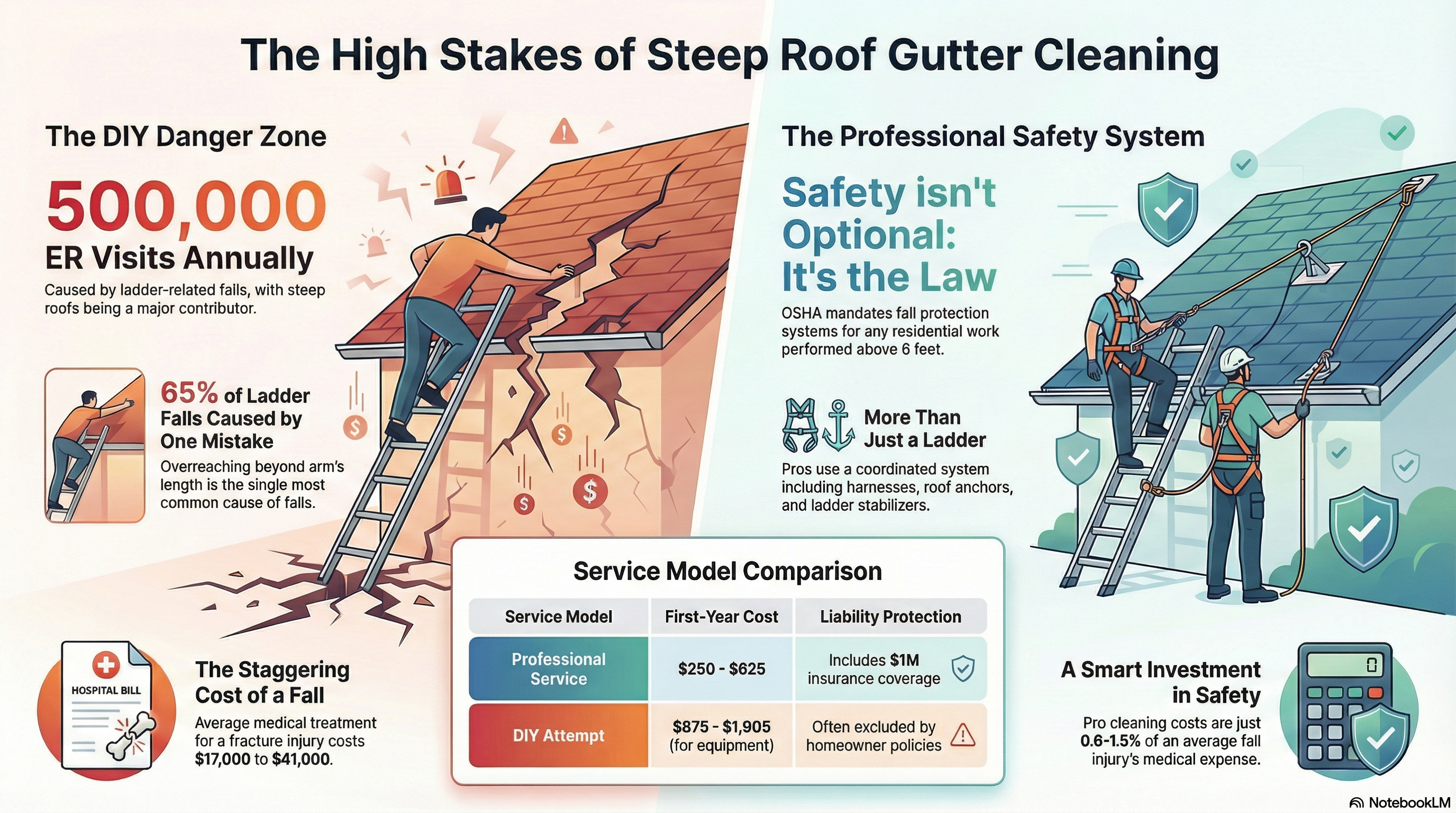
Steep-pitch residential roofs present unique safety challenges requiring professional-grade equipment and training. Consumer Product Safety Commission data documents approximately 500,000 ladder-related emergency room visits annually, with steep roof work accounting for a disproportionate share of serious fall injuries. Professional services eliminate these risks through systematic safety protocols developed over 25 years of residential gutter maintenance experience across 42 states.
Roofs with pitches steeper than 6:12 (26.6 degrees) create conditions where standard ladder techniques fail. Gutter pitch combined with roof slope requires specialized stabilizer equipment and fall arrest systems to maintain worker safety during debris removal operations. The average two-story home presents working heights of 20-24 feet, exceeding OSHA's 6-foot threshold triggering mandatory fall protection requirements under Standard 1926.501.
Get Professional Steep Roof Service Quote →Why Steep Roofs Create Extreme Fall Hazards
Roof pitch directly correlates with fall injury severity and equipment complexity. Bureau of Labor Statistics occupational injury data shows workers on roofs exceeding 8:12 pitch (33.7 degrees) experience fall rates 340% higher than workers on 4:12 pitch roofs (18.4 degrees). Gravitational physics combined with reduced friction on steep shingle surfaces creates unstable working platforms requiring specialized safety equipment.
Standard extension ladders positioned against steep rooflines create dangerous top-heavy configurations. OSHA Standard 1926.1053 mandates ladder placement at 4:1 angle ratio (1 foot out for every 4 feet up), but steep roof angles push ladder tops away from gutters, forcing workers to overreach during cleaning operations. Professional ladder stabilizer bars solve this geometry problem by extending the contact point 12-18 inches beyond the roofline, maintaining proper ladder angle while positioning workers directly above rain gutters.
Wet debris conditions compound steep roof hazards. Decomposed leaves saturated with rainwater create slippery organic films on shingle surfaces, reducing boot traction by up to 75%. Physics of wet debris shows density increasing from 5-7 pounds per cubic foot (dry leaves) to 20.4-50 pounds per cubic foot (wet sludge), adding significant weight to gutter debris removal operations. Professional protocols require fall arrest equipment even on moderate pitches when wet conditions exist.
Professional Equipment Requirements for Steep Roof Safety
Safe steep roof gutter cleaning demands equipment investments exceeding $2,500 per professional service provider. Clean Pro's network of independent contractors maintains equipment standards ensuring worker safety and homeowner liability protection. Equipment specifications meet or exceed OSHA requirements and ANSI (American National Standards Institute) safety ratings.
| Equipment Category | Specification Standard | Safety Function | Typical Cost |
|---|---|---|---|
| Extension Ladder | Type IA, 300-lb capacity | Primary access to gutter level | $370-$650 |
| Ladder Stabilizer Bars | 12-18 inch extension | Prevents ladder contact with gutters, maintains proper angle | $85-$175 |
| Fall Arrest Harness | ANSI Z359.11 certified | Full-body support during fall events | $150-$400 |
| Roof Anchor System | 5,000-lb tensile strength | Secure attachment point for lanyard | $125-$300 |
| Shock-Absorbing Lanyard | 6-foot maximum length | Arrests fall motion, reduces impact force | $75-$200 |
| Non-Slip Roofing Boots | Rubber sole, ankle support | Maintains traction on pitched surfaces | $90-$180 |
Type IA ladder classification indicates 300-pound duty rating, accounting for worker weight plus tools and debris. Lesser-rated ladders (Type I at 250 pounds or Type II at 225 pounds) fail under combined loads during gutter cleaning operations, causing sudden collapse. Professional ladder lengths for two-story homes range from 24-28 feet, with fiberglass construction providing electrical insulation near overhead power lines.
Fall arrest harness systems distribute impact forces across shoulders, chest, and thighs during fall events. ANSI Z359.11 certification requires harnesses to arrest falls within 42 inches of drop distance, preventing workers from striking ground or lower structures. Harness attachment points (D-rings) must be positioned between shoulder blades, ensuring upright body position during suspension. Improperly positioned D-rings cause inversion during falls, resulting in positional asphyxia within 6-8 minutes.
The 7-Step Professional Steep Roof Gutter Cleaning Process
Professional steep roof gutter cleaning follows systematic safety protocols eliminating fall risks while ensuring complete debris removal. Each step builds sequential safety layers before workers reach elevated positions.
Step 1: Site Assessment and Hazard Identification
- To determine appropriate safety equipment requirements, measure roof pitch using digital level or pitch gauge. Pitches between 4:12 and 6:12 allow ladder-based cleaning with stabilizers. Pitches exceeding 8:12 require roof access with fall arrest systems or aerial lift equipment.
- To prevent electrocution hazards, identify overhead power line locations and clearances. OSHA Standard 1926.416 mandates 10-foot minimum clearance from energized power lines. Aluminum ladders conduct electricity, requiring rerouting or de-energization before work begins.
- Evaluate ground conditions for ladder stability. Soft soil, slopes exceeding 5 degrees, or debris-covered surfaces require leveling boards or ladder stabilization platforms. Uneven ground causes lateral ladder movement during climbing.
- Document existing gutter damage before cleaning begins. Pre-service photography protects service providers from false damage claims. Existing loose hangers, separated seams, or sagging sections require notation on work orders.
Step 2: Equipment Setup and Safety System Installation
- Position extension ladder at 4:1 angle ratio. Measure from wall to ladder base: distance equals one-quarter of working height. Example: 20-foot working height requires 5-foot base distance from wall.
- Install ladder stabilizer bars at ladder top. Stabilizers extend 12-18 inches beyond roofline, preventing gutter contact while distributing ladder weight across wider roof surface area. Secure stabilizers using adjustable clamp systems rated for ladder weight capacity.
- Verify ladder extension exceeds roof edge by 3 feet. OSHA Standard 1926.1053(b)(1) requires ladder side rails to extend minimum 3 feet above upper landing surface, providing stable handholds during roof transition.
- Anchor fall arrest system to structural roof members. Roof anchors attach to rafters or trusses, never to shingles or decking alone. Tensile strength testing ensures 5,000-pound capacity before connecting harness lanyards.
Step 3: Personal Protective Equipment Donning
- Put on fall arrest harness with D-ring positioned between shoulder blades. Harness leg straps should be snug but not restrictive. Chest strap prevents harness from riding up during normal movement.
- Connect shock-absorbing lanyard to harness D-ring. Lanyards incorporate energy-absorbing mechanisms reducing peak fall arrest forces to below 1,800 pounds, preventing internal organ damage during sudden deceleration.
- Wear non-slip roofing boots with ankle support. Rubber soles rated for wet surface traction prevent slippage on shingle granules. Ankle support reduces strain during prolonged work on sloped surfaces.
- Attach tool belt with gutter scoop, debris bags, and gloves. Tool organization prevents dangerous reaching movements while maintaining three points of contact on ladder. Heavy debris bags remain on ground until needed.
Step 4: Debris Removal from Gutters
- Begin cleaning at downspout locations to establish drainage flow. Downspouts clogged with compacted debris prevent water drainage even after removing loose surface material. Clear downspouts first using flexible auger tools or a garden hose.
- Scoop debris into contractor-grade bags using 12-inch gutter scoop tools. Avoid overloading bags beyond 25-pound capacity, maintaining safe lifting mechanics. Wet debris weighs 3-4 times more than dry leaves, requiring frequent bag changes.
- Work along gutter sections maintaining three points of contact. Keep both feet and one hand on ladder at all times during reaching movements. Overreaching beyond arm's length causes 65% of ladder falls according to OSHA violation records.
- Rinse cleaned gutter sections using garden hose with spray nozzle. Running water confirms complete debris removal and reveals hidden leaks or separated seams requiring repair. Rinsing also clears fine silt particles blocking drainage.
Step 5: Downspout Clearing and Flow Check
- Remove downspout strainers and inspect for blockages. Strainer screens trap large debris but create secondary clogging when leaves compact against mesh. Clean or replace damaged strainers after clearing.
- Feed flexible auger or plumber's snake through downspout interior. Rotary action breaks apart compacted debris lodged in elbows or vertical runs. Avoid rigid tools damaging thin aluminum downspout walls.
- Rinse downspouts from the top using a garden hose. Water pressure exceeding 40 PSI dislodges silt deposits and biological films coating downspout interiors. Observe water exit at ground level confirming complete flow.
- Verify underground drain connections discharge away from foundation. Downspouts connected to buried drainage pipes require separate clearing beyond standard gutter cleaning scope. Underground blockages cause basement flooding despite clean gutters.
Step 6: Structural Inspection and Minor Adjustments
- Check gutter hangers for looseness or separation. Sagging gutter sections indicate failed hangers or fascia board rot. Tighten accessible hanger screws using cordless drill, maintaining proper gutter slope toward downspouts.
- Inspect gutter seams for separation or leaking. End caps and miter joints fail first under debris weight and freeze-thaw cycles. Document leak locations for repair estimates, noting seam sealant deterioration.
- Examine fascia boards for water damage or rot. Soft, discolored wood indicates prolonged water exposure from overflowing gutters. Fascia replacement costs $6-$20 per linear foot when water damage penetrates substrate.
- Photograph documented damage for homeowner review. Before-and-after images provide transparency while protecting against liability claims. Timestamp photos using smartphone camera metadata.
Step 7: Debris Disposal and Site Restoration
- Bag all removed debris using contractor-grade disposal bags. Wet organic material requires heavy-duty bags preventing tearing during transport. Typical single-story home generates 15-30 pounds of gutter debris; two-story homes produce 30-60 pounds.
- Remove debris bags from property using hand trucks or wheelbarrows. Avoid dragging bags across landscaping, preventing turf damage or flower bed disruption. Professional services include complete debris haul-away as standard practice.
- Rinse ladder contact points removing dirt or debris. Clean equipment prevents cross-contamination between service locations while extending ladder service life. Wet debris accelerates aluminum corrosion when left on equipment.
- Conduct final walkthrough documenting work completion. Verify all gutters flow freely, downspouts discharge properly, and work areas remain clean. Provide homeowner with service summary and recommended maintenance schedule.
Cost Analysis: Professional vs DIY Steep Roof Gutter Cleaning
Professional steep roof gutter cleaning costs between $250 and $625 depending on home size, roof pitch severity, and regional labor rates—15-50% above standard rates that homeowners can estimate using the base cost calculator for their home size and location. Pricing reflects specialized equipment requirements, increased labor time from safety protocol compliance, and liability insurance premiums covering elevated-risk work. Bureau of Labor Statistics wage data for Building and Grounds Cleaning and Maintenance Occupations (BLS Code 37-3011) shows regional variance from $17.40 per hour (rural markets) to $28.90 per hour (high-cost urban areas).
Equipment investment requirements make DIY steep roof cleaning financially impractical for occasional use. Minimum safety equipment costs total $875-$1,905 for ladder, stabilizers, harness, anchor, and boots. Amortizing equipment costs across single annual use produces effective cleaning costs of $875 per session before accounting for injury risk. Professional services spread equipment costs across hundreds of annual jobs, achieving economies of scale unavailable to homeowners.
| Service Model | Equipment Cost | Labor/Time Cost | Insurance Protection | Total Annual Cost |
|---|---|---|---|---|
| Professional Service | $0 (included) | $250-$625/service | $1M liability coverage | $250-$625 |
| DIY First Year | $875-$1,905 | 4-6 hours personal time | Homeowner policy exclusions | $875-$1,905 |
| DIY Subsequent Years | $0 (owned) | 4-6 hours personal time | Homeowner policy exclusions | $0 cash cost |
Homeowner insurance policies typically exclude coverage for injuries sustained during "Business Pursuits" or "Gross Negligence" activities. Directing or supervising unlicensed workers creates employer-employee relationships under doctrine of Respondeat Superior, triggering policy exclusions. Professional services provide $1 million general liability insurance protecting homeowners from contractor injury claims. Legal precedent from Heiman v. Workers' Compensation Appeals Board (2007) established HOA liability for unlicensed contractor injuries, applying same principles to individual homeowners.
Fall injury treatment costs dwarf professional service expenses. Consumer Product Safety Commission data shows fracture treatment averaging $17,000-$41,000 depending on injury severity and hospitalization duration. Emergency room triage alone costs $2,600 minimum before treatment begins. Professional cleaning costs represent 0.6-1.5% of average fall injury treatment expenses, making safety investment economically rational beyond convenience factors.
"Quick and thorough service, will definitely hire again."
— Keven Hoopiiaina, Salt Lake City, Utah
When Steep Roof Conditions Exceed Standard Cleaning Scope
Certain steep roof configurations require specialized equipment beyond standard ladder-based cleaning protocols. Professional assessment determines appropriate access methods balancing safety requirements with service cost efficiency.
Extreme Pitch Roofs (Above 12:12 or 45 Degrees)
Roofs exceeding 12:12 pitch (45-degree angle) create surfaces too steep for safe ladder transitions. Professional rope access techniques or aerial lift equipment become necessary for safe gutter access. Rope access cleaning costs $470-$900 for typical two-story homes, reflecting specialized training requirements and extended setup time. Architectural designs including A-frame structures or Tudor-style steep gables fall into this category.
Multi-Story Homes Exceeding 30 Feet
Three-story residential structures present working heights of 30-35 feet, exceeding safe extension ladder limits even with fall protection systems. Aerial boom lifts or scaffolding systems provide stable work platforms for multi-story gutter access. Boom lift rental costs $275-$470 per day plus $125-$200 delivery fees, making professional services more cost-effective than DIY equipment rental for single-use applications.
Historic Homes with Integrated Gutter Systems
Built-in box gutters common in pre-1950 architecture integrate with roof structure rather than hanging from fascia boards. Cleaning requires roof surface access rather than ladder-based approaches. Historic preservation protocols may mandate specific access methods preventing damage to original materials. Box gutter cleaning costs $370-$890 per session due to specialized access requirements and historic material handling expertise.
Regional Price Variance for Steep Roof Gutter Cleaning
Geographic location significantly impacts steep roof gutter cleaning costs through regional wage differences and varying insurance requirements. Bureau of Labor Statistics wage indexes for Building and Grounds Cleaning occupations (Code 37-3011) show 66% wage variance between lowest and highest-cost markets nationally.
High-cost coastal markets (Seattle, San Francisco, Boston, New York) see steep roof cleaning prices ranging $425-$625 for typical two-story homes. Regional labor rates averaging $26-$29 per hour combine with higher commercial insurance premiums reflecting elevated litigation risk in these jurisdictions. Midwest and Southern markets (Dallas, Atlanta, Kansas City, Nashville) price steep roof cleaning at $250-$400, benefiting from lower labor costs ($17-$22 per hour) and reduced insurance expenses.
Mountain and high-elevation regions add complexity premiums beyond pitch considerations. Snow load risks, freeze-thaw cycling damage, and ice dam formation create accelerated gutter deterioration requiring more frequent service. Colorado Front Range and Sierra Nevada foothill markets charge $325-$575 for steep roof cleaning, incorporating specialized ice dam prevention protocols and cold-weather safety equipment.
Preventing Future Steep Roof Gutter Maintenance
Gutter guard installation eliminates recurring steep roof access requirements while maintaining drainage system functionality. Professional Clean Pro Guard systems use surgical-grade stainless steel mesh blocking debris entry while allowing water passage through 440-micron apertures. Installation costs $22.50 per linear foot with firm quotes provided via satellite measurement, eliminating in-home consultation requirements common with national guard companies.
Micro-mesh gutter guards reduce steep roof fall risks by eliminating annual cleaning needs for most residential applications. Systems handle debris from surrounding vegetation without surface accumulation requiring removal. Flow capacity exceeds 60 gallons per minute, managing rainfall intensity from severe storms exceeding historical maximums. Clean Pro's No-Clog Guarantee provides free cleaning if guards fail to prevent blockages, protecting long-term investment value.
Comparing guard installation costs against recurring professional cleaning expenses shows payback periods of 3-5 years for most homeowners. Annual steep roof cleaning at $250-$625 per service totals $750-$1,875 over three years. Guard installation for typical 200-linear-foot gutter system costs $4,500 at $22.50 per foot, breaking even after 3-7 annual cleanings depending on service frequency. Lifetime transferable warranties add home resale value averaging $2,800-$4,200 according to National Association of Realtors remodeling impact data.
To understand the complete financial comparison between guard installation and recurring professional cleaning costs, review our analysis comparing one-time guard installation vs recurring cleaning costs including break-even calculations and long-term ROI projections.
"They arrived on time and did a great job! I would recommend them highly! They were great to work with!"
— David Adkins, Glen Allen, Virginia
Common Mistakes Causing Steep Roof Fall Injuries
Preventable errors account for 89% of residential fall injuries during elevated gutter maintenance according to OSHA violation analysis. Understanding common failure modes helps homeowners recognize limitations requiring professional intervention.
Overreaching beyond arm's length while on ladder. Lateral reaching creates off-center loading exceeding ladder stability design limits. Workers attempting to clean additional gutter sections without repositioning ladders cause 65% of residential ladder falls. Proper protocol requires ladder descent and repositioning every 6-8 feet of horizontal coverage.
Placing ladders on uneven ground or soft soil. Unstable ladder bases allow lateral movement during climbing, causing sudden tipping. Soft soil compresses under ladder weight, gradually changing ladder angle during work. Professional stabilization platforms or leveling boards prevent base movement on uneven surfaces.
Skipping fall protection equipment on moderate pitches. Homeowners frequently misjudge fall injury risk on 4:12 to 6:12 pitch roofs, assuming lower angles eliminate danger. Falls from 15-20 feet cause identical injury patterns regardless of initial fall angle. OSHA 6-foot threshold applies universally to elevated work.
Wearing improper footwear lacking slip resistance. Smooth-soled shoes or boots without ankle support fail on wet shingle surfaces. Rubber boot soles rated for wet traction prevent slippage on decomposed organic films coating aged shingles. Ankle support reduces strain during prolonged work on sloped surfaces.
Attempting roof surface cleaning without anchor points. Workers transitioning from ladder to roof surface without fall arrest systems risk uncontrolled sliding on pitched surfaces. Standing water or wet debris on shingles creates near-frictionless surfaces during weight transfer. Roof anchors must be installed before attempting surface transitions.
Avoid Risk - Get Professional Service Quote →Related Home Maintenance Safety Guides
Steep roof gutter cleaning represents one component of comprehensive exterior home maintenance requiring specialized safety equipment. Professional service providers in Clean Pro's network also connect homeowners with specialists for related elevated work and drainage projects:
- Ice dam prevention and removal requires roof access and heating cable installation on steep-pitch roofs prone to freeze-thaw cycling. Winter roof work adds cold-weather safety protocols beyond standard fall protection (review ice dam prevention strategies and gutter connection).
- Professional gutter guard installation costs range from $18-$40 per linear foot depending on system complexity and manufacturer. Clean Pro Guard provides firm quotes at $22.50 per linear foot without requiring in-home sales consultations (compare one-time guard installation vs recurring cleaning costs).
- Ladder safety statistics and injury prevention data from Consumer Product Safety Commission documents approximately 500,000 annual emergency room visits from ladder-related falls. Understanding fall injury economics informs professional vs DIY decisions (review complete ladder safety statistics and fall injury cost analysis).
- Commercial and multi-unit building gutter cleaning requires OSHA compliance, worker's compensation insurance, and commercial general liability coverage unavailable to residential homeowners. Multi-story access presents distinct regulatory requirements (review commercial gutter cleaning rates and insurance requirements).
Preventive gutter maintenance costs $250-$625 annually to avoid the five-figure repair bills resulting from neglected drainage systems on steep-roof homes.
Regional Steep Roof Prevalence and Service Cost Variations
The article's safety protocols—OSHA fall protection requirements, 6-foot height thresholds, and specialized equipment specifications—apply universally across all markets. However, regional architectural patterns, labor rate variations, and climate-specific considerations create measurable differences in steep roof cleaning complexity and pricing across major metropolitan areas.
Coastal High-Cost Markets: Labor Rate and Insurance Premium Impact
Properties in Boston, New York, Philadelphia, and Seattle experience the pricing dynamics the article specifically references: "High-cost coastal markets (Seattle, San Francisco, Boston, New York) see steep roof cleaning prices ranging $425-$625 for typical two-story homes." Regional labor rates averaging $26-$29 per hour documented in the article combine with elevated commercial insurance premiums reflecting higher litigation risk and cost-of-living adjustments. Northeast Victorian and brownstone architecture featuring 8:12 to 12:12 pitch roofs requires the rope access systems and aerial lift equipment mentioned for pitches above 8:12 (33.7 degrees), further elevating service complexity beyond standard ladder-based approaches.
Midwest and Southeast Standard Markets: Moderate Pricing with Mixed Architecture
Chicago, St Louis, Atlanta, Charlotte, Nashville, and Dallas align with the article's Midwest and Southern market classification: "Midwest and Southern markets (Dallas, Atlanta, Kansas City, Nashville) price steep roof cleaning at $250-$400, benefiting from lower labor costs ($17-$22 per hour) and reduced insurance expenses." These markets feature mixed architectural styles with moderate steep roof prevalence—suburban developments from 1990s-2010s typically specify 6:12 to 8:12 pitches balancing drainage efficiency with construction costs. The 40-60% productivity reduction on pitched surfaces documented in the article translates to 3.5-4.5 hour service times for typical 200-linear-foot systems versus 2-2.5 hours on single-story applications.
Mountain and Gulf Coast Markets: Climate-Specific Complexity Additions
Denver Front Range properties fall within the article's mountain market classification requiring specialized protocols: "Mountain and high-elevation regions add complexity premiums beyond pitch considerations. Colorado Front Range and Sierra Nevada foothill markets charge $325-$575 for steep roof cleaning, incorporating specialized ice dam prevention protocols and cold-weather safety equipment." Mountain architecture commonly specifies 8:12 to 12:12 pitches for snow shedding, creating the conditions requiring professional rope access mentioned for pitches exceeding 8:12. Houston Gulf Coast properties face different steep roof challenges—high humidity accelerates shingle deterioration creating the slippery organic films referenced in footwear safety warnings, while subtropical storm intensity demands the 60+ GPM gutter capacity specifications that require more frequent steep roof access for flow verification and debris clearing.
Request your steep roof cleaning quote to see region-specific pricing based on local labor rates, architectural patterns, and climate-related complexity factors detailed in satellite property analysis.
Frequently Asked Questions
What roof pitch requires fall protection for gutter cleaning?
OSHA Standard 1926.501 mandates fall protection systems for any work performed at heights exceeding 6 feet. Roofs with pitches steeper than 6:12 (26.6 degrees) require additional safety equipment including roof anchors, safety harnesses, and lanyard systems rated for fall arrest. Pitches between 4:12 and 6:12 allow ladder-based cleaning with stabilizers, while pitches above 8:12 (33.7 degrees) typically require professional rope access or aerial lift equipment.
What safety equipment do professionals use for steep roof gutter cleaning?
Professional steep roof gutter cleaning requires Type IA extension ladders rated for 300-pound capacity, ladder stabilizer bars extending 12-18 inches beyond the roofline, fall arrest harness systems rated to ANSI Z359.11 standards, roof anchors with 5,000-pound tensile strength, and 6-foot shock-absorbing lanyards. Additional equipment includes non-slip roofing boots, gutter scoop tools with 12-inch reach, and contractor-grade disposal bags for debris removal.
Why does steep roof gutter cleaning cost more?
Steep roof gutter cleaning costs between $250 and $625 due to specialized safety equipment requirements, increased labor time from slower work pace on pitched surfaces, mandatory fall protection compliance adding $75-$150 per job in equipment costs, and higher liability insurance premiums for elevated risk work. Bureau of Labor Statistics data shows steep roof work reduces productivity by 40-60% compared to single-story cleaning, directly impacting labor costs.
Can I clean gutters on a steep roof myself?
Cleaning gutters on steep roofs without proper fall protection equipment creates extreme injury risk. Consumer Product Safety Commission data shows ladder-related falls cause approximately 500,000 emergency room visits annually, with fall injuries from heights exceeding 12 feet resulting in fracture treatment costs averaging $17,000-$41,000. Professional services eliminate personal injury risk while providing liability insurance coverage, making DIY steep roof cleaning financially and physically dangerous for untrained homeowners.
How do professionals secure ladders on steep roofs?
Professional ladder securing on steep roofs follows OSHA Standard 1926.1053 requirements: stabilizer bars extending the ladder base 12-18 inches from the wall prevent tipping, ladder feet positioned on level ground with 4:1 angle ratio (1 foot out for every 4 feet up), top rails extending 3 feet above the roof edge for stable transition points, and ladder securing straps anchored to structural members preventing lateral movement during climbing.
What mistakes cause falls during steep roof gutter cleaning?
Common fatal errors include overreaching beyond arm's length while on ladders (causes 65% of ladder falls), placing ladders on uneven ground or soft soil, skipping fall protection equipment on pitches exceeding 6:12, wearing improper footwear lacking slip resistance, and attempting to clean from roof surfaces without anchor points. OSHA violation records show these five errors account for 89% of residential fall injuries during elevated maintenance work.
Professional steep roof gutter cleaning eliminates fall risks through systematic safety protocols developed over 100,000 completed service jobs. Clean Pro's network of independent contractors maintains equipment standards and insurance coverage protecting homeowners from liability while ensuring worker safety. Satellite-based measurement provides instant quotes at cleanproguttercleaning.com/quote without requiring in-home consultations, streamlining the booking process for steep-roof properties nationwide.