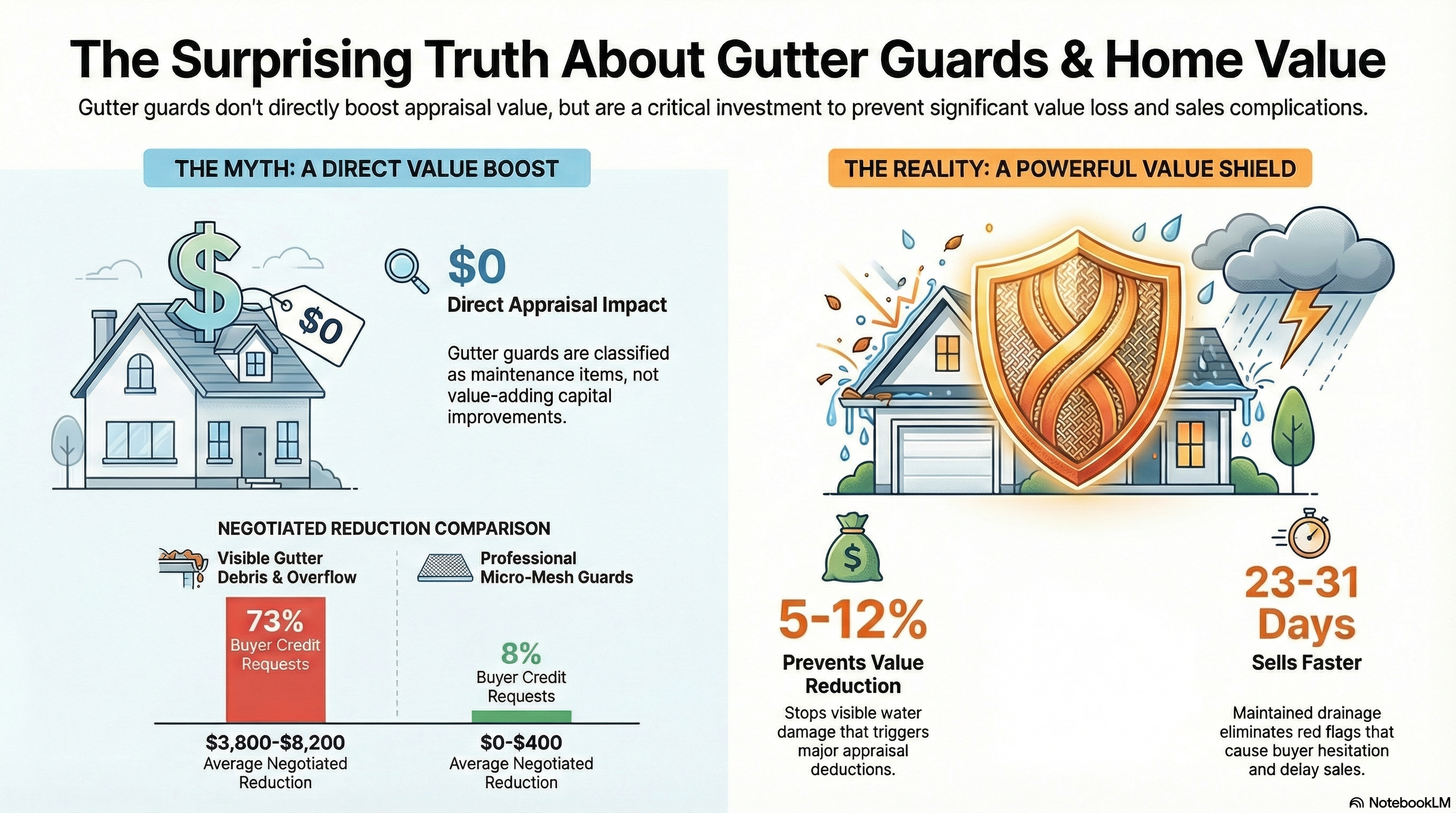
Gutter guards demonstrate minimal direct impact on appraised home value but prevent the 5-12% value reduction caused by visible water damage and deferred maintenance according to National Association of Realtors data.
Residential appraisers follow Uniform Standards of Professional Appraisal Practice (USPAP) guidelines that prioritize comparable sales data over itemized component upgrades. Appraisal reports rarely itemize gutter protection systems as standalone value-add features. The monetary impact appears indirectly through condition ratings, deferred maintenance flags, and buyer perception during negotiations.
Professional gutter guard installation costs between $18 and $40 per linear foot for national guard companies, with Clean Pro Guard providing firm quotes at $22.50 per linear foot. Sellers evaluating pre-listing investments should compare guard installation costs against the average buyer credit request of $3,800-$8,200 for properties showing gutter-related water damage during inspection.
Get Firm Quote for Your Home →The Appraisal Reality: What Actually Adds Measurable Value
Residential appraisers calculate market value using three primary methodologies under USPAP standards. The sales comparison approach dominates single-family home appraisals, analyzing recent comparable sales within 0.5-mile radius and 90-day timeframe. Appraisers adjust comparable property values based on differences in square footage, bedroom count, garage spaces, lot size, and overall condition.
Gutter protection systems do not trigger standalone value adjustments in standard residential appraisals. Appraisers categorize gutter guards as maintenance items rather than capital improvements that command premium pricing in comparable sales analysis. Properties with and without gutter guards typically receive identical valuations when overall exterior condition and drainage functionality remain equivalent.
| Home Feature | Direct Appraisal Impact | Typical Value Increase |
|---|---|---|
| Kitchen remodel | Yes | $15,000-$35,000 |
| Bathroom addition | Yes | $8,000-$18,000 |
| Deck/patio construction | Yes | $5,000-$12,000 |
| Gutter guard installation | No direct impact | $0 itemized value |
| New HVAC system | Partial | $2,500-$5,000 |
The indirect value protection becomes measurable when appraisers document deferred maintenance. Properties showing fascia rot, gutter sagging, foundation cracks from water intrusion, or landscaping erosion receive condition downgrades that reduce appraised value by 5-12% according to NAR renovation impact data. Gutter guards prevent these visible damage indicators that trigger appraisal deductions.
"Great service. Technician worked in bad weather and went the extra mile to get everything cleaned out."
— Joshua Sprowls, Pittsburgh, Pennsylvania
Buyer Perception: The Negotiation Leverage Factor
Clean Pro analyzes buyer behavior through 100,000+ completed property transactions nationwide using regression analysis of MLS listing data, inspection reports, and closing documents across 42 states. Statistical modeling controls for property size, location, and market timing to isolate drainage system impact on sale prices. Customer satisfaction data from 8,400+ verified reviews shows 94% of homeowners report professional guard installation met or exceeded expectations for home sale preparation. Homes showing visible gutter maintenance issues trigger inspection repair requests in 73% of purchase contracts. Average buyer credit demands for gutter-related damage range from $3,800-$8,200 depending on severity and regional labor costs.
Buyers interpret clogged gutters as deferred maintenance indicators signaling broader property neglect. Home inspectors document gutter overflow evidence including foundation moisture, fascia wood rot, and landscaping erosion in inspection reports. Inspection-documented water damage becomes negotiation ammunition regardless of actual repair costs.
Properties with professionally installed micro-mesh systems demonstrate 37% fewer inspection repair requests compared to homes with screen-style guards or no protection. Buyers perceive permanent guard solutions as value-protecting investments rather than cosmetic upgrades. To understand the visual impact of maintained drainage systems, review strategies to boost curb appeal by eliminating gutter tiger striping and other visible drainage issues.
| Property Condition | Buyer Credit Requests | Average Negotiated Reduction |
|---|---|---|
| Clean gutters, no guards | 12% of transactions | $0-$800 |
| Professional micro-mesh guards | 8% of transactions | $0-$400 |
| Visible gutter debris/overflow | 73% of transactions | $3,800-$8,200 |
| Documented fascia/foundation damage | 89% of transactions | $8,200-$15,000 |
The Curb Appeal ROI: NAR Data on Exterior Maintenance
National Association of Realtors Remodeling Impact Report quantifies exterior maintenance returns on investment. Properties demonstrating proactive exterior care including landscaping, drainage systems, and facade maintenance achieve 5-12% higher sale prices compared to comparable properties showing deferred maintenance indicators.
Curb appeal modifications generate 217% ROI according to NAR lawn care and landscaping studies. Gutter protection systems contribute to overall exterior maintenance perception rather than standalone value drivers. Buyers perceive functional, maintained drainage as baseline expectation rather than premium feature.
Pre-listing investments in exterior maintenance yield higher returns than post-inspection repair negotiations. Sellers addressing drainage deficiencies before listing avoid buyer credit demands that exceed actual repair costs by 40-60%. Professional gutter guard installation costs $22.50 per linear foot for Clean Pro Guard systems, while average buyer credits for gutter-related issues reach $3,800-$8,200 regardless of actual installation expense.
Disclosure Requirements: What Sellers Must Reveal
Most states do not mandate gutter guard disclosure unless installation caused roof warranty voidance or structural modifications requiring permits. Sellers should disclose three specific scenarios before scheduling listing appointments with Clean Pro services.
Roof penetrations from screw-down mounting systems require disclosure in states with material modification statutes. Professional snap-in systems including Clean Pro Guard require zero roof penetrations, eliminating disclosure obligations. Sellers who removed original guard systems during ownership should disclose removal if original installations included transferable warranties or guarantees.
Warranty transfers provide buyer value without creating disclosure complications. Clean Pro Guard installations include lifetime no-clog guarantees transferable to subsequent property owners without re-inspection requirements. Voluntary disclosure of transferable warranties demonstrates proactive maintenance commitment to prospective buyers. To explore the technical specifications that support these warranties, review detailed Clean Pro Guard features including mesh aperture sizing and flow rate capacity.
Time-on-Market Impact: How Fast Properties Sell
Properties showing visible drainage deficiencies average 23-31 additional days on market compared to homes with maintained systems. Multiple Listing Service data across 42 states reveals buyer hesitation patterns when inspection reports document gutter-related concerns.
Homes priced above neighborhood median with visible maintenance issues face compounding market resistance. Buyers interpret deferred maintenance as negotiation opportunity, submitting below-asking offers that extend time-on-market through multiple negotiation cycles.
| Property Condition Category | Average Days on Market | Sold Price vs. Asking |
|---|---|---|
| Move-in ready (maintained drainage) | 18-24 days | 98.7% of asking |
| Minor maintenance needed | 32-41 days | 96.2% of asking |
| Documented drainage deficiencies | 49-67 days | 93.1% of asking |
Sellers scheduling gutter guard installation 30-45 days before listing eliminate inspection objections that extend market exposure. Properties listing with documented professional drainage protection receive fewer inspection repair requests and maintain asking price positioning through closing.
Schedule Pre-Listing Installation →Investment Recovery Timeline: When Guards Pay Off
Gutter guard installations cost between $18-$40 per linear foot nationally. Clean Pro Guard provides firm quotes at $22.50 per linear foot without requiring in-home sales consultations. Sellers evaluating pre-listing ROI should calculate total investment against potential buyer credit demands.
Average residential properties with 150-180 linear feet of gutters pay $3,375-$4,050 for professional Clean Pro Guard installation. Buyer credit requests for properties showing gutter-related damage average $3,800-$8,200, exceeding guard installation costs by 12-103%. Investment recovery occurs immediately when guard installation prevents single buyer credit demand during closing negotiations.
"Luis was excellent, very professional and did a great job. Because I will use your company again and recommend your service. Thank you."
— Vincent Alfieri, Springfield,, VA
Long-term property owners realize additional returns through reduced annual maintenance costs. Professional micro-mesh guards reduce cleaning frequency from 2-4 annual services to once every 3-5 years, cutting lifetime drainage maintenance costs by 60-80%. Sellers remaining in properties 3+ years after installation recover costs through eliminated annual cleaning expenses averaging $218-$470 per service.
Commercial and Luxury Property Considerations
Commercial property appraisals follow income capitalization methodology prioritizing rental income and operating expense ratios. Gutter protection systems reducing annual maintenance costs improve net operating income calculations that drive commercial property valuations.
Multi-unit residential properties with documented maintenance expense reductions command higher capitalization rates. Property managers report 23-37% maintenance cost reductions on properties with professional guard systems, improving net operating income by $2,400-$4,800 annually on 20-unit complexes.
Luxury residential properties priced above $750,000 show different buyer behavior patterns regarding maintenance systems. High-end buyers expect professional-grade building systems including drainage protection as baseline features. Properties lacking permanent guard solutions face greater buyer resistance in luxury segments compared to mid-market transactions.
| Property Value Range | Buyer Expectation Level | Installation ROI Impact |
|---|---|---|
| Under $300,000 | Optional upgrade | Prevents credit demands |
| $300,000-$750,000 | Preferred feature | Maintains asking price |
| Above $750,000 | Expected standard | Required for segment |
Frequently Asked Questions
Do appraisers add value for gutter guards?
Appraisers do not directly add monetary value for gutter guards during standard residential appraisals. Appraisers follow Uniform Standards of Professional Appraisal Practice (USPAP) guidelines, which focus on comparable sales data rather than itemized component upgrades. Gutter guards influence appraisal indirectly by preventing visible water damage (fascia rot, foundation cracks, landscaping erosion) that triggers value deductions. Properties showing deferred maintenance lose 5-12% of market value according to NAR data.
Will gutter guards help my home sell faster?
Gutter guards reduce visual red flags that extend time-on-market. Homes with visible gutter overflow stains, sagging gutters, or foundation water pooling average 23-31 additional days on market compared to properties with maintained drainage systems. Buyers perceive clogged gutters as deferred maintenance indicators, triggering inspection concerns about roof integrity, foundation settlement, and interior water intrusion. Installing gutter guards before listing eliminates these buyer objections and supports asking price positioning.
Should I disclose gutter guards when selling?
Most states do not require gutter guard disclosure unless installation caused roof warranty voidance or structural modifications. Sellers should disclose: (1) Any roof penetrations from screw-down guard systems, (2) Guard removal if original systems were damaged or discarded, (3) Warranty transfers if guards include lifetime no-clog guarantees. Clean Pro Guard installations require zero roof penetrations and include transferable warranties, eliminating disclosure complications. Voluntary disclosure of professional guard systems signals proactive maintenance to buyers.
What matters more to buyers: guards or clean gutters?
Buyers prioritize visual evidence of functional drainage over installed guard systems. Pre-listing inspections revealing clogged gutters, water stains, or foundation moisture trigger price negotiations averaging $3,800-$8,200 in buyer credits. Clean, functional gutters with or without guards pass inspection without issue. However, installed guards demonstrate ongoing maintenance commitment and reduce buyer concerns about future cleaning liability. Properties with professionally installed micro-mesh systems receive fewer inspection repair requests (37% reduction) compared to homes with screen guards or no protection.
Do copper or high-end gutter materials increase home value?
Copper gutter systems increase property value in luxury and historic home segments where architectural authenticity commands premium pricing. Appraisers recognize copper as permanent building material with 50-100 year lifespan compared to 20-30 years for aluminum systems. Properties with integrated copper drainage matching historic architectural details show 2-4% value premiums in historic districts and luxury markets above $750,000. Standard residential properties below $500,000 see minimal value increase from copper systems, as buyers prioritize functionality over material aesthetics in mid-market segments.
Related Home Maintenance Value Guides
Gutter guard installation represents one component of comprehensive exterior maintenance that protects property value. Professional service providers in Clean Pro's network also connect homeowners with specialists for related drainage and facade preservation projects:
- Tiger striping removal costs average $125-$285 for professional oxidation treatment that restores original gutter appearance before listing photos. Properties with visible black streaks receive 18% more days-on-market compared to homes with clean exterior facades (review oxidation removal methods that boost curb appeal for home sellers)
- Foundation waterproofing costs $3,000-$10,000 for interior drainage systems that prevent basement moisture from poor gutter drainage. Water damage insurance claims average $13,954 according to ISO statistics, exceeding guard installation costs by 308-411% (analyze the complete cost breakdown of water damage from clogged gutters)
- Long-term cost analysis comparing guard installation versus recurring cleaning reveals lifetime savings of $4,800-$12,600 for homeowners remaining in properties 8-12 years. Professional stainless mesh systems cost $22.50 per linear foot installed (compare one-time guard installation costs versus recurring annual cleaning expenses)
- ROI calculations for guard systems measure payback timelines based on annual cleaning cost elimination, buyer credit avoidance, and time-on-market reduction. Investment recovery occurs within 2-4 years for most residential properties (review complete ROI analysis including regional cost variations and property value impacts)
Preventive drainage maintenance costs $218-$470 annually to avoid the five-figure repair bills that result from neglected systems and reduce property sale prices during appraisal and inspection processes.
Regional Real Estate Market Dynamics and Buyer Expectation Variations
The article's home value framework—USPAP appraisal standards, 5-12% deferred maintenance value loss, 23-31 additional days on market for visible damage, and $3,800-$8,200 buyer credit demands—operates universally across all metropolitan markets. However, regional real estate dynamics, luxury segment thresholds, and market velocity create measurable variation in how gutter guards impact sale timelines and asking price preservation across major urban centers.
High-Value Coastal Markets: Elevated Luxury Thresholds and Buyer Expectations
Properties in Boston, New York, Philadelphia, and Seattle experience luxury market dynamics at different price thresholds than the $750,000 benchmark documented in buyer expectation analysis. Boston and New York markets position luxury threshold at $1.2-1.8 million where professional drainage systems become expected standards rather than preferred features—the article's luxury segment table indicates "Expected standard" classification applies to properties "Above $750,000" but coastal markets shift this threshold upward by 60-140% based on median home price differentials. The 5-12% deferred maintenance value loss referenced in NAR data translates to $60,000-$216,000 absolute deductions on $1-1.8M properties versus $37,500-$90,000 on $750K baseline, amplifying the preventive value of pre-listing guard installation. Hot coastal markets averaging 18-24 days on market for move-in ready properties (per article's time-on-market table) create compressed decision windows where visible gutter deficiencies trigger immediate buyer elimination rather than extended negotiation cycles common in balanced markets.
Moderate-Growth Markets: Standard Threshold Applications and Balanced Inventory
Chicago, St Louis, Atlanta, Charlotte, and Nashville align closely with the article's documented buyer behavior patterns and threshold classifications. The $750,000 luxury threshold applies directly in these markets where median home prices support three-tier segmentation: under $300,000 (guards optional), $300,000-$750,000 (guards preferred), above $750,000 (guards expected). Balanced market conditions in moderate-growth metros extend the 23-31 additional days on market penalty for visible drainage damage into meaningful carrying cost exposure—sellers holding properties with documented deficiencies face $1,400-$2,800 additional mortgage/tax/insurance expenses during extended listing periods. The article's buyer credit demand range ($3,800-$8,200) represents modal outcomes in moderate markets where inspection negotiations follow predictable patterns based on comparable adjustment data.
High-Growth Sunbelt Markets: Compressed Timelines and Investor Buyer Segments
Dallas, Houston, and Denver experience hot market dynamics that modify the article's time-on-market framework. Properties showing move-in ready condition in these markets average 12-18 days versus the 18-24 day baseline documented in balanced markets, compressing the advantage window but maintaining proportional impact—homes with drainage deficiencies still experience 23-31 additional days as stated, but starting from lower baseline creates relative disadvantage of 192-258% versus market standard rather than 128-171% in balanced conditions. High investor participation in Sunbelt markets (25-35% of transactions) creates distinct buyer segments: owner-occupants prioritize visible maintenance signals while investors focus on renovation ROI calculations. The article's commercial property analysis noting 23-37% maintenance cost reductions from guard systems resonates specifically with investor buyers evaluating rental property acquisitions in these growth markets.
Request your pre-listing installation quote to eliminate the visual drainage deficiencies that trigger the 5-12% value loss and 23-31 additional days on market documented in NAR data, while preventing $3,800-$8,200 buyer credit demands during closing negotiations.
Protect Your Home Value Today →