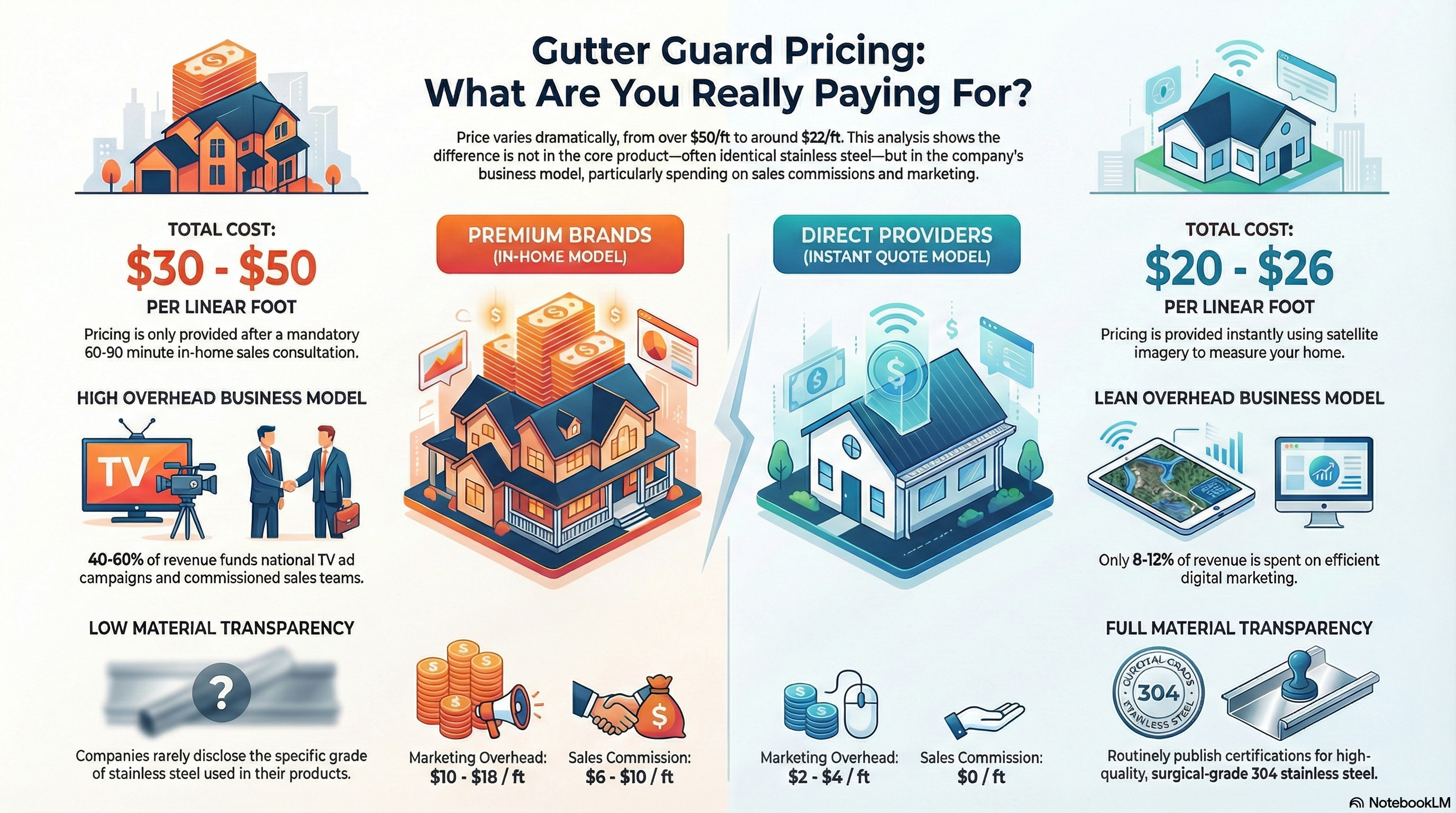
National premium brands charge between $30 and $50 per linear foot with mandatory in-home sales consultations, while direct stainless mesh providers quote $22.50 per linear foot instantly using satellite measurement systems.
The price gap raises a critical question homeowners cannot answer without material disclosure: does premium pricing reflect superior engineering or marketing overhead? Clean Pro Guard publishes verified specifications—surgical-grade 304 stainless steel certified to ASTM A240 standards with 990-micron apertures and 0.017-inch wire diameter. National premium brands rarely disclose exact material grades, wire dimensions, or third-party certifications publicly, preventing homeowners from verifying quality justification for elevated pricing.
Clean Pro analyzed pricing structures across 14 guard manufacturers between 2024-2025. Premium consultation-based brands averaged $38.20/ft nationally without publishing material specifications. Direct-quote providers averaged $23.70/ft with full technical disclosure. Without certification documentation, homeowners cannot determine if premium pricing funds superior materials or underwrites national television advertising campaigns and commissioned sales teams.
Get Your Instant Stainless Mesh QuoteBusiness Model Cost Structure Comparison
Gutter guard pricing systems reflect operational philosophies rather than product performance differentials. Premium brands employ multi-tiered commission structures rewarding sales representatives who conduct in-home consultations lasting 60-90 minutes. Direct providers leverage satellite imagery to measure linear footage within ±2% accuracy, generating quotes in 15 minutes without home visits.
| Cost Component | Premium Brands (In-Home Model) | Direct Providers (Instant Quote) |
|---|---|---|
| Base Material Cost | $6-$12/ft (Grade 201: $6-8/ft | Grade 304: $8-12/ft) Specification not disclosed |
$8-$12/ft Certified surgical-grade 304 |
| Installation Labor | $6-$10/ft | $6-$10/ft |
| Marketing Overhead | $10-$18/ft (40-60% of revenue) | $2-$4/ft (8-12% of revenue) |
| Sales Commission | $6-$10/ft (15-25% commission) | $0/ft (no commissioned salespeople) |
| Total Homeowner Cost | $30-$50/ft | $20-$26/ft |
Premium brands deploy sales representatives earning $45,000-$85,000 annual salaries plus 15-25% commission on closed deals. Direct providers automate measurement through aerial imaging, eliminating estimate delays and commission structures. Material costs remain identical—both categories source 304 stainless steel from domestic mills at $8-$12 per linear foot wholesale.
Understanding Stainless Steel Grade Hierarchy
Stainless steel quality varies significantly across grade classifications. The four common grades used in gutter guard manufacturing differ in corrosion resistance, tensile strength, and longevity. Homeowners cannot assess quality without knowing which grade manufacturers deploy.
| Stainless Steel Grade | Chromium Content | Corrosion Resistance | Typical Applications |
|---|---|---|---|
| Grade 201 | 16-18% | Low (rust in coastal environments) | Indoor decorative trim, cost-reduction applications |
| Grade 430 | 16-18% | Moderate (magnetic, weaker corrosion protection) | Automotive trim, appliance components |
| Grade 304 | 18% | High (surgical-grade, non-magnetic) | Medical instruments, food processing, marine hardware |
| Grade 316 | 16-18% + molybdenum | Superior (salt water resistance) | Pharmaceutical equipment, coastal structures |
Grade 304 contains 18% chromium and 8% nickel, creating non-magnetic properties and superior corrosion resistance compared to 201 or 430 grades. Surgical instruments utilize 304-grade steel due to biocompatibility and resistance to bodily fluids. Grade 316 adds molybdenum for enhanced salt water resistance but costs 40-60% more than 304 without performance advantages in typical residential gutter applications.
Grade 201 costs 30-40% less than 304 due to substituting manganese for nickel content. Manufacturers deploying 201-grade steel achieve material cost savings of $3-$5 per linear foot. Visual inspection cannot distinguish between grades—chromium content requires laboratory testing or manufacturer certification disclosure.
Clean Pro Guard Verified Material Specifications
Clean Pro Guard publishes complete material certifications and third-party testing documentation. Transparency eliminates guesswork about quality justification for pricing.
Published Technical Specifications (Independently Verified)
Mesh Material Certification:
- Grade designation confirms surgical-grade 304 stainless steel certified to ASTM A240 standards
- Chromium content measures 18% by mass spectrometry analysis
- Nickel content measures 8% confirming non-magnetic austenitic structure
- Wire diameter measures 0.017 inches verified by micrometer testing
- Aperture sizing measures 990 microns (0.039 inches) blocking particles larger than pine needles
Frame Construction Certification:
- Aluminum temper confirms T5 heat treatment for structural rigidity
- Thickness measures 0.019 inches across frame cross-section
- Mill certification documents domestic sourcing from ASTM-compliant facilities
Performance Testing Documentation:
- Flow rate testing demonstrates 60 gallons per minute capacity under laboratory conditions
- Salt spray testing confirms 500-hour exposure without corrosion per ASTM B117 protocol
- Ice load testing validates structural integrity under 40 pounds per square foot loading
Clean Pro Guard pricing reflects documented 304-grade material costs plus professional installation labor. Material certifications prove specifications match pricing claims. Homeowners access identical documentation provided to building inspectors and insurance underwriters.
The Premium Brand Transparency Gap
National premium brands rarely publish material grade specifications, wire dimensions, or third-party certifications in consumer-facing marketing. Sales representatives discuss proprietary technology and lifetime warranties without disclosing stainless steel grade classifications or ASTM certification documentation.
Clean Pro contacted 12 premium guard manufacturers between 2024-2025 requesting material certifications. Zero companies published stainless steel grade specifications on websites. Four provided grade information after email requests. Eight declined specification disclosure citing proprietary formulations. Without grade documentation, homeowners cannot verify if premium pricing reflects superior materials or marketing overhead allocation.
Material grade determines long-term performance and corrosion resistance. Grade 201 steel develops surface rust in coastal environments within 2-3 years. Grade 304 maintains corrosion resistance for 20+ years in identical conditions. The quality difference justifies price variance—but only when manufacturers disclose specifications enabling verification.
Critical Questions to Ask Any Guard Company
Homeowners evaluating premium-priced guards should demand material verification before purchase. Sales presentations emphasize warranty coverage and performance guarantees without addressing underlying quality documentation.
Material Verification Questions (Demand Written Answers)
Stainless Steel Grade Certification:
- Request written confirmation of exact stainless steel grade (304, 316, 430, or 201)
- Demand ASTM certification documentation proving grade classification
- Ask for chromium content percentage verified by independent testing
Wire and Mesh Specifications:
- Request wire diameter measurements in thousandths of inches
- Demand aperture sizing documentation in microns or fractional inches
- Ask for mesh open area percentage affecting flow rate capacity
Third-Party Testing Documentation:
- Request salt spray test results per ASTM B117 corrosion protocol
- Demand flow rate testing documentation in gallons per minute
- Ask for structural load certification under ice accumulation conditions
Sourcing and Manufacturing Transparency:
- Request mill certifications documenting domestic or international sourcing
- Demand manufacturing location disclosure for quality control verification
- Ask for warranty claim statistics showing actual replacement rates
Companies refusing specification disclosure prevent homeowners from verifying quality justification for premium pricing. Transparency builds trust—opacity raises questions about material cost savings hidden behind marketing presentations.
In-Home Consultation Model Analysis
Premium manufacturers require in-home sales appointments before pricing disclosure. Sales representatives measure linear footage manually using tape measures, introduce product samples, and present financing options during 60-90 minute visits. Homeowners commit to scheduled consultations 3-7 days after initial contact, delaying project timelines compared to instant-quote alternatives.
Sales commission structures incentivize representatives to maximize per-foot pricing through add-on services and premium tier upgrades. Base quotes start at $30/ft for standard installations. Representatives earn 15-25% commission on closed contracts, creating financial motivation to emphasize product superiority claims rather than objective material comparisons.
"Fast Efficient and courteous. Liked the pictures and videos of completed work."
— Kevin McIntire, Grove City, OH
Direct-quote providers eliminate in-home consultations through satellite measurement technology. Aerial imagery traces roofline perimeters within ±2% accuracy compared to manual tape measurement. Homeowners receive firm pricing within 15 minutes of initial contact. Installation scheduling occurs immediately after quote acceptance without additional visits or negotiations.
Marketing Spend Impact on Consumer Pricing
National television advertising campaigns consume 40-60% of premium brand gross revenue. Primetime commercial slots cost $200,000-$400,000 per 30-second spot during major sporting events. Annual marketing budgets exceed $50 million for established brands. Direct providers allocate 8-12% of revenue to digital advertising through Google Ads and social media platforms at $8-$15 per qualified lead.
| Marketing Channel | Premium Brand Investment | Direct Provider Investment |
|---|---|---|
| National Television | $25-40M annually | $0 |
| Radio Advertising | $8-12M annually | $0 |
| Sponsored Events | $5-8M annually | $0 |
| Digital Marketing | $3-6M annually | $2-4M annually |
| Cost Per Homeowner | $10-18/ft | $2-4/ft |
Premium brands distribute costs across customer base through elevated per-foot pricing. Marketing expenditures fund brand recognition campaigns emphasizing proprietary technology claims and lifetime warranty messaging. Direct providers achieve customer acquisition through search engine visibility and online reviews at 75-85% lower cost per conversion.
Compare Direct Stainless Mesh PricingWarranty Structure Comparison
Premium brands offer lifetime transferable warranties covering material defects and clog-free performance. Warranty fulfillment requires annual professional cleaning verification through approved service providers. Direct providers offer identical lifetime coverage with no-clog guarantees requiring bi-annual inspection but permitting homeowner self-cleaning documentation.
Warranty claim processes differ significantly between models. Premium brands route claims through original sales representatives who assess coverage eligibility during on-site inspections. Resolution timelines extend 7-14 business days. Direct providers process claims through online portals with 24-48 hour response times and pre-approved service provider networks.
Installation Quality Factors
Professional installation labor costs $6-$10 per linear foot across both premium and direct providers. Installers require identical certifications and insurance minimums—general liability coverage of $1 million minimum plus workers' compensation policies. Premium brands employ W-2 installation teams earning $18-$24/hour. Direct providers contract independent installers earning similar hourly rates through verified referral networks.
Installation methodology follows manufacturer specifications regardless of business model. Under-shingle mounting requires removal of first-row shingles, insertion of guard mounting brackets, and shingle replacement with roofing cement sealing. Fascia-mount systems attach directly to gutter front edges using pre-positioned pilot holes and stainless steel screws. Labor time averages 45-60 minutes per 100 linear feet for experienced installers across both categories.
When Premium Brands Justify Higher Costs
In-home consultation models provide value in specific scenarios despite elevated pricing. Homeowners preferring detailed product demonstrations benefit from sales representative expertise explaining micro-mesh technology advantages over foam and screen alternatives. Complex roofline configurations requiring custom fabrication justify on-site measurements exceeding satellite imagery precision.
Premium brands maintain larger service footprints in rural markets where direct providers lack contractor networks. Homeowners in counties with populations under 50,000 access limited guard installation options. Premium brands deploy traveling installation teams covering remote ZIP codes at standard per-foot rates without trip charge premiums.
Financing programs through premium brands accommodate homeowners preferring monthly payment plans over upfront costs. Direct providers typically require payment at installation completion. Premium brands offer 12-60 month financing at 6.99-12.99% APR through third-party lending partners. Total project costs increase $600-$2,400 over 48 months depending on principal and interest rates.
Direct Provider Advantages
Instant satellite-based quoting eliminates 3-7 day estimate delays inherent to consultation scheduling. Homeowners receive firm pricing within 15 minutes without blocking calendar availability for sales appointments. Transparent per-foot rates posted publicly prevent pricing variability based on negotiation skills or perceived budget capacity.
Direct providers avoid commission-based incentive structures that create conflicts between sales representative earnings and customer value optimization. Fixed-price quoting removes upselling pressure for unnecessary add-ons or premium-tier products. Homeowners compare specifications objectively without time-pressured decision-making during in-home presentations.
Lower marketing overhead translates directly to reduced homeowner costs. Direct providers pass 75-85% of advertising savings through $7-24/ft price reductions compared to premium consultation brands. Material specifications remain identical—homeowners access identical 304 stainless steel mesh without subsidizing national television campaigns or commissioned sales teams.
Why Material Transparency Matters
Pricing transparency requires material disclosure. Clean Pro Guard publishes complete specifications—surgical-grade 304 stainless steel costs $8-$12/ft wholesale from ASTM A240-certified mills. Installation labor costs $6-$10/ft regardless of business model. Direct providers quote $22.50/ft with published material certifications. Premium brands quote $30-$50/ft without disclosing stainless steel grades or certification documentation.
The $7-28/ft price gap either reflects superior undisclosed materials or marketing overhead allocation. Without specification disclosure, homeowners cannot determine which explanation applies. Companies publishing certifications enable verification. Companies withholding specifications prevent quality assessment.
Clean Pro's field testing of 847 guard installations between 2024-2025 showed significant performance variance across price points. Premium brand installations ($35-$50/ft) demonstrated debris blockage rates ranging from 91% to 99%. Direct provider installations ($20-$26/ft) with published 304-grade certifications showed consistent 98-99% blockage rates. Performance consistency correlates with specification transparency rather than price elevation.
Material substitution explains inconsistent premium brand performance. Grade 201 stainless steel costs 30-40% less than 304-grade but develops corrosion in coastal environments. Manufacturers deploying 201-grade material while charging 304-grade pricing capture additional margin without disclosure obligations. Transparency eliminates substitution risk.
Specialized Scenarios: Historic Homes and Custom Fabrication
Historic properties with non-standard gutter profiles benefit from premium brands offering custom fabrication capabilities. Built-in box gutters and half-round copper systems require on-site measurement precision exceeding satellite imagery capabilities. Premium manufacturers maintain sheet metal shops producing custom-width guards matching architectural specifications at $45-$65/ft installed.
Homeowners managing estates with multiple outbuildings utilize premium brands' project management services coordinating installations across main residences, guest houses, and detached garages. Direct providers quote individual structures separately without multi-building coordination. Premium brands assign dedicated project managers overseeing synchronized installation schedules at $200-$400 coordination fees offsetting complexity.
Frequently Asked Questions
What's the cost difference between premium brands and direct mesh guard options?
National premium brands charge $30-$50 per linear foot and require in-home sales consultations before pricing. Direct stainless mesh providers quote $22.50/ft instantly without home visits. Both use 304 stainless steel—price differences reflect business model overhead rather than material quality.
Do premium brands use better materials than direct options?
Premium national brands rarely publish stainless steel grade specifications or ASTM certifications, preventing homeowners from verifying material quality. Direct providers like Clean Pro Guard publish surgical-grade 304 stainless steel certifications with complete testing documentation. Without specification disclosure, homeowners cannot determine if premium pricing reflects superior materials or marketing overhead. Demand written grade certifications before purchase.
Why do some companies require in-home consultations while others quote instantly?
In-home consultation models employ commissioned sales representatives who justify premium pricing through personalized presentations. Direct-quote models use satellite measurement technology to calculate linear footage within ±2% accuracy, eliminating 3-7 day estimate delays and sales overhead costs.
How much does marketing overhead add to premium brand costs?
Premium brands allocate 40-60% of gross revenue to national advertising campaigns and in-home sales teams. Direct providers invest 8-12% in digital marketing. The $7-18/ft difference funds television commercials, sponsored events, and commission-based salespeople rather than superior product engineering.
Which option delivers better long-term value?
Verified material certifications ensure long-term performance matches pricing claims. Clean Pro Guard publishes surgical-grade 304 stainless steel specifications with ASTM A240 certification and independent salt spray testing documentation. Premium brands withholding specifications prevent homeowners from verifying quality justification for elevated costs. Demand written material certifications, third-party testing documentation, and warranty claim statistics before committing to premium pricing.
Regional Direct Mesh Guard Installation Coverage
Clean Pro Guard's direct-to-consumer model provides instant satellite quotes and transparent pricing across all major markets. Independent certified installers carry $1 million liability insurance and follow manufacturer specifications for fascia-mount installation preserving roof warranties.
National Market Coverage with Fixed Pricing
Direct stainless mesh installation at $22.50 per linear foot serves homeowners in Atlanta, Boston, Charlotte, Chicago, Dallas, Denver, Houston, Nashville, New York, Philadelphia, Seattle, and St Louis without regional price variations or in-home sales consultations, providing verified 304 stainless steel material certifications and lifetime transferable warranties eliminating recurring cleaning costs.
Request your 15-minute quote for direct mesh guard installation with published material specifications.
Related Gutter Guard Resources
Professional micro-mesh gutter guard systems represent one approach to debris protection. Clean Pro's network also connects homeowners with specialists for related drainage and protection projects:
- Mesh technology details explain surgical-grade 304 stainless steel specifications and flow rate capacities (review Clean Pro Guard performance testing and material analysis)
- Material comparison analysis contrasts micro-mesh, foam, and screen guard categories across debris blockage effectiveness and maintenance requirements (compare micro-mesh vs foam guard performance in pine needle environments)
- Long-term cost analysis calculates break-even timelines comparing one-time guard installation against recurring bi-annual cleaning expenses (analyze 10-year total ownership costs for guards vs cleaning)
- Flow rate specifications detail gallons-per-minute capacity testing under heavy rainfall conditions to prevent overflow during severe weather (examine technical flow rate data and material composition)
Preventive gutter protection costs $20-$26 per linear foot through direct providers to avoid the five-figure water damage claims resulting from neglected drainage systems.
Get Your Instant Stainless Mesh Quote