Gutter guards fail within 8-15 years from material corrosion, biofilm accumulation, or inadequate flow capacity despite $4,500-$9,000 installation costs.
Professional-grade gutter protection systems average $15-$45 per linear foot installed—yet most utilize aluminum mesh susceptible to galvanic corrosion, plastic frame components that degrade under UV exposure, or inadequate flow engineering specifications that trigger overflow during peak precipitation events. The replacement cost for typical homes reaches $1,800-$4,500 when these predictable failure modes occur.
The gutter guard industry markets "lifetime protection" while engineering products with inherent failure modes that necessitate replacement within a decade. Understanding why premium guards fail—despite costing $4,500-$9,000 for typical installations—requires examining the material science, hydraulic engineering, and installation methodologies that separate permanent solutions from temporary fixes.
Why Commodity Guards Aren't Viable Alternatives
Before examining premium guard failures, it's essential to address commodity-grade protection systems. Foam inserts, plastic screens, and brush-style guards represent temporary debris covers rather than engineered protection systems.
Foam gutter guards fail within 2-3 years according to industry lifespan data, with UV exposure causing cracking and brittleness while porous polyurethane structures trap fine particles creating internal clogs. Unlike engineered micro-mesh filtration systems, foam inserts lack the structural integrity and material specifications required for permanent protection. Field testing demonstrates foam retains 34% humidity 72 hours after rainfall, creating ideal conditions for mold and algae growth that reduces water flow by 40-60% within six months in shaded installations.
Plastic screen guards experience UV degradation within 4-6 years when manufactured with UV protection, degrading to 2-3 years without stabilizers according to material analysis studies. Extended sunlight exposure causes brittle failure and cracking that compromises debris exclusion effectiveness. Temperature cycling between summer peaks (95°F+) and winter lows (28°F) causes plastic warping averaging 3.2mm per 10-foot section annually, creating gaps that defeat protective function.
These commodity systems cost $0.40-$5 per linear foot but require complete replacement every 2-5 years, generating higher total ownership costs than professionally engineered systems over typical 15-25 year protection periods. For homeowners seeking reliable gutter protection, commodity guards represent false economy rather than viable alternatives to professional-grade solutions. For detailed material comparisons, see our analysis of micro-mesh versus foam guard performance and plastic versus aluminum material durability.
Failure Mode 1: Plastic Frame Components Despite Premium Pricing
Premium gutter guard manufacturers charge $15-$45 per linear foot while utilizing plastic mounting systems, frame components, and fastening mechanisms that degrade through UV exposure and thermal cycling. Plastic component substitution represents the industry's most pervasive engineering failure—charging surgical-grade pricing while delivering commodity-grade structural components.
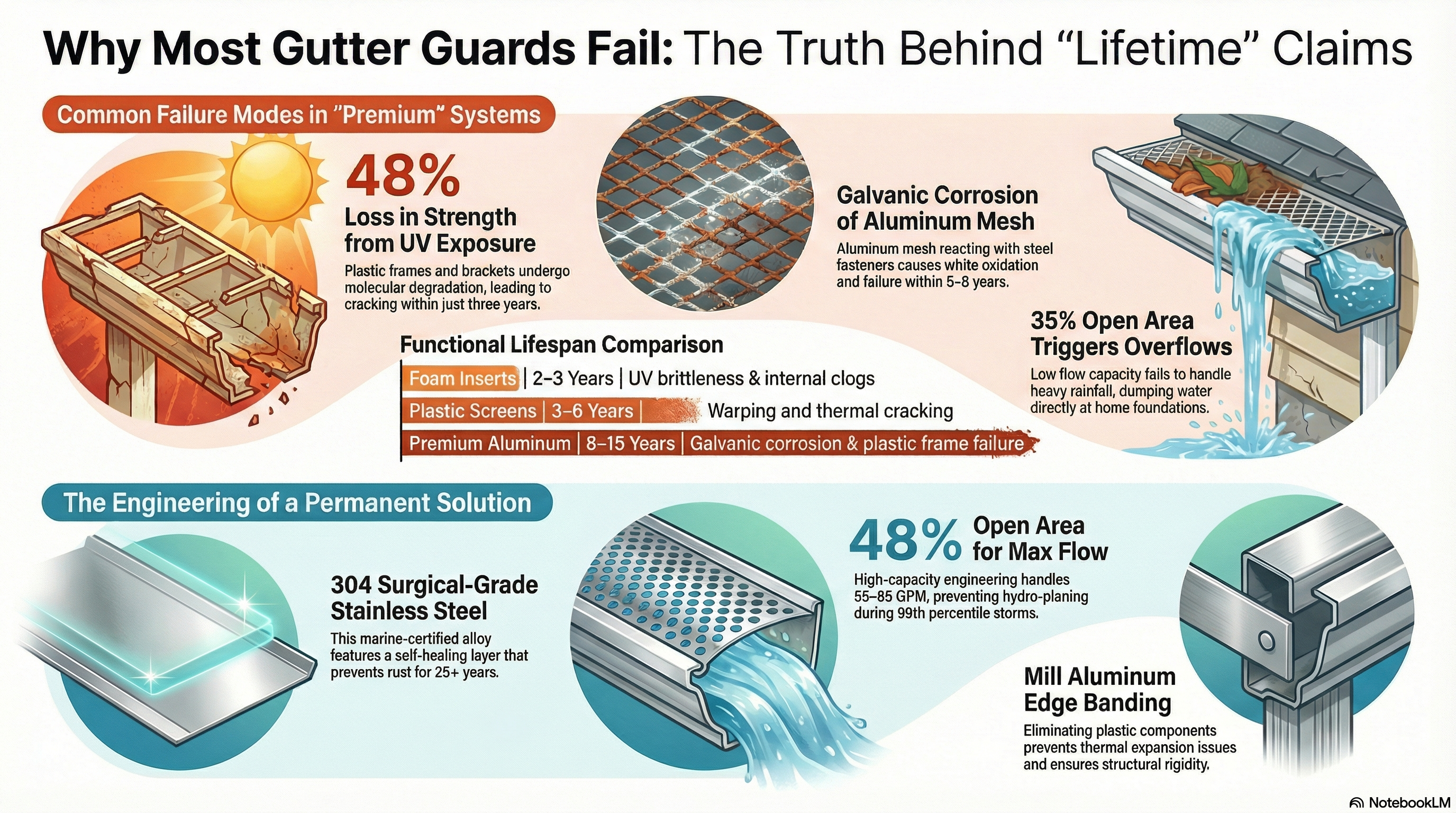
Plastic frame elements experience photodegradation from UV radiation, causing molecular chain scission that reduces tensile strength by 48% within 3 years of continuous exposure according to accelerated weathering tests. UV-induced brittleness manifests as cracking at fastener penetration points and mounting bracket failures during thermal expansion cycles.
Temperature fluctuations cause plastic components to expand during summer heat (coefficients 5-10 times greater than metal alternatives) then contract during winter cold, creating microscopic stress fractures that propagate into structural failures. After 8-12 years, plastic mounting systems separate from fascia boards or gutter lips, allowing guards to sag, creating debris accumulation zones, or detaching entirely during wind events.
Premium installations at $15-$45 per linear foot ($3,000-$9,000 for typical 200-foot homes) should deliver metal-only construction—yet manufacturers substitute plastic components in concealed locations to reduce production costs while maintaining premium pricing structures.
Failure Mode 2: Aluminum Mesh Corrosion in Premium Systems
High-end gutter guards priced at $15-$40 per linear foot frequently utilize aluminum mesh rather than 304 stainless steel, triggering galvanic corrosion when installed with steel fasteners or on copper gutter systems. Galvanic corrosion causes white powdery oxidation (aluminum oxide) that degrades mesh integrity and fastener connections within 5-8 years in humid climates.
Aluminum gutters and aluminum mesh guards maintain 15-20 year lifespans according to material longevity studies, with coastal installations experiencing accelerated corrosion from salt air exposure. Properties within 2-3 miles of coastlines show visible aluminum corrosion by year 7-8, while inland installations maintain functionality for 10-12 years before replacement becomes necessary.
The cost differential between aluminum mesh and 304 stainless steel mesh is $2-$4 per linear foot in raw materials—yet this minor upfront saving generates complete system replacement requirements at 8-12 years rather than 20-25+ year lifespans available through marine-grade stainless steel construction. For a typical 200 linear foot installation, manufacturers save $400-$800 in material costs while creating $4,000-$9,000 replacement obligations for homeowners within a decade.
Premium guard manufacturers market "lifetime warranties" while specifying aluminum mesh that requires replacement within 10-15 years maximum, creating warranty exclusions for "normal wear and tear" that encompass predictable galvanic corrosion failures. Aluminum mesh specification represents systematic engineering of planned obsolescence within products marketed as permanent solutions.
Failure Mode 3: Inadequate Flow Capacity Engineering
Gutter guards fail during heavy precipitation when manufacturers prioritize debris exclusion over hydraulic flow capacity, creating systems with insufficient GPM (gallons per minute) capacity for regional storm intensities. Standard 5-inch K-style gutters with 3-inch downspouts require 45-50 GPM minimum capacity to handle 6-8 inches per hour rainfall intensities common in Gulf Coast and Southeast markets.
Premium guards utilizing 30-35% open area specifications generate 35-40 GPM maximum flow rates—inadequate for peak precipitation events that occur multiple times annually in high-rainfall regions. During 6-inch per hour storm intensities, insufficient flow capacity triggers overflow within 8-10 minutes on 1,500 square foot roof sections, dumping 200+ gallons directly at foundation perimeters and defeating the guard's entire protective function. For detailed testing on how guards perform during heavy rain, see our flow rate analysis.
Open area percentage—the ratio of void space to total surface area—determines maximum water acceptance without triggering surface hydro-planing where water overshoots the gutter entirely. Industry-leading specifications require 48% open area minimum to maintain 55-65 GPM flow capacity, yet most premium guards utilize 30-35% open area to simplify manufacturing and reduce material costs.
Micron rating specifications create additional flow capacity failures when manufacturers select aperture sizes without correlating to regional debris types and rainfall intensities. Systems rated below 500 microns trigger molecular silt bonding where pollen dust creates impermeable biofilms, while systems exceeding 1,200 microns permit pine needle and shingle grit penetration causing internal gutter clogging. The empirically validated sweet spot of 990-micron aperture diameter balances debris exclusion with water acceptance—yet most premium guards lack published micron specifications entirely, marketing generic "micro-mesh" descriptions without performance verification.
Failure Mode 4: Installation and Design Deficiencies
Correctly specified materials fail when installation methodologies omit critical hydraulic engineering requirements—even premium professional installations charging $15-$45 per linear foot frequently skip pitch verification, water dam integration, and downspout capacity validation. Installation deficiencies create systems that overflow regardless of guard quality or manufacturer pricing.
Gutter pitch specifications require 1/4 inch slope per 10 feet toward downspouts to maintain drainage velocity and prevent standing water accumulation. Improper pitch alignment during guard installation—even 1/8 inch deviation over 20-foot runs—creates low points where water pools rather than flows, triggering overflow during moderate rainfall despite adequate guard flow capacity. Premium installations should include pitch verification using laser levels and adjustment before guard mounting, yet most contractors install guards over existing gutter configurations without slope validation. For proper installation methodologies, see our guide on professional versus DIY gutter guard installation.
Integrated water dam design prevents overflow and "run-through" at guard front edges during heavy precipitation by creating hydraulic deceleration zones that convert high-velocity roof runoff into controlled entry flow. Without integrated water dam design, water hydro-planes over guard surfaces during 6+ inch per hour rainfall—a condition that reduces effective GPM capacity by 40-60% regardless of open area percentage. Most premium guards utilize flat surface designs that omit water dams entirely, relying on surface tension alone to direct water into gutters during peak flow conditions.
Downspout bottleneck prevention requires correlating total guard flow capacity with downspout discharge rates. A 3-inch round downspout provides 45-55 GPM maximum discharge while 4-inch downspouts handle 75-90 GPM according to hydraulic engineering standards. Premium guard installations that maintain 55-65 GPM intake capacity on 3-inch downspout systems create backup overflow conditions where guards function correctly but inadequate discharge capacity triggers gutter overflow—a failure mode that installer should prevent through downspout assessment and upgrade recommendations before guard installation.
Failure Mode 5: Biofilm Accumulation on "No-Maintenance" Systems
Gutter guards marketed as "never clean your gutters again" solutions accumulate biological films from algae, mold, and bacterial growth that reduce water flow capacity by 30-50% within 2-3 years without surface maintenance. Biofilm accumulation contradicts industry marketing while representing predictable biological processes in moist, shaded environments.
Micro-mesh surfaces exposed to partial shade conditions develop biofilm layers from airborne spores, pollen particles, and decomposing organic matter that lands on guard surfaces. Unlike gross debris that sheds from sloped surfaces, biofilm creates a molecular-level flow resistance that bonds to mesh fibers and reduces effective micron ratings from design specifications (990 microns) to functional apertures of 600-700 microns within 18-24 months.
The biofilm formation rate accelerates in humid climates and properties with tree coverage, requiring annual or biannual surface maintenance using garden hose pressure (40-60 PSI) or professional cleaning to restore original flow capacity. Premium guards utilizing 304 stainless steel construction resist biofilm bonding more effectively than aluminum alternatives due to smoother surface finish and absence of oxidation layer that provides bacterial attachment points—yet even surgical-grade materials require periodic cleaning to maintain peak hydraulic performance. For maintenance requirements, see our guide on how to clean gutter guards effectively.
Manufacturers marketing "lifetime no-maintenance" warranties typically exclude "routine cleaning" from coverage while simultaneously acknowledging biofilm accumulation as normal operating conditions in warranty documentation fine print. Warranty exclusion language represents contradictory messaging where guards eliminate gutter cleaning while requiring guard cleaning to maintain protective function.
The True Cost of Guard Failure and Replacement
Gutter guard failure triggers cascading expenses beyond replacement costs. When premium guards installed at $15-$45 per linear foot fail after 8-12 years, homeowners face $3,000-$9,000 replacement expenses for typical 200 linear foot installations—yet manufacturers positioned these systems as "lifetime" solutions with transferable warranties that exclude "normal wear and tear" encompassing predictable material degradation failures.
During the 2-3 year period before complete guard failure becomes obvious, degraded systems permit debris accumulation, trigger overflow during storms, and allow water infiltration at foundation perimeters. The transitional failure period generates foundation repairs ($3,000-$8,000), basement waterproofing requirements ($2,500-$7,000), and fascia board replacement from rot damage ($1,200-$3,500) according to home repair industry data.
Guard removal labor costs add $200-$600 to replacement projects as degraded systems often bond to gutters through oxidation or require fastener extraction that damages gutter lips. Disposal fees for failed aluminum or plastic guards contribute additional $150-$300 depending on local waste management requirements and material recycling availability.
The opportunity cost of failed guard investments compounds when homeowners pay $15-$45 per linear foot for systems utilizing the same aluminum mesh and plastic components as mid-tier alternatives. A $7,000 premium installation that fails at year 10 generates identical replacement cycles as systems costing half as much—yet the marketing promised "lifetime protection" and "never clean your gutters again" positioning that concealed predictable material science failures. For long-term economics analysis revealing true ownership costs, see our comparison of gutter guards versus cleaning costs and evaluation of whether gutter guards are worth the investment.
Related Home Exterior Maintenance Guides
Gutter guard failure analysis represents one component of comprehensive exterior system evaluation. Professional service providers in Clean Pro's network also connect homeowners with specialists for related waterproofing and drainage projects:
- Fascia board replacement costs $6-$20 per linear foot when water damage from failed guards penetrates wood substrate (review comprehensive water damage cost analysis from overflow conditions)
- Roof valley repair costs $400-$1,500 for shingle replacement when inadequate guard flow capacity triggers ice dam formation (examine winter performance risks and ice dam prevention strategies)
- Professional cleaning maintenance costs $218-$470 annually for homes that remove failed guard systems and return to periodic professional service (review current professional cleaning rates and regional pricing variance)
- Installation methodology analysis examines proper pitch verification, water dam integration, and downspout capacity validation preventing overflow regardless of material quality (compare professional installation practices versus DIY methods and quality outcomes)
Understanding guard failure modes costs nothing—replacing water-damaged structural systems from failed guards costs $5,000-$15,000 on average.
Engineering Permanent Solutions: Material Science Requirements
Permanent gutter protection requires specifying materials that resist the fundamental failure modes of UV degradation, galvanic corrosion, thermal expansion, and biofilm formation. Permanent protection necessitates surgical-grade construction using marine-certified alloys rather than commodity materials wrapped in premium marketing.
304 stainless steel mesh (18% chromium, 8% nickel composition) creates a self-healing passive oxide layer 1-5 nanometers thick that reforms within seconds after surface damage, preventing rust formation even when mesh is scratched during installation or maintenance. The chromium passivation layer provides marine-grade corrosion resistance essential for coastal markets (zero corrosion after 15+ years within 50 miles of coastlines) and freeze-thaw regions where aluminum alternatives show visible degradation by year 7-8.
The nickel content stabilizes austenitic crystal structure, preventing martensitic transformation during thermal cycling that causes brittleness in carbon steel and thermal fatigue in aluminum. Nickel stabilization ensures mesh maintains consistent ductility and strength across temperature ranges from -20°F winter nights to 180°F+ summer roof surfaces—conditions that trigger mechanical failures in inferior materials within 10-12 years.
Mill aluminum frames (not plastic, not painted steel) with 0.019-inch minimum thickness provide structural support without galvanic reaction risks. Unlike powder-coated aluminum that relies on surface finish for corrosion protection (coating degradation from UV exposure triggers base metal oxidation within 5-8 years), mill-finished aluminum derives corrosion resistance from natural oxide formation that self-renews continuously.
Engineered specifications including 48% open area (not 30-35%), 990-micron aperture rating (not unspecified "micro-mesh"), and integrated water dam design (not flat surfaces) separate hydraulic engineering from commodity screening. These specifications determine whether systems maintain 98% flow efficiency after five freeze-thaw cycles or degrade into drainage failure nodes requiring replacement. For debris-specific performance, see our analysis of the best gutter guards for pine needles and comprehensive micro-mesh versus foam guard comparison.
Why CleanPro Guard Eliminates the Replacement Cycle
CleanPro Guard addresses every identified failure mode through surgical-grade material selection and forensic engineering rather than marketing-driven cost reduction. The system utilizes 304 surgical-grade stainless steel mesh—the same marine-certified alloy used in medical instruments and aerospace fasteners—ensuring zero galvanic corrosion across 25+ year installation lifespans in coastal and freeze-thaw markets.
The 18-mesh specification with 990-micron aperture diameter and 48.16% open area delivers 55-65 GPM flow capacity on standard 5-inch gutters, exceeding the 45-50 GPM minimum required for 6-8 inches per hour storm intensities. The flow capacity margin prevents overflow during 99th percentile precipitation events that cause retail guard failures. For complete specifications, see our CleanPro Guard technical specifications breakdown.
Integrated water dam design and downward mesh lip architecture prevent surface hydro-planing during peak runoff, maintaining 98% water flow efficiency even during extreme rainfall. Mill aluminum edge band construction (0.019-inch thickness) provides structural rigidity without plastic components, eliminating UV degradation and thermal expansion failures common in premium competitors utilizing plastic mounting systems.
The lifetime no-clog guarantee backed by material specifications that actually deliver permanent performance represents the fundamental difference between engineered solutions and marketed promises. You're not buying gutter guards that require replacement in 8-12 years despite premium pricing—you're installing the last gutter protection system your home will ever need.
Premium brands charging $15-$45 per linear foot deliver 8-12 year replacement cycles through aluminum mesh and plastic frames. CleanPro Guard's surgical-grade construction at comparable pricing eliminates the replacement cycle entirely through material science rather than marketing narratives. The investment comparison isn't upfront cost—it's total ownership over 25 years: one permanent installation versus two or three complete replacements of inferior materials marketed as "lifetime" solutions.
Engineering permanence into product specification rather than planning obsolescence into the business model represents fundamental competitive differentiation. When manufacturers prioritize material science over profit margins, lifetime warranties become technical reality rather than marketing fiction. For skeptics questioning whether premium guards deliver on promises, our investigation into whether gutter guards actually work examines real-world performance data.
For comprehensive technical specifications and performance verification, see our CleanPro Guard product review detailing the engineering principles that prevent the failure modes plaguing premium competitors.