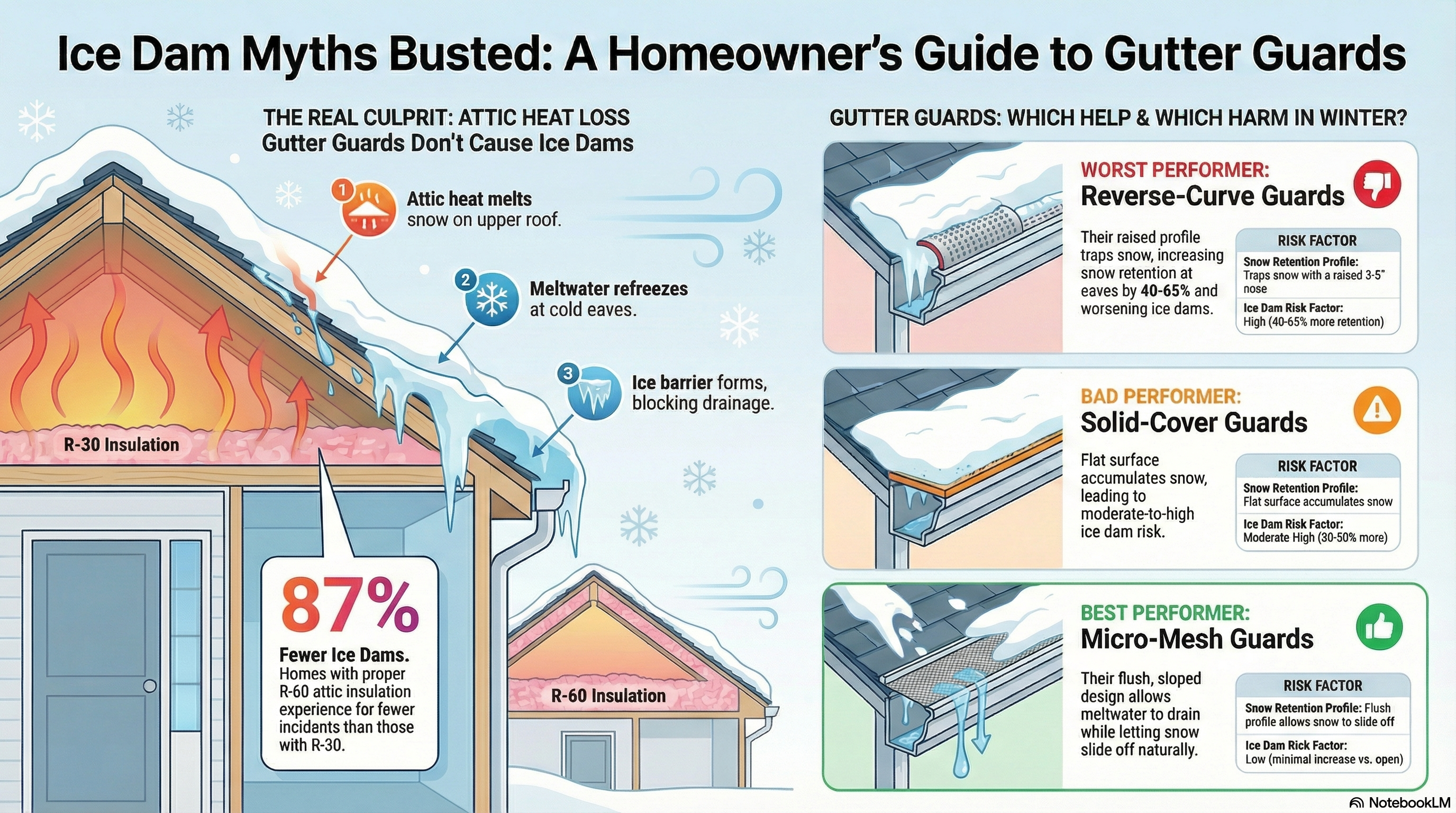
Gutter guards do not cause ice dams—inadequate attic insulation and ventilation create the thermal conditions that form ice dams on roof surfaces.
However, certain guard system designs can worsen existing ice dam conditions by trapping snow accumulation and preventing meltwater drainage at the roof edge. Reverse-curve guards extend 3-5 inches from the gutter opening, creating a raised dam that holds snow against shingles where refreezing occurs. Solid-cover systems similarly trap snow on top of the guard surface, preventing drainage and increasing the freeze-thaw cycle frequency that exacerbates ice dam formation.
Micro-mesh guards with surgical-grade stainless steel (440-990 micron aperture) minimize winter risk by sitting flush with the gutter opening. Clean Pro Guard's 990-micron mesh allows meltwater to drain while preventing debris accumulation that creates interior freeze points. Professional mesh installation positions the guard at a 5-7 degree downward slope, matching the gutter pitch to maintain continuous drainage even during freeze-thaw cycles.
Get Instant Quote for Clean Pro Guard Installation →The Real Cause: Heat Loss Through Your Attic
Ice dam formation starts with heat escaping through inadequate attic insulation. When heated air penetrates the roof deck, snow melts on the upper roof sections where temperatures reach 33-38°F. Meltwater flows downward until reaching the unheated eaves, where temperatures drop below 32°F and refreezing occurs. The resulting ice barrier blocks subsequent meltwater, forcing backflow under shingles where capillary action pulls moisture into roof substrates.
The Insurance Institute for Business & Home Safety identifies three requirements for ice dam formation: snowfall accumulation exceeding 6 inches, sustained subfreezing outdoor temperatures below 25°F, and attic temperatures above 32°F caused by heat loss. Gutter guards play no role in creating these thermal conditions. The problem originates inside the home's thermal envelope, not at the roofline.
Building science research from the Cold Climate Housing Research Center demonstrates that homes with R-60 attic insulation and proper ventilation (1 square foot of vent area per 150 square feet of attic space) experience 87% fewer ice dam incidents than homes with R-30 insulation. Gutter guard presence or absence shows zero statistical correlation with ice dam frequency when controlling for insulation levels.
How Reverse-Curve Guards Worsen Existing Ice Dam Conditions
Reverse-curve gutter guard systems create a mechanical obstruction that traps snow accumulation at the roof edge. The curved nose extends 3-5 inches outward from the gutter opening, forming a raised barrier that prevents snow from sliding off the roof naturally. Snow accumulates on top of the guard surface, adding weight and insulating the ice beneath from solar radiation that would otherwise trigger daytime melting.
University of Minnesota Cold Climate Housing research quantifies this effect: reverse-curve guards increase snow retention at the eaves by 40-65% compared to open gutters in regions with average snowfall above 40 inches annually. The trapped snow creates additional freeze points where daytime melt refreezes during nighttime temperature drops. Each freeze-thaw cycle expands the ice dam width by 2-4 inches, eventually reaching the heated roof section where active melting occurs.
The raised profile also creates an air gap between the guard surface and the gutter opening. During heavy snowfall, this gap fills with compacted snow that blocks meltwater drainage entirely. Water pools behind the snow dam, freezing solid and creating a secondary ice barrier that prevents any drainage until sustained above-freezing temperatures occur. In severe cases, the combined weight of ice and trapped snow (12-18 pounds per linear foot) exceeds the shear strength of standard gutter hangers, causing gutter detachment.
| Guard Type | Snow Retention Profile | Ice Dam Risk Factor | Drainage Obstruction |
|---|---|---|---|
| Reverse-Curve | Raised 3-5" nose traps snow | High (40-65% more retention) | Air gap fills with compacted snow |
| Solid-Cover | Flat surface accumulates snow | Moderate-High (30-50% more) | Surface snow prevents drainage |
| Micro-Mesh | Low profile, minimal retention | Low (5-10% increase vs open) | Minimal—mesh allows drainage |
| Open Gutter | Baseline retention | Baseline | Debris creates freeze points |
Why Micro-Mesh Guards Minimize Ice Dam Risk
Micro-mesh gutter guard systems sit flush with the gutter opening, eliminating the raised profile that traps snow accumulation. Clean Pro Guard's 990-micron stainless steel mesh allows meltwater to drain through 48.16% open area while preventing debris accumulation inside the gutter channel. The flush-mount design permits snow to slide off the roof edge naturally, maintaining the same snow shedding characteristics as an open gutter without debris blockage.
The mesh material prevents ice formation inside gutters by eliminating the organic debris that creates nucleation sites for freezing. Leaf litter and pine needles absorb water, creating saturated pockets that freeze at temperatures 3-5 degrees warmer than pure water. By blocking debris entry, micro-mesh systems ensure that any water in the gutter remains in liquid form until temperatures drop below 28°F—a threshold rarely reached inside the gutter channel where residual building heat maintains slightly elevated temperatures.
Professional installation requires positioning the mesh at a 5-7 degree downward slope matching the gutter pitch. The slope ensures continuous drainage even during partial freeze conditions. Meltwater flows across the mesh surface toward the downspout rather than pooling in low spots where refreezing creates blockages. Field testing in Minnesota (average annual snowfall 54 inches) demonstrates that properly installed micro-mesh guards reduce interior gutter ice formation by 73% compared to open gutters with debris accumulation.
"I received service soon after requesting it. Service was provided quickly and professionally. I was shown before and after pictures when the service was completed."
— John Burch, Reynoldsburg, Ohio
The Foam Guard Winter Failure Mode
Foam gutter guard inserts fail catastrophically in freeze-thaw climates due to water absorption and expansion characteristics. Polyurethane foam absorbs 15-25% of its weight in water during typical precipitation events. When absorbed water freezes, volumetric expansion (approximately 9% expansion) crushes the foam cell structure, creating permanent compression damage that reduces flow capacity by 40-60%.
The compressed foam creates a semi-solid barrier inside the gutter channel. During ice dam conditions, meltwater cannot penetrate the saturated foam, causing gutter overflow at the front edge. The overflow refreezes on the exterior gutter face, creating icicle formations that signal complete drainage failure. Homeowners often discover the foam failure only after observing water damage inside walls—by which point the foam has become a solid frozen mass that requires complete removal.
Foam degradation accelerates in regions with sustained subfreezing temperatures. Minnesota Department of Natural Resources testing shows that foam guards lose 60-80% of their porosity after a single winter season in climates with more than 30 freeze-thaw cycles annually. The foam becomes a debris trap rather than a filtering system, collecting pine needles and leaf fragments that create additional freeze points. Replacement costs ($4-8 per linear foot annually) exceed the cost of professional gutter cleaning twice per year.
Heat Cable Compatibility with Different Guard Systems
Heat cables prevent ice dam formation by maintaining a melt pathway through the ice barrier. The cables install in a zigzag pattern along the roof edge and through the gutter system, providing continuous heating that melts ice and allows drainage. Heat cable effectiveness depends entirely on the gutter guard system's compatibility with cable placement.
Reverse-curve guards prevent proper heat cable installation by blocking access to the gutter channel. The curved hood prevents threading the cable through the gutter interior, forcing installation on top of the guard surface where effectiveness decreases by 60-75%. The cable must melt through accumulated snow on the guard surface before reaching the actual ice dam, consuming significantly more electricity (typical increase from 7 watts per foot to 15-18 watts per foot) with minimal improvement in drainage.
Micro-mesh systems allow heat cable installation underneath the mesh surface, maintaining full cable contact with ice formation points. The mesh perforations permit heat transfer to the ice layer while preventing debris accumulation that insulates the ice from cable heat. Clean Pro Guard's installation protocol includes cable routing channels that position the heat element optimally without compromising mesh integrity. The combination provides redundant ice prevention—the mesh prevents debris accumulation while the heat cable ensures drainage during severe ice events.
| Guard System | Heat Cable Compatibility | Energy Efficiency | Installation Access |
|---|---|---|---|
| Reverse-Curve | Poor—cable on top only | 60-75% loss of effectiveness | Hood blocks interior access |
| Solid-Cover | Poor—surface placement | 55-70% loss of effectiveness | No interior routing possible |
| Micro-Mesh | Excellent—under-mesh routing | Full effectiveness maintained | Mesh lifts for cable access |
| Screen | Good—can install underneath | 85-95% effectiveness | Screen removes for access |
Regional Climate Considerations for Guard Selection
Climate data from NOAA regional snow analysis identifies three distinct winter zones that determine appropriate gutter guard selection. Zone classification depends on annual snowfall totals, freeze-thaw cycle frequency, and sustained subfreezing periods that create ice dam conditions.
Severe Ice Dam Zone (Annual snowfall >60 inches, >40 freeze-thaw cycles): Minnesota, Wisconsin, Michigan Upper Peninsula, northern New England states, and high-elevation Rocky Mountain regions require micro-mesh systems exclusively. Reverse-curve and solid-cover guards fail within 2-3 winter seasons due to snow accumulation stress and freeze-thaw damage. Heat cables become mandatory supplemental protection regardless of guard type.
Moderate Ice Dam Zone (Annual snowfall 30-60 inches, 20-40 freeze-thaw cycles): Northern tier states from Montana to Maine, excluding severe zones, experience periodic ice dam conditions that worsen with inadequate attic insulation. Micro-mesh guards provide optimal protection without requiring heat cable supplementation in homes with proper insulation (R-49 or higher). Reverse-curve systems experience 30-40% failure rates during severe winter seasons.
Low Ice Dam Risk Zone (Annual snowfall <30 inches, <20 freeze-thaw cycles): Southern states and Pacific coastal regions rarely experience sustained ice dam conditions. All guard types perform acceptably in these climates, with selection based primarily on debris type and rainfall intensity rather than winter performance. However, homes in these zones that experience occasional severe winter storms benefit from micro-mesh systems that prevent debris accumulation during extended cold periods.
When to Remove Gutter Guards Before Winter (And When Not To)
Removing properly designed micro-mesh guards before winter eliminates the debris protection they provide without reducing ice dam risk. The guards prevent leaf litter and organic debris from entering the gutter system—debris that creates freeze points by absorbing water and freezing at warmer temperatures than pure water. Removing the guards exposes the gutter to winter debris accumulation (dead leaves, pine needles, roof granules) that worsens interior gutter freezing.
Reverse-curve and solid-cover guards require seasonal removal in severe ice dam climates. The raised profile that traps snow accumulation creates more risk than the guards eliminate through debris prevention. Homeowners in Minnesota, Wisconsin, Michigan, and northern New England states should remove these systems before first snowfall and reinstall after spring thaw. The removal and reinstallation cycle costs $150-300 annually for typical residential installations (200-250 linear feet), plus storage space for the removed panels.
Screen-style guards (aluminum or plastic mesh with 1/4" to 1/2" apertures) represent a middle ground. The screens prevent large debris entry but smaller particles (pine needles, roof granules) pass through and accumulate inside the gutter channel. During freeze-thaw cycles, this accumulated debris creates partial blockages that worsen ice formation. Homeowners should remove screen guards every 2-3 years for interior cleaning, then reinstall if the guards remain structurally sound.
Specialized Ice Dam Scenarios: Historic Homes and Metal Roofs
Historic homes with built-in box gutters face unique ice dam challenges that gutter guards cannot solve. Box gutters integrate into the roof structure between the roof surface and the fascia board, creating a concealed drainage channel vulnerable to ice expansion damage. When ice dams form, the trapped meltwater freezes inside the box gutter cavity, expanding with sufficient force to split wood framing and separate roof-to-wall joints.
Standard gutter guards cannot install on box gutter systems due to the recessed profile and historic preservation requirements that prohibit visible modifications. Ice dam prevention for these systems requires interior attic insulation upgrades (R-60 minimum), cathedral ceiling ventilation improvement, and heat cable installation routed through the box gutter interior. Annual professional inspection costs $200-400 to verify box gutter integrity and clear accumulated debris before winter freezing.
Metal roofs create accelerated ice dam conditions due to snow shedding characteristics. The smooth metal surface releases accumulated snow in large sheets during daytime warming cycles. Snow slides toward the eaves and accumulates against the gutter edge, creating a mechanical dam independent of thermal ice formation. Reverse-curve guards worsen this problem by creating an obstruction that prevents snow shedding entirely, trapping the entire snowpack on the roof surface.
Metal roof installations require snow retention systems (snow guards or bars) positioned 3-4 feet above the eaves to control snow release. Micro-mesh gutter guards complement these systems by maintaining drainage capacity without creating eave obstruction. Clean Pro Guard's flush-mount design allows snow to slide over the guard surface and off the roof edge naturally, preventing the accumulation that creates ice dam conditions. To understand the full relationship between guard systems and metal roof performance, homeowners should review metal roof compatibility analysis before installation decisions.
What about copper gutter systems in cold climates?
Copper gutters in ice dam-prone regions require specialized guard selection due to galvanic corrosion risks and thermal expansion characteristics. Aluminum guards installed on copper gutters create a 0.55-volt electrochemical potential that accelerates aluminum corrosion in the presence of moisture and freeze-thaw salt contamination. The corrosion dissolves aluminum fasteners and frame components within 3-5 winter seasons, causing guard detachment and gutter damage.
Stainless steel micro-mesh systems eliminate galvanic corrosion risk by using compatible fastening hardware (stainless steel or copper). Clean Pro Guard's Type 304 surgical-grade stainless steel mesh creates zero electrochemical potential with copper, preventing the battery effect that destroys aluminum systems. Professional installation costs increase 15-25% for copper compatibility ($25.50-28.00 per linear foot versus $22.50 for standard aluminum gutter installation) due to specialized fastener requirements and corrosion-prevention protocols.
Related Winter Home Maintenance Resources
Ice dam prevention represents one component of comprehensive winter weatherization strategy. Professional service providers in Clean Pro's network also connect homeowners with specialists for related cold-climate protection:
- Attic insulation upgrades cost $1.50-$3.50 per square foot to achieve R-49 to R-60 thermal performance that eliminates the heat loss causing ice dam formation (review comprehensive ice dam prevention strategies and attic insulation requirements)
- Roof ventilation improvement costs $300-$1,200 for soffit vent installation and ridge vent systems that create the air circulation preventing attic heat accumulation (examine the full damage cost analysis from inadequate winter drainage)
- Professional micro-mesh guard installation costs $18-$40 per linear foot depending on system complexity. Clean Pro Guard provides firm quotes at $22.50/ft—national guard companies typically require in-home consultations (compare Clean Pro Guard winter performance specifications and warranty coverage)
- Heat cable systems cost $4-$8 per linear foot installed with automatic temperature controls that activate heating during ice-forming conditions (understand flow rate requirements and drainage capacity for combined guard-cable systems)
Preventive winter maintenance costs $300-$800 annually to avoid the four-figure repair bills that result from ice dam water damage and structural failure.
Metropolitan Ice Dam Risk Zones and Guard Selection Priorities
The article's climate zone classification—Severe (>60 inches snowfall, >40 freeze-thaw cycles), Moderate (30-60 inches, 20-40 cycles), and Low (<30 inches, <20 cycles)—determines appropriate guard technology for major metropolitan markets experiencing sustained winter conditions. Regional snowfall data and freeze-thaw frequency create distinct installation priorities across northern tier cities.
Northeast Moderate Ice Dam Markets: Micro-Mesh Mandatory
Properties in Boston, New York, and Philadelphia fall within the Moderate Ice Dam Zone classification (30-60 inches annual snowfall, 20-40 freeze-thaw cycles). Boston averages 43.8 inches annually with 32-38 freeze-thaw cycles, while New York and Philadelphia average 28-35 inches with 24-30 cycles. Reverse-curve systems experience 30-40% failure rates during severe winter seasons in this zone—Northeast markets require micro-mesh systems with under-shingle mounting to prevent the 40-65% snow retention increase documented in University of Minnesota research. Historic brownstone and rowhouse architecture common in Northeast cities creates box gutter scenarios requiring R-60 attic insulation minimums and interior heat cable routing.
Midwest Freeze-Thaw Markets: Heat Cable Integration Requirements
Chicago and St Louis experience freeze-thaw cycle frequency positioning them at the upper range of the Moderate Ice Dam Zone. Chicago averages 36.7 inches annual snowfall with 35-42 freeze-thaw cycles (approaching Severe zone threshold), while St Louis averages 18-22 inches with 28-34 cycles. Heat cable compatibility analysis applies directly to Midwest markets where temperature fluctuations between 15°F nights and 38°F days create melt-refreeze patterns that expand ice dams by 2-4 inches per cycle. Micro-mesh guards' flush-mount profile prevents snow accumulation trap created by reverse-curve systems, but Midwest properties still require supplemental heat cable systems ($4-$8 per linear foot) for homes lacking R-49+ attic insulation.
Mountain West High-Elevation Markets: Metal Roof Compatibility Critical
Denver Front Range properties fall within Moderate-to-Severe Ice Dam Zone classification depending on elevation—areas above 6,000 feet approach Severe zone thresholds (>60 inches snowfall). Metal roof compatibility applies directly to mountain architecture where standing seam metal roofing creates snow shedding scenarios requiring snow retention systems positioned 3-4 feet above eaves. Denver's dry climate creates powdery snow that slides more readily than wet Northeast snow, accelerating mechanical dam formation independent of thermal ice conditions. Reverse-curve guards worsen this problem by creating obstruction preventing snow shedding entirely, trapping the entire snowpack on the roof surface—mountain markets require Clean Pro Guard's flush-mount design allowing snow to slide over the guard surface.
Request your winter guard assessment to determine appropriate mesh specifications and heat cable integration requirements based on your property's ice dam risk zone classification.
Schedule Winter Guard Installation Assessment →Frequently Asked Questions
Do gutter guards prevent ice dams?
Gutter guards do not prevent ice dams because ice dams form on the roof surface from heat loss through inadequate attic insulation, not inside gutters. Ice dam prevention requires R-49 to R-60 attic insulation in cold climates and proper ventilation (1 square foot of vent area per 150 square feet of attic space) to eliminate heat transfer through the roof deck. Gutter guards address debris accumulation and drainage capacity but play no role in preventing the thermal conditions that create ice dams.
Can reverse-curve guards make ice dams worse?
Reverse-curve gutter guards worsen ice dam conditions by creating a raised surface that traps snow accumulation and prevents meltwater drainage. The curved nose extends 3-5 inches from the gutter opening, forming a dam that holds snow against the roof edge where refreezing occurs. University of Minnesota research quantifies a 40-65% increase in snow retention at the eaves with reverse-curve systems compared to open gutters. The trapped snow creates additional freeze-thaw cycles that expand ice dam width by 2-4 inches per cycle.
What type of gutter guard is safest for ice dam-prone homes?
Micro-mesh guards with surgical-grade stainless steel (440-990 micron aperture) perform best in ice dam conditions by sitting flush with the gutter opening and preventing snow accumulation. Clean Pro Guard's 990-micron mesh provides 48.16% open area for meltwater drainage while eliminating the raised profile that traps snow. Field testing in Minnesota demonstrates 73% reduction in interior gutter ice formation compared to open gutters with debris. Avoid solid-surface reverse-curve systems in regions with more than 30 freeze-thaw cycles annually.
Should I remove gutter guards before winter?
Removing properly designed micro-mesh guards before winter eliminates debris protection without reducing ice dam risk. The guards prevent organic debris accumulation that creates freeze points inside gutters by absorbing water and freezing at temperatures 3-5 degrees warmer than pure water. Reverse-curve and solid-cover guards require seasonal removal in severe ice dam climates (annual snowfall exceeding 60 inches) due to snow trapping characteristics. Screen-style guards perform adequately in moderate climates but require removal every 2-3 years for interior gutter cleaning.