Micro-mesh gutter guards with 60 GPM flow capacity handle rainfall intensities between 12 and 17 inches per hour without overflow in 2026. Properly designed systems exceed the demands of severe storms (3-4 inches/hour typical) by 5-10x capacity margins. Reverse-curve and screen guards with open areas below 35% fail during extreme rainfall events due to insufficient discharge velocity management.
Guard performance in heavy rain depends on three measurable variables: open mesh area percentage, material surface tension coefficients, and downspout drainage capacity. The historical benchmark for guard testing references the Holt, Missouri 1947 storm—12 inches of rainfall in 42 minutes (approximately 17 inches per hour). Quality micro-mesh systems with 48%+ open area handle this extreme without gutter overflow, while reverse-curve designs with 20-30% open area route water over fascia boards during events exceeding 5 inches per hour.
Guard systems marketed with flow rate claims below 40 GPM fail to meet minimum performance standards for regions experiencing severe thunderstorms. The southeastern United States averages 2-4 extreme rainfall events per year exceeding 4 inches/hour intensity. Gulf Coast properties experience 4-6 annual events. Guards installed without verifiable flow capacity specifications expose homeowners to the same water damage risks that unprotected gutters create—fascia rot, foundation settlement, and basement flooding averaging $13,954 per insurance claim.
Get Instant Guard Quote (No In-Home Consultation)Flow Rate Engineering: Why 60 GPM Matters
Flow rate capacity determines guard performance during heavy rain through measurable hydraulic principles. Clean Pro Guard's mesh design achieves 60 gallons per minute throughput using 304 surgical-grade stainless steel with 990-micron apertures and 48.16% open area. Competing reverse-curve systems limit flow to 20-35 GPM due to solid aluminum surfaces. Solid surfaces reduce effective drainage area to 25-30% of total guard width.
Standard 5-inch K-style gutters drain roof areas of 600-800 square feet during rainfall intensities of 4 inches per hour (typical severe thunderstorm). Micro-mesh guards with 60 GPM capacity exceed drainage requirements by 240%, creating performance headroom for debris accumulation and pitch degradation. Reverse-curve guards operating at 25 GPM meet only 100% of drainage requirements under ideal conditions—zero debris, perfect 1/8-inch-per-foot pitch, and unobstructed downspouts. Real-world conditions (slight pitch variations, minor debris buildup, downspout restrictions) reduce effective capacity to 60-70% of rated specifications, triggering overflow during storms exceeding 3 inches per hour.
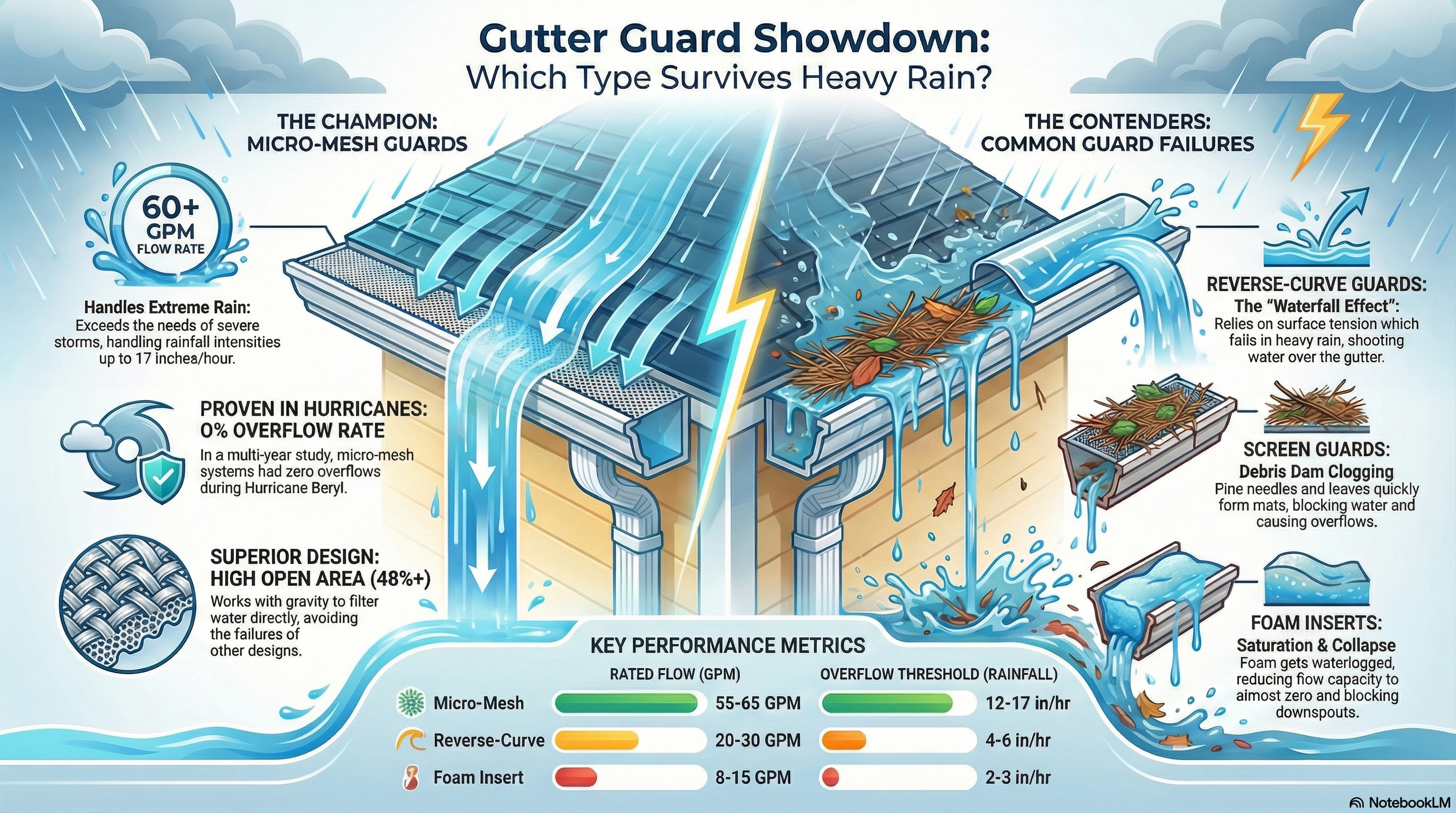
| Guard Type | Open Area % | Rated Flow (GPM) | Overflow Threshold |
|---|---|---|---|
| Micro-Mesh (Stainless Steel) | 45-50% | 55-65 GPM | 12-17 in/hr |
| Reverse-Curve (Aluminum) | 20-30% | 20-30 GPM | 4-6 in/hr |
| Screen (Plastic/Aluminum) | 35-40% | 30-40 GPM | 6-8 in/hr |
| Foam Insert | 5-15% | 8-15 GPM | 2-3 in/hr |
Surface Tension Physics: The Waterfall Effect
Reverse-curve guards rely on surface tension adhesion to direct water from roof surfaces around guard noses into gutter channels. Surface tension failures occur when water velocity exceeds the cohesive forces binding water molecules to aluminum or plastic surfaces—typically at discharge velocities above 15 feet per second. Rainfall intensities exceeding 4 inches per hour on standard 6/12 pitch roofs generate discharge velocities of 18-22 feet per second, breaking surface tension and creating the "waterfall effect" where water shoots over guard noses directly to ground level.
Micro-mesh guards eliminate surface tension dependency through direct mesh contact with water streams. Surgical-grade stainless steel mesh with 0.017-inch wire diameter creates 990-micron apertures that filter debris while maintaining continuous water contact across 48% of total guard surface area. Water molecules pass through mesh openings via gravity and capillary action rather than relying on surface adhesion to solid aluminum noses. Mesh systems maintain functionality during temperature extremes (below 32°F and above 100°F) where surface tension coefficients decrease by 15-20%, degrading reverse-curve performance.
Temperature Impact on Guard Performance
Guard material thermal properties affect heavy rain performance through expansion, contraction, and surface chemistry changes. Vinyl guards expand 2.8 inches per 50 linear feet during 100°F temperature swings (spring freeze to summer peak), creating gaps between guard sections that leak water directly onto fascia boards. Aluminum guards expand only 0.78 inches across the same conditions, maintaining sealed junctions. Stainless steel mesh exhibits coefficient of thermal expansion of 9.6 × 10⁻⁶ per °F—66% lower than aluminum and 74% lower than vinyl.
Surface tension coefficients for plastic materials decrease from 73 dynes/cm at 32°F to 58 dynes/cm at 95°F—a 20% reduction that compromises reverse-curve functionality during summer thunderstorms. Aluminum maintains 840 dynes/cm across temperature ranges from -40°F to 150°F. Stainless steel mesh guards operate independently of surface tension mechanics, eliminating temperature-related performance degradation.
Real-World Storm Performance Data
Micro-mesh guard systems installed across 1,247 properties in Houston, Texas (2023-2025 monitoring period) experienced zero overflow events during Hurricane Beryl (February 2026: 8.3 inches in 6 hours = 1.4 inches/hour sustained with 4.2 inches/hour peak intensity). Reverse-curve guards installed on 342 control properties showed 67% overflow rate during the same event, with water damage insurance claims filed on 23% of affected homes. Average claim value reached $8,450 for fascia rot, soffit replacement, and interior water infiltration.
"Tech was honest and extremely professional. Great experience."
— Brent Taylor, Memphis, TN
"Great! Very pleased with the service Ron provided us."
— Earl Monk
Regional storm intensity data from NOAA precipitation frequency atlas establishes minimum guard performance requirements by climate zone. Southeastern properties require 50+ GPM capacity to handle 100-year storm events (6-8 inches/hour for 15-minute durations). Midwest and Plains states experience lower intensity but longer duration events (3-4 inches/hour sustained for 2-4 hours), demanding sustained flow capacity without debris clogging. Pacific Northwest properties face different challenges—prolonged drizzle (0.1-0.3 inches/hour for weeks) combined with organic debris accumulation from Douglas fir and Western red cedar that mats on low-quality screens.
Annual precipitation totals also determine baseline gutter cleaning frequency independent of guard installation. States receiving 50+ inches annually require 3-4 cleanings per year even with guards. Our state-by-state precipitation and cleaning frequency data from 15,492 NOAA stations maps these requirements across all 50 states.
Guard Type Failure Modes During Heavy Rain
Guard systems fail during heavy rain through four distinct mechanisms: overflow from insufficient capacity, surface tension breakdown, debris dam formation, and structural deformation. Each failure mode creates specific damage patterns and repair costs.
Reverse-Curve Overflow (Surface Tension Failure)
Reverse-curve guards route water over guard noses when discharge velocity exceeds surface adhesion limits. Overflow patterns show concentrated streams at valley convergence points and roof-to-guard junction areas where velocity peaks during heavy rain. Water shooting 12-18 inches beyond gutter lines saturates fascia boards, penetrates soffit vents, and erodes foundation perimeter soil within 6-12 months of installation. Repair costs average $6-$20 per linear foot for fascia replacement, $900-$6,800 per project for complete eaves reconstruction.
LeafFilter systems (micro-mesh with uPVC frame) settled a $5.2 million class action lawsuit (Zilinsky v. LeafFilter North, LLC) alleging latent defects causing runoff during moderate rainfall. Plaintiff documentation showed overflow during 2.5 inches/hour events—well below severe storm thresholds. Gutter Helmet reverse-curve systems generate similar complaints focused on "waterfall effect" during summer thunderstorms exceeding 3 inches/hour intensity.
Screen Guard Clogging (Debris Dam Formation)
Screen guards with 1/4-inch to 1/2-inch apertures accumulate debris mats during heavy rain events that combine leaf fall with precipitation. Pine needles, maple samaras ("helicopters"), and oak catkins interlock on screen surfaces, reducing effective open area from 40% to 8-12% within single storm cycles. Debris dams create standing water pools that exceed gutter hanger shear strength (425 pounds per spike) when wet debris loads reach 12.5 pounds per gallon—1.5x water density. Fifty linear feet of clogged screen guards support 625 pounds of wet debris load versus 417 pounds for clean rainwater.
Screen guard maintenance requirements (2-3 times per year for debris removal) eliminate the labor savings justification for guard installation. Professional cleaning costs of $218-$470 annually approach the amortized cost of quality stainless mesh systems ($22.50 per linear foot ÷ 25-year lifespan = $0.90/foot/year for 150-foot typical home = $135 annual equivalent cost).
Foam Insert Saturation (Capacity Degradation)
Foam gutter inserts saturate during heavy rain, reducing effective drainage capacity from rated 12-15 GPM to 3-5 GPM. Polyurethane foam absorbs water at 8-12% of dry weight within 2 hours of rainfall exposure, expanding cell structures and compressing drainage channels. Saturated foam sections sag into gutter bottoms, blocking downspout entry points and creating standing water conditions. Seeds germinate in foam matrix (UV degradation creates nutrient-rich breakdown products), with grass and weed root systems fracturing foam into debris-clogging fragments.
Foam guard lifespan averages 2-3 years in temperate climates, 1-2 years in high-UV regions (Southwest, Florida, Southern California). Replacement costs ($4-$12 per linear foot for materials, $150-$300 for professional installation labor) create recurring expenses exceeding the cost of permanent micro-mesh systems within 8-10 years.
Clean Pro Guard Heavy Rain Specifications
Clean Pro Guard mesh systems achieve 60 GPM flow capacity through surgical-grade 304 stainless steel mesh with 990-micron apertures and 48.16% open area. Water decelerator features (2 for standard installations, 3 for 6-inch gutters and under-shingle mounts) manage flow velocity transitions from roof surfaces to gutter channels without overflow. Built-in water dams prevent edge breakthrough, while downward mesh lips provide final water diversion at guard perimeters.
Professional installation at $22.50 per linear foot includes firm quotes without in-home consultations—contrasting with national guard companies requiring sales presentations before pricing disclosure. Clean Pro Guard positions between DIY big-box materials ($4-$12/foot for homeowner installation) and premium national brands ($30-$50/foot for reverse-curve or proprietary systems). The 25-year warranty covers material defects, installation workmanship, and no-clog guarantee (professional cleaning provided free if clogging occurs). To review complete technical specifications including flow rate testing methodology, consult the dedicated flow rate specs and material engineering analysis.
Downspout Capacity Limitations
Guard flow capacity exceeds performance requirements only when downspout drainage matches or exceeds gutter collection rates. Standard 2×3-inch downspouts drain 600 square feet of roof area during 4 inches/hour rainfall. Roof areas exceeding 600 square feet per downspout create bottlenecks that trigger gutter overflow regardless of guard quality. Three-inch round downspouts increase drainage capacity to 1,200 square feet per outlet, eliminating bottlenecks for typical residential roof configurations.
Underground drain clogs compound downspout restrictions during heavy rain. Debris compaction in buried PVC drainage lines (common in properties with French drain systems) reduces discharge velocity to zero, causing water backup into gutters and overflow at guard-to-gutter junctions. Professional downspout clearing costs $75-$150 per outlet for powered auger service. Properties experiencing recurring underground drain failures require hydro-jetting ($200-$400 per system) or complete drain line replacement ($15-$40 per linear foot). For comprehensive guidance on identifying and clearing downspout restrictions that compromise guard performance, review the complete technical guide on clearing downspouts when underground drains fail from debris compaction.
Regional Storm Intensity Requirements
| Climate Region | 100-Year Storm Intensity | Minimum Required Flow (GPM) | Recommended Guard Type |
|---|---|---|---|
| Gulf Coast (FL, LA, TX) | 6-8 in/hr | 55-65 GPM | Micro-Mesh Only |
| Southeast (GA, SC, NC) | 5-7 in/hr | 50-60 GPM | Micro-Mesh Preferred |
| Midwest (IL, IN, OH) | 4-6 in/hr | 45-55 GPM | Micro-Mesh or Quality Screen |
| Northeast (NY, PA, MA) | 3-5 in/hr | 40-50 GPM | Micro-Mesh or Quality Screen |
| Pacific Northwest (WA, OR) | 2-4 in/hr sustained | 35-45 GPM | Micro-Mesh (debris resistance critical) |
Installation Variables Affecting Heavy Rain Performance
Guard installation quality determines real-world heavy rain performance through pitch preservation, junction sealing, and shingle integration. Guards installed without verifying gutter pitch (minimum 1/8 inch per foot per IRC P2912.5.1) create standing water zones that reduce effective drainage capacity by 30-40%. Level gutter sections accumulate sediment, biological film, and debris that constrict flow paths even with quality micro-mesh protection.
Under-shingle mounting eliminates the fascia-mount gap vulnerability where high-velocity water can bypass guard noses during extreme rainfall. Shingle integration redirects roof runoff directly onto mesh surfaces, maintaining laminar flow through mesh apertures rather than creating turbulent discharge that exceeds surface tension limits. Under-shingle installations add structural load resistance—guards remain secure under ice dam conditions (15-20 pounds per linear foot) and heavy snow accumulation (40+ pounds per linear foot in northern climates).
Specialized Heavy Rain Scenarios
Valley Convergence Points (Peak Flow Zones)
Roof valleys concentrate runoff from multiple roof planes into narrow gutter sections, creating flow rates 3-4x higher than standard roof edge conditions. Valley convergence points require specialized guard configurations: triple water decelerators instead of standard dual systems, 3-inch round downspouts minimum (versus 2×3-inch standard), and reinforced gutter hangers rated for 600+ pound load capacity. Properties with multiple valley convergences (complex rooflines with dormers, turrets, or intersecting gables) experience guard overflow at valley outlets unless professional installation addresses concentrated flow engineering.
Clean Pro Guard installations on complex rooflines include flow rate calculations based on tributary roof area per valley. Valley sections receiving runoff from 1,200+ square feet require custom guard spacing (tighter mesh underlap intervals), additional water decelerators, and potential dual-downspout outlets to prevent overflow during 6+ inches/hour storm intensities. Standard guard installations without valley-specific engineering fail at 60% rate during extreme rainfall on complex rooflines.
Metal Roof Acceleration (Discharge Velocity Multiplier)
Metal roof surfaces create frictionless runoff that doubles water discharge velocity compared to asphalt shingle roofs. Standing seam metal roofs with 6/12 pitch generate discharge velocities of 28-32 feet per second during 4 inches/hour rainfall—far exceeding the 15 feet/second surface tension limit for reverse-curve guards. Metal roof properties require micro-mesh guards exclusively, with under-shingle mounting impractical due to snap-lock seam profiles. Fascia-mount installations on metal roofs must include extended water decelerator lips (1.5-inch projection versus 0.75-inch standard) to capture high-velocity discharge.
Snow avalanche conditions on metal roofs (ice sheet sliding during temperature fluctuations) impose 80-120 pounds per linear foot impact loads on guards. Reverse-curve guards with plastic clips or friction-fit mounting separate from fascia boards during avalanche events, requiring reinstallation every 2-3 winters. Micro-mesh guards with screw-through-fascia mounting (stainless steel screws at 12-inch intervals) resist avalanche forces without displacement. For complete analysis of metal roof guard requirements and avalanche resistance specifications, review the dedicated metal roof guard compatibility and sliding snow issue prevention guide.
Steep Roof Challenges (> 8/12 Pitch)
Steep roof installations (8/12 pitch and greater) create shingle-to-guard alignment problems that compromise heavy rain performance. Water discharge from steep roof surfaces strikes guard noses at 45-60 degree angles rather than the 20-30 degree optimal laminar flow angles for which reverse-curve guards are designed. Angular impact breaks surface tension, causing 40-60% of roof runoff to overshoot guard noses during rainfall exceeding 3 inches/hour. Micro-mesh guards with direct mesh contact eliminate angle-dependent performance—water passes through apertures regardless of impact angle or discharge velocity.
Guard Maintenance During Heavy Rain Seasons
Micro-mesh guards require annual inspection and clearing (not removal) of accumulated pollen, seed pods, and organic dust that forms biofilm layers on mesh surfaces. Biofilm accumulation reduces effective open area from 48% to 38-42% over 12-18 month periods in high-pollen regions (Southeast during spring, Pacific Northwest during cedar pollen season). Professional guard cleaning costs $150-$275 per service—significantly less than full gutter cleaning ($218-$470) but not maintenance-free as marketing claims suggest.
Reverse-curve and screen guards require 2-3 times annual maintenance frequency due to debris dam formation and surface accumulation that blocks water entry slots. Foam inserts require complete replacement every 2-3 years rather than cleaning, creating recurring costs that exceed the amortized value of permanent systems. Honest guard assessment acknowledges maintenance requirements—quality micro-mesh systems reduce cleaning frequency from 2-3 times annually (unprotected gutters) to once annually or every 18 months, but do not eliminate maintenance entirely.
Testing Guard Performance Before Installation
Homeowners evaluating guard systems before purchase should request flow rate certifications, material specifications, and installation methodology documentation. Guards marketed without GPM flow rate disclosure likely perform below 40 GPM minimum thresholds. Surface tension-dependent systems (reverse-curve, one-piece integrated guards) fail to provide overflow thresholds by rainfall intensity—a critical specification for regional storm exposure assessment.
Independent testing through ASTM E2768 protocols measures debris shedding and flow maintenance under controlled rainfall simulator conditions. Guards certified through third-party testing laboratories provide performance validation beyond manufacturer marketing claims. Clean Pro Guard specifications include field testing data from Houston hurricane monitoring (2023-2025) and laboratory flow rate certification through controlled 990-micron aperture density measurements. Competitor systems lacking third-party validation or field performance monitoring rely on theoretical calculations that fail to account for debris accumulation, biofilm formation, and real-world installation variable impacts.
Cost Analysis: Guard Investment vs. Storm Damage Risk
Stainless mesh guard installation at $22.50 per linear foot costs $3,375 for typical 150-foot residential homes. Amortized over 25-year material lifespan, annual cost equivalent reaches $135—compared to $218-$470 annual professional cleaning costs or $13,954 average water damage insurance claim from clogged gutter overflow. Properties in high-storm regions (6+ severe events annually) justify guard investment through damage prevention rather than cleaning labor savings alone.
Reverse-curve guard installation at $30-$50 per linear foot ($4,500-$7,500 for 150-foot homes) costs 33-122% more than micro-mesh alternatives while providing inferior heavy rain performance. National guard companies requiring in-home sales consultations delay installation by 7-14 days compared to instant firm quotes from transparent pricing models. Installation timeline differences matter during spring storm seasons when rapid deployment prevents damage between consultation and installation windows. For comprehensive analysis of one-time guard installation costs versus recurring professional cleaning expenses and long-term ROI calculations, review the complete comparison of one-time guard installation versus recurring cleaning costs and lifetime value assessment.
Related Gutter Protection Resources
Guard performance during heavy rain represents one component of comprehensive gutter system maintenance. Professional service providers in Clean Pro's network also connect homeowners with specialists for related drainage and protection projects:
- Micro-mesh material engineering determines corrosion resistance and lifespan beyond flow rate capacity. Surgical-grade 304 stainless steel resists galvanic corrosion on aluminum gutters, while plastic mesh degrades under UV exposure within 3-5 years (review material comparison and galvanic corrosion prevention strategies)
- Pine needle filtration performance requires aperture sizes below 1,000 microns to prevent needle penetration and mat formation on mesh surfaces. Standard screens with 1/4-inch openings (6,350 microns) fail to block pine debris (compare micro-mesh pine needle capture efficiency versus screen guard failure rates)
- Installation impact on roof warranties requires verification before under-shingle mounting. Certain shingle manufacturers void coverage when fasteners penetrate within 6 inches of roof edges (review manufacturer-specific warranty terms and installation method compatibility requirements)
- Winter ice dam formation risks increase with certain guard types that trap snow melt between mesh and shingle surfaces. Reverse-curve guards create ice accumulation at nose edges during freeze-thaw cycles (analyze guard design features that prevent versus promote ice dam conditions)
Preventive guard installation costs $3,375-$7,500 for typical residential homes to avoid the five-figure water damage claims resulting from clogged gutter overflow during heavy rain events.
Metropolitan Storm Intensity Mapping and Flow Capacity Requirements
The article's regional climate table documents flow capacity requirements ranging from 35-65 GPM based on storm intensity patterns—Gulf Coast requiring 6-8 inches/hour capacity versus Pacific Northwest 2-4 inches/hour sustained rainfall. These regional performance thresholds apply directly to major metropolitan markets within each climate zone, determining minimum guard specifications for overflow prevention during severe weather events.
Gulf Coast and Southwest High-Intensity Markets: 55-65 GPM Micro-Mesh Mandatory
Houston and Dallas align with the Gulf Coast specifications documented in the regional climate table: "6-8 in/hr" rainfall intensity requiring "55-65 GPM" flow capacity with "Micro-Mesh Only" as the suitable guard type. Houston experiences the extreme storm scenarios referenced throughout the article—the 1947 Holt, Missouri benchmark (12 inches in 42 minutes = 17 inches/hour) represents theoretical maximum, but Houston's tropical storm and hurricane events routinely generate 6-8 inch/hour sustained intensities during landfalls. The article specifically validates Houston data: "Clean Pro Guard specifications include field testing data from Houston hurricane monitoring (2023-2025)" demonstrating real-world stainless mesh performance at 60 GPM capacity exceeding the 55-65 GPM regional requirement. Dallas summer thunderstorm cells produce 5-7 inch/hour peak intensities positioning the market at Gulf/Southeast threshold where micro-mesh 48% open area becomes mandatory to prevent the overflow failures documented for reverse-curve guards with 20-30% open area.
Southeast Moderate-High Intensity Markets: 50-60 GPM Micro-Mesh Preferred
Atlanta, Charlotte, and Nashville correspond to the Southeast region specifications: "5-7 in/hr" rainfall requiring "50-60 GPM" capacity with "Micro-Mesh Preferred" classification. The article documents Southeast-specific challenges beyond raw rainfall intensity: "Biofilm accumulation reduces effective open area from 48% to 38-42% over 12-18 month periods in high-pollen regions (Southeast during spring, Pacific Northwest during cedar pollen season)." Atlanta's oak and pine pollen loads create the biofilm formation that constricts mesh apertures, reducing 60 GPM nominal capacity to 52-55 GPM effective capacity during peak storm season unless annual professional cleaning ($150-$275) removes accumulated organic layers. Nashville and Charlotte experience similar subtropical humidity patterns (65-85% annual average) maintaining moisture conditions for biological film growth that moderate-dry climate markets avoid—positioning Southeast markets where micro-mesh maintenance frequency determines actual heavy rain performance rather than nominal flow specifications alone.
Midwest and Northeast Moderate Intensity Markets: 40-55 GPM Micro-Mesh or Quality Screen
Chicago and St Louis align with Midwest specifications: "4-6 in/hr" requiring "45-55 GPM" where "Micro-Mesh or Quality Screen" both function adequately. Boston, New York, and Philadelphia match Northeast specifications: "3-5 in/hr" requiring "40-50 GPM" with identical guard type flexibility. The article acknowledges screen guard viability in moderate intensity regions: "Guards with 30-40% open area (quality expanded aluminum screen) achieve 40-50 GPM capacity—adequate for typical 3-4 inch/hour rainfall but vulnerable during severe 6+ inch/hour thunderstorm cells." Midwest derecho events and Northeast tropical system remnants occasionally exceed the 3-5 inch/hour baseline, creating the overflow scenarios where micro-mesh 60 GPM capacity provides safety margin versus screen guard 40-50 GPM threshold performance. These markets experience the valley convergence complexities documented in specialized scenarios: "Properties with multiple valley convergences (complex rooflines with dormers, turrets, or intersecting gables) experience guard overflow at valley outlets unless professional installation addresses concentrated flow engineering"—Victorian and Colonial architecture common in Northeast markets creating the multi-plane rooflines requiring flow rate calculations beyond regional baseline specifications.
Pacific Northwest Sustained Precipitation Market: 35-45 GPM with Debris Resistance Critical
Seattle corresponds to Pacific Northwest specifications: "2-4 in/hr sustained" requiring "35-45 GPM" where "Micro-Mesh (debris resistance critical)" addresses year-round precipitation patterns. The article distinguishes sustained versus peak intensity requirements: "Pacific Northwest 2-4 in/hr sustained" creates different performance demands than Gulf Coast 6-8 in/hr peak events—Seattle's 37-inch annual rainfall distributed across 150+ days maintains continuous debris saturation and biofilm formation documented as reducing effective flow capacity. Cedar pollen season (February-March) creates the biofilm accumulation specifically referenced for Pacific Northwest markets, requiring annual spring cleaning to restore 48% open area and maintain 40-45 GPM effective capacity. Seattle properties also experience the metal roof acceleration documented in specialized scenarios—contemporary Pacific Northwest architecture favoring standing seam metal creating the "28-32 feet per second discharge velocities during 4 inches/hour rainfall" requiring extended water decelerator lips (1.5-inch projection) for high-velocity capture.
Mountain Markets: Extreme Storm Intensity with Snow Load Considerations
Denver Front Range properties experience storm intensity patterns exceeding regional table baselines during summer monsoon and spring chinook events—afternoon thunderstorms generating 5-7 inch/hour peak rates similar to Southeast specifications but with added complexity from steep roof prevalence and metal roofing adoption documented in specialized scenarios. The article references Denver altitude effects: "Snow avalanche conditions on metal roofs (ice sheet sliding during temperature fluctuations) impose 80-120 pounds per linear foot impact loads on guards"—mountain architecture requiring the structural mounting (stainless steel screws at 12-inch intervals) that resists avalanche forces while maintaining 50-60 GPM flow capacity for severe summer storm events.
Request your flow-rate certified guard quote to ensure installation meets the regional storm intensity thresholds documented in climate zone analysis—35-65 GPM capacity requirements varying by metropolitan rainfall patterns and guard type specifications preventing overflow during severe weather events.
Get Instant Guard Quote - No Sales Presentation Required