Five warning signs reveal clogged gutters before visible water damage begins: overflow during rain, sagging between hangers, plant growth in channels, basement moisture, and foundation cracks.
Wet debris accumulation weighs 12.5 pounds per gallon—50% heavier than water alone—causing structural stress that progresses from minor overflow to foundation damage costing $13,954 in average insurance claims. Professional inspection identifies blockages before progressive deterioration reaches critical failure thresholds.
Homeowners who schedule annual cleaning prevent the cascade effect where initial overflow leads to fascia rot at $6-$20 per linear foot, then foundation settlement requiring piering at $1,500-$3,000 per anchor point.
Get Instant Quote – Satellite Pricing in 15 MinutesSign #1: Water Overflow During Moderate Rain
Drainage systems designed to handle moderate rainfall overflow when debris blockages reduce flow capacity below precipitation volume. Standard five-inch K-style gutters process 1,200 gallons per hour under optimal pitch conditions—blockages reduce this capacity by 60-90% depending on debris density.
Overflow during light-to-moderate rain (less than 1 inch per hour) indicates advanced blockage affecting multiple downspout connections. Severe storms generating 3-4 inches per hour can overwhelm even clean systems, but overflow during routine weather patterns signals maintenance failure.
Visual confirmation requires observation during active precipitation. Water spilling over front edges rather than flowing toward downspouts reveals clog locations—typically at elbows, valleys, or downspout entries where debris accumulates fastest.
Professional assessment costs $218-$470 for complete system evaluation, far less than repairing water damage to fascia boards at $900-$6,800 per project.
Sign #2: Sagging Sections Between Hangers
Weight-bearing failures occur when wet debris exceeds structural capacity of mounting hardware. Standard aluminum K-style gutters with ferrule-spike hangers support 625 pounds across 50 linear feet before shear failure—wet sludge at 12.5 pounds per gallon reaches this threshold in 90 days without maintenance.
Visible sagging between support points indicates exceeded load capacity. Ferrule spikes driven through aluminum into fascia boards lack the tensile strength of hidden hangers secured to rafter tails. Progressive deformation begins at 0.25 inches of vertical displacement and accelerates once hangers begin pulling from mounting points.
| Hanger Type | Load Capacity | Failure Threshold | Wet Debris Timeline |
|---|---|---|---|
| Ferrule Spikes | 400-500 lbs | 0.25" sag visible | 60-90 days |
| Hidden Hangers | 800-1,200 lbs | 0.50" sag visible | 120-180 days |
| Strap Hangers | 300-400 lbs | 0.20" sag visible | 45-75 days |
Replacement requires removing damaged sections, reinforcing fascia attachment points, and upgrading to hidden hangers spaced 24 inches on center rather than 36-inch ferrule spacing.
Sign #3: Plant Growth Sprouting From Gutter Channels
Vegetation growing from gutter troughs indicates sustained standing water and decomposed organic matter providing growth medium. Seeds from maple samaras, oak catkins, and wind-dispersed grass seeds germinate in wet leaf debris within 7-14 days of moisture exposure.
Moss, algae, and small trees sprouting from gutters reveal inadequate pitch allowing water pooling. IRC Code P2912.5.1 requires minimum 1/8 inch slope per foot (approximately 1% grade) to maintain flow velocity preventing sediment deposition. Level installations create stagnant zones where biological growth accelerates.
Root systems penetrate seams between gutter sections, compromising waterproof integrity and creating leak points. Removal requires cutting vegetation at gutter level, then excavating root balls that anchor into decomposed sludge layers.
Common Gutter Vegetation and Growth Timelines
- Moss develops within 30 days in shaded sections with consistent moisture
- Grass sprouts appear within 14 days from airborne seeds in wet debris
- Tree seedlings germinate within 21 days from maple, oak, or elm seeds
- Algae blooms form within 45 days, creating dark biofilm on surfaces
The presence of vegetation indicates neglect exceeding 60-90 days. When you schedule professional cleaning, service providers remove both plant matter and the nutrient-rich decomposed substrate preventing regrowth.
Sign #4: Basement Moisture or Musty Odors During Rain
Foundation perimeter saturation from misdirected gutter runoff creates hydrostatic pressure forcing groundwater through basement walls and floor slabs. Saturated soil applies 62.4 pounds per cubic foot against foundation walls—pressure that increases exponentially as water table rises during prolonged rain events.
Basement dampness correlating with precipitation timing indicates exterior drainage failure rather than plumbing leaks. Musty odors from mold growth on organic materials (wood framing, drywall, stored items) develop within 48-72 hours of moisture exposure.
Clogged gutters discharge 1,200 gallons per hour directly against foundation perimeters rather than routing water 10+ feet away through functioning downspouts and extensions. Concentrated discharge saturates backfill soil, overwhelming perimeter drain tiles designed for dispersed water volume.
Understanding the complete impact of basement water infiltration requires examining how neglected drainage systems cause five-figure damage. To understand the financial consequences, review our analysis documenting the risk of water damage from foundation saturation and the repair costs associated with basement waterproofing failures.
"I thought the service was outstanding, with lots of professionalism and care."
— Hilgrove Delancy, Binghamton, NY
How Do Clogged Gutters Cause Basement Problems?
Overflow concentrates 50-100 gallons per minute at foundation perimeters during moderate rain. Soil absorption rates of 0.5-2 inches per hour cannot process this volume, creating saturated zones extending 3-6 feet from foundation walls.
Water follows least resistance paths—through foundation cracks, cold joints between footings and walls, and porous concrete or block construction. Basement waterproofing systems costing $3,000-$10,000 address symptoms rather than correcting the source failure at gutter level.
Sign #5: Foundation Cracks or Settling Near Corners
Differential settlement occurs when soil moisture imbalance causes non-uniform foundation support. Saturated zones beneath gutter overflow points compress more than adjacent dry soil, creating stress concentrations that manifest as diagonal cracks from corners or vertical separations at control joints.
Foundation movement of 0.25 inches generates visible cracking in attached structures—garage aprons, basement walls, and exterior brick veneer. Progressive settlement requires stabilization through helical piers or push piers at $1,500-$3,000 per anchor point, with average homes needing 5-10 piers for perimeter correction.
Corner locations experience concentrated stress because two perpendicular gutter runs discharge at intersecting downspouts. Blocked corners accumulate debris from multiple roof planes, increasing overflow volume and soil saturation intensity.
| Foundation Damage Type | Visual Indicator | Repair Cost Range | Cause |
|---|---|---|---|
| Diagonal Corner Cracks | 45° cracks from corners | $1,500-$3,000 per pier | Differential settlement from moisture imbalance |
| Horizontal Wall Cracks | Cracks along mortar joints | $900-$2,500 per wall | Hydrostatic pressure from saturated backfill |
| Stair-Step Brick Cracks | Stepped pattern in veneer | $1,200-$4,000 per section | Foundation movement from soil expansion/contraction |
Preventing foundation damage costs $218-$470 for professional cleaning—less than 10% of single-pier stabilization work. Early intervention when overflow first appears prevents the progression to structural repairs.
Additional Warning Signs (Uncommon Scenarios)
Specialized situations reveal unique clogging indicators beyond the five primary signs:
Copper Gutter Systems: Green Staining on Siding
Copper oxide runoff creates distinctive blue-green staining on light-colored siding below overflow points. The chemical reaction between copper and standing water accelerates in clogged sections where water exposure time increases from seconds to hours.
Copper system owners face specialized cleaning requirements to prevent oxidation damage. Professional cleaning costs $275-$625 for copper gutters due to non-abrasive solution requirements and specialized handling protocols.
Historic Homes: Built-In Box Gutter Failure
Built-in box gutters integrated into roofline architecture lack external visibility for inspection. Water staining on interior ceilings near eaves indicates overflow backing into roof structure through inadequate flashing or deteriorated lining materials.
Box gutter cleaning requires specialized access and preservation protocols, costing $370-$890 per session due to architectural sensitivity and structural integration complexity.
Multi-Story Homes: Ice Dam Formation in Winter
Clogged gutters filled with debris and standing water create ideal conditions for ice dam formation when temperatures drop below freezing. Water backing up behind ice accumulation infiltrates under shingles, causing interior ceiling damage and insulation saturation.
Winter overflow from inadequate fall cleaning creates ice buildups 6-12 inches thick along eave edges—weight that exceeds gutter system structural capacity and pulls mounting hardware from fascia boards.
How Often Should You Inspect for These Warning Signs?
Monthly visual inspections during growing season (April-November) catch early indicators before damage progression. Focus inspection timing around these events:
- Spring inspection targets winter debris accumulation and ice damage assessment
- Late spring checks identify seed pod accumulation from maple, oak, and elm species
- Summer monitoring detects plant growth and algae formation in stagnant sections
- Fall assessment measures leaf accumulation rates and pre-winter clearing needs
- Post-storm evaluation confirms system capacity and identifies new overflow patterns
Professional assessment provides thermal imaging, moisture meters, and structural load analysis beyond visual inspection capabilities. Service providers document conditions with before-and-after photography, creating maintenance records for insurance and property value purposes.
Understanding optimal maintenance timing based on regional climate and tree species density helps homeowners prevent seasonal accumulation patterns. To determine your property's specific cleaning schedule, read our comprehensive analysis of maintenance frequency requirements for homes with pine trees versus deciduous species and the seasonal debris cycles that drive professional cleaning intervals.
Regional climate variation produces measurable differences in clogging speed and severity. States with high precipitation, frequent freeze-thaw cycles, and dense forest canopy experience accelerated debris accumulation. Our 50-state gutter cleaning frequency map derived from NOAA climate data identifies your state's risk profile and recommended cleaning interval.
"Quick, professional and completely painless procedure."
— Marius Meyer, Little Rock, AR
What Happens If You Ignore These Warning Signs?
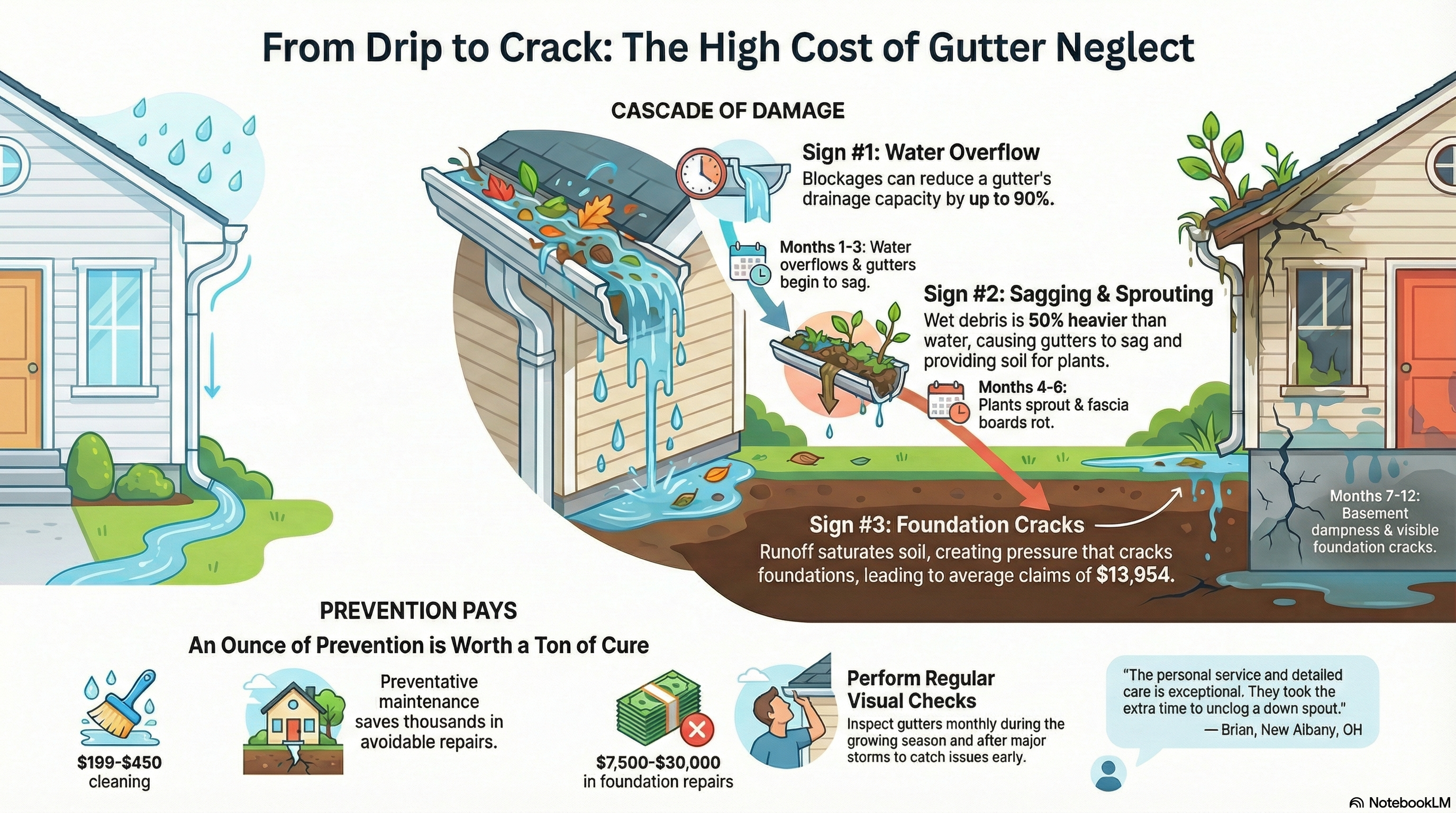
Progressive deterioration follows a predictable cascade once initial symptoms appear. Month 1-3 brings visible overflow and minor sagging. Month 4-6 introduces fascia rot and vegetation growth. Month 7-12 manifests as foundation cracks and basement moisture.
Repair cost escalation accelerates exponentially rather than linearly. Initial $218-$470 cleaning prevents $900-$6,800 eaves repair, which if neglected, leads to $3,000-$10,000 basement waterproofing, ultimately requiring $7,500-$30,000 in foundation stabilization.
Insurance coverage complications arise when damage results from deferred maintenance rather than sudden catastrophic events. Policies often exclude or limit coverage for deterioration from neglect, leaving homeowners responsible for full repair costs.
Timeline of Damage Progression
- Weeks 1-4: Initial overflow during rain, minor debris accumulation visible
- Months 2-3: Sagging develops between hangers, black streaks appear on exterior surfaces from algae-laden overflow
- Months 4-6: Plant growth emerges, fascia boards show moisture damage, paint peeling begins
- Months 7-9: Basement dampness appears during rain, foundation perimeter soil stays saturated
- Months 10-12: Foundation cracks visible, settlement at corners measurable, structural intervention required
Professional intervention at any stage halts progression and prevents advancement to next damage level. Early detection during overflow phase costs minimal compared to structural repair after settlement begins.
Schedule Inspection – Prevent $13,954 in Water DamageRegional Professional Gutter Inspection and Cleaning Services
Clean Pro's nationwide network provides professional gutter inspection and cleaning services identifying warning signs before structural damage occurs. Certified service providers conduct comprehensive assessments documenting overflow patterns, sagging sections, plant growth, and moisture intrusion requiring immediate intervention.
Comprehensive National Service Coverage
Professional gutter cleaning and inspection teams operate in Atlanta, Boston, Charlotte, Chicago, Dallas, Denver, Houston, Nashville, New York, Philadelphia, Seattle, and St Louis, providing complete debris removal, downspout clearing, and structural assessment within 1.5-3.5 hours preventing $13,954 average water damage claims from clogged gutter overflow and foundation saturation.
Request your 15-minute quote for professional gutter inspection and cleaning with verified insurance coverage.
Related Home Drainage and Maintenance Guides
Gutter maintenance represents one component of comprehensive exterior water management. Professional service providers in Clean Pro's network also connect homeowners with specialists for related drainage and structural protection projects:
- Downspout clearing costs $75-$150 per downspout when underground drain connections require powered auger equipment to clear debris compaction in buried PVC piping (review technical methods for clearing downspouts when underground drains fail from root infiltration or sediment buildup)
- Ice dam prevention costs include attic insulation upgrades at $1.50-$3.50 per square foot and roof heat cable installation at $8-$20 per linear foot to prevent winter overflow damage (understand the gutter connection to ice dam formation and prevention strategies combining insulation, ventilation, and drainage system maintenance)
- Professional gutter guard installation costs $18-$40 per linear foot depending on system complexity. Clean Pro Guard provides firm quotes at $22.50/ft—national guard companies typically require in-home consultations (compare one-time guard installation investment versus recurring bi-annual cleaning costs over 10-20 year ownership periods)
- Foundation waterproofing costs $3,000-$10,000 for interior drainage systems or $8,000-$15,000 for exterior excavation and membrane installation when gutter failure causes chronic basement moisture (review complete water damage cost analysis documenting repair expenses from neglected drainage systems)
Preventive gutter maintenance costs $218-$470 bi-annually to avoid the five-figure repair bills that result from progressive water damage to foundations, basements, and structural framing.
Frequently Asked Questions About Clogged Gutter Warning Signs
What are the first signs of clogged gutters?
Water overflow during moderate rain indicates blockages preventing proper drainage. Wet sludge accumulation weighs 12.5 pounds per gallon—50% heavier than water alone—causing visible sagging between hangers within 2-3 months of neglect.
How do I know if my gutters need cleaning without climbing a ladder?
Black streaks on exterior surfaces (tiger striping) indicate overflow carrying algae and dirt down siding. Plant growth sprouting from gutter channels reveals standing water and decomposed organic matter. Basement moisture during rain signals foundation perimeter saturation from misdirected runoff.
Can clogged gutters cause foundation damage?
Hydrostatic pressure from saturated soil applies 62.4 pounds per cubic foot against foundation walls. Differential settlement from moisture imbalance causes cracks requiring foundation piering at $1,500-$3,000 per pier. Average water damage insurance claims total $13,954 according to ISO statistics.
What causes gutters to sag?
Wet debris weighs 12.5 pounds per gallon versus 8.34 pounds for water. A 50-foot gutter section holds 625 pounds of saturated sludge—exceeding the shear strength of standard aluminum ferrule spikes. Hangers fail within 90 days under sustained load.
How often should I check for clogged gutter symptoms?
Monthly visual inspections prevent progressive damage. Look for overflow during the next moderate rain, check for black streaks after storms, and inspect foundation perimeter for soil saturation. Professional assessment costs $218-$470 and identifies hidden issues before structural damage begins.
Do all five warning signs appear simultaneously?
Warning signs progress sequentially over 6-12 months. Overflow appears first during active rain. Sagging develops within 60-90 days as weight accumulates. Plant growth emerges by month 4-6. Basement moisture and foundation cracks represent advanced stages after 7-12 months of neglect.
Can I fix clogged gutters myself or should I hire professionals?
Ladder-related injuries send 500,000 people to emergency rooms annually according to CPSC statistics. Professional service costs $218-$470 and includes insurance coverage, safety equipment, and proper disposal. DIY attempts risk falls, incomplete debris removal, and damage to gutter systems from improper tools.
Early detection saves thousands in repair costs. When you book professional inspection, service providers identify blockage locations, assess structural damage, and provide documentation for insurance purposes—services unavailable through DIY approaches.
Get Your Instant Quote – Satellite Pricing Ready in 15 Minutes