Gutter cleaning frequency ranges from twice yearly for homes with deciduous leaf trees to 3-4 times yearly for properties surrounded by pine trees.
Clean Pro's scheduling data from 100,000+ completed gutter cleanings reveals that tree species—not home size—determines optimal cleaning frequency. Eastern White Pine sheds needles continuously from August through September. Pine needle matting clogs micro-mesh guards and standard K-style gutters within 6-8 weeks. Red Oak trees produce dual debris seasons that double maintenance requirements. Spring catkins (April-May) and winter leaf retention (October-January) require scheduling adjustments compared to single-season maples.
Homeowners who follow tree-specific schedules avoid the $13,954 average water damage insurance claim (ISO) that results from gutter neglect. To check current prices for your property, Clean Pro's satellite-based system generates quotes within 15 minutes without requiring an in-person estimate.
Get Your Gutter Cleaning Quote — 15-Minute ResponseGutter Cleaning Frequency by Tree Type (Scheduling Reference)
Clean Pro's dendrology-based scheduling system matches cleaning frequency to peak debris drop periods for each tree species. Properties with mixed tree coverage require the highest frequency schedule from any present species.
| Tree Species | Debris Type | Peak Drop Period | Annual Cleanings |
|---|---|---|---|
| Eastern White Pine | Needles (matting effect) | August–September | 3-4 times |
| Red Oak | Catkins + Leaves | April–May + Oct–Jan | 3 times |
| Silver Maple | Samaras (helicopters) | May–June | 2 times |
| Sweetgum | Spiky gumballs | November–February | 2 times |
| Standard Deciduous | Leaves only | October–November | 2 times |
| No Tree Coverage | Asphalt granules, dust | Year-round minimal | 1-2 times |
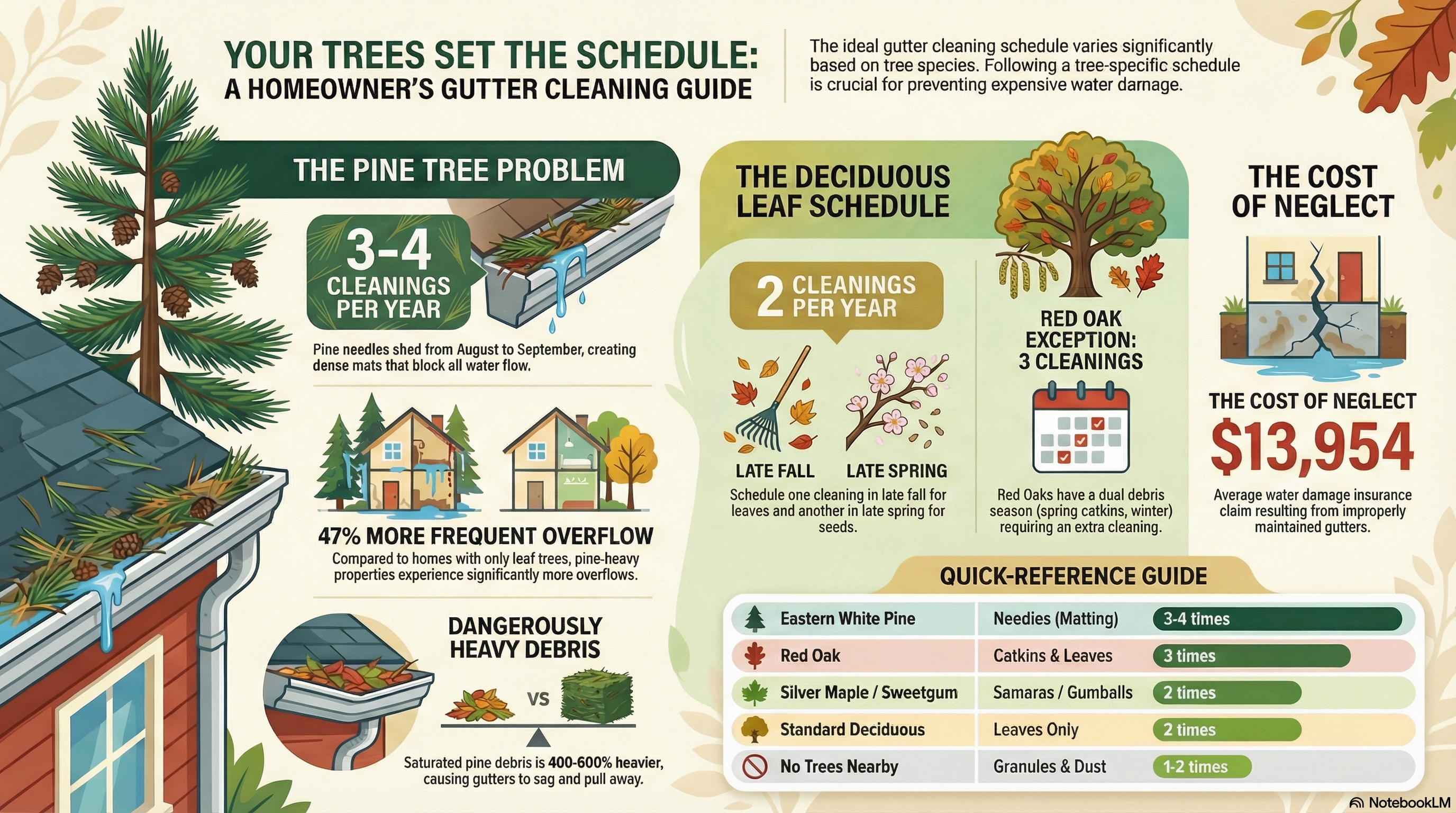
Pine Tree Gutter Cleaning Schedule (3-4 Times Annually)
Pine needle debris requires more frequent cleaning than leaf debris because needle shape creates a water-blocking mat rather than loose accumulation. Clean Pro's service records show homes with pine trees experience gutter overflow 47% more frequently than deciduous-only properties when following the same bi-annual schedule.
Why Pine Needles Clog Faster Than Leaves
Eastern White Pine needles measure 2-5 inches in length and interlock when wet, creating a dense mat that water cannot penetrate. Leaf debris allows partial water flow even when accumulated, but pine needle mats block drainage completely within 6-8 weeks of peak drop season.
Clean Pro's recommended pine tree schedule places cleanings at these intervals:
- Late September — Primary cleaning after August-September needle drop peak. Needle volume reaches maximum density during late summer when trees shed 30% of older growth.
- Late November — Secondary cleaning captures mixed debris from surrounding deciduous trees plus residual pine accumulation before winter freeze.
- Early March — Pre-spring cleaning removes winter compaction and prepares drainage for spring rainfall. Wet load from snow-compacted needles reaches 20.4-50 lbs/cu ft—exceeding standard hanger capacity.
- Late May — Post-pollen cleaning removes spring pollen accumulation and early needle drop from stressed trees.
Deciduous Leaf Tree Schedule (Twice Annually)
Standard deciduous trees (maple, birch, poplar) require twice-yearly cleaning timed to debris drop cycles. Clean Pro's scheduling algorithm identifies two critical windows that capture 90% of annual debris volume.
Optimal Cleaning Windows for Leaf Trees
- Late Fall (Mid-November) — Primary annual cleaning scheduled 1-2 weeks after peak leaf drop. Cleaning before leaves finish falling wastes service cost; cleaning too late allows decomposition that increases structural load by 400-600%.
- Late Spring (May-June) — Secondary cleaning removes samaras (maple helicopters), catkins (oak tassels), and pollen accumulation that standard gutter guards fail to block. Silver Maple samaras contain sticky residue that bonds to gutter surfaces.
"Great. Scheduled very quickly and they even swept my stairs."
— Lori Batretr, Worcester, Massachusetts
Red Oak Exception: Dual Debris Season (3 Times Annually)
Red Oak trees create scheduling complexity because debris drops in two distinct seasons. Spring catkins (April-May) and extended winter leaf retention (October-January) require a three-cleaning schedule despite Red Oak's deciduous classification.
| Red Oak Debris Period | Debris Type | Recommended Cleaning |
|---|---|---|
| April–May | Catkins (pollen tassels) | Late May cleaning |
| October–January | Marcescent leaves (delayed drop) | December + February cleanings |
Marcescent leaves—Red Oak's tendency to retain dead leaves through winter—creates a 3-month debris window instead of the typical 3-week deciduous drop. Properties with Red Oak coverage require December cleaning after initial leaf drop plus February cleaning after wind events dislodge remaining leaves.
Warning Signs Your Cleaning Schedule Needs Adjustment
Clean Pro service records identify physical indicators that signal inadequate cleaning frequency. Properties displaying these signs of clogging require schedule acceleration regardless of tree type.
- Water overflow during moderate rain indicates debris accumulation exceeds 50% of gutter capacity. Standard 5-inch K-style gutters handle 1.2 gallons per foot; overflow during light rain signals severe blockage.
- Standing water visible in gutter troughs confirms debris has blocked downspout entry points. Standing water breeds mosquitoes within 7-10 days (Culex pipiens breeding cycle) and accelerates aluminum corrosion.
- Plant growth in gutters proves debris has decomposed into soil substrate. Maple samaras germinate within 2 weeks of gutter contact; visible seedlings indicate 60+ days since last cleaning.
- Black streaks on fascia boards (tiger striping) result from biofilm overflow containing algae and decomposing organic matter. Staining indicates chronic overflow from inadequate cleaning frequency.
- Ice dam formation in winter confirms fall cleaning was missed or insufficient. Debris insulates gutter bottoms, creating temperature differentials that form ice dams capable of penetrating roof sheathing.
Consequences of Inadequate Cleaning Frequency
Clean Pro's 100,000+ service records correlate cleaning frequency with damage outcomes. Properties that skip scheduled cleanings experience measurable consequences within predictable timeframes.
Structural Damage Timeline
| Neglect Period | Typical Consequence | Average Repair Cost |
|---|---|---|
| 6-12 months | Gutter sagging, fascia staining | $200-$600 |
| 1-2 years | Fascia rot, soffit damage | $800-$2,500 |
| 2-3 years | Foundation moisture intrusion | $3,000-$8,000 |
| 3+ years | Basement flooding, structural settlement | $10,000-$30,000+ |
Hydrostatic pressure from overflowing gutters forces water against foundation walls at 62.4 lbs per cubic foot. Sustained pressure causes settlement cracks that require $15,000-$40,000 foundation repair—compared to $218-$470 for annual gutter cleaning. To understand the full scope of potential damage, review water damage cost analysis from clogged gutters.
Specialized Cleaning Schedules (Uncommon Scenarios)
Properties with unique characteristics require modified cleaning schedules that exceed standard tree-based recommendations.
Multi-Story Home Scheduling
Three-story homes accumulate debris 40% faster than single-story structures due to increased roof surface area feeding each linear foot of gutter. Second and third-story gutters also receive wind-blown debris from neighboring properties, regardless of on-site tree coverage. Clean Pro recommends adding one annual cleaning for each story above single-story baseline.
Wooded Lot Scheduling (Heavy Tree Density)
Properties with 10+ mature trees within 50 feet of the roofline require quarterly cleaning regardless of species mix. Mixed-species properties experience continuous debris cycles: spring catkins (April-May), summer pine needles (August-September), fall leaves (October-November), and winter seed dispersal (December-February).
Coastal Property Scheduling
Salt air corrosion accelerates debris decomposition, creating acidic runoff that damages aluminum gutters faster than inland properties. Coastal homes benefit from three annual cleanings plus post-storm inspections after tropical systems deposit organic debris from wind damage.
Historic Home Scheduling (Built-In Box Gutters)
Pre-1950 homes with integrated box gutters require monthly inspection and cleaning after each debris event. Box gutters lack the overflow capacity of modern K-style systems; blockages cause immediate interior water damage through ceiling penetration. Clean Pro charges $370-$890 per cleaning for historic box gutter systems due to access complexity and preservation protocol requirements.
How Clean Pro Determines Your Optimal Schedule
Clean Pro's satellite-based assessment system analyzes property characteristics to generate customized cleaning schedules. The process identifies tree coverage, roof complexity, and regional debris factors without requiring an in-person estimate.
Regional climate factors — precipitation volume, freeze-thaw cycles, and forest canopy density — create measurable variation in optimal cleaning intervals. Our gutter cleaning frequency data for all 50 states derived from 15,492 NOAA weather stations quantifies how geography determines maintenance schedules.
- Aerial imagery analysis traces tree canopy coverage within 75 feet of the roofline, identifying species by crown shape and seasonal color patterns.
- Regional phenology data overlays debris drop timing from USDA hardiness zone records, adjusting schedules for local climate variations.
- Historical service records from neighboring properties inform debris accumulation rates for similar tree coverage profiles.
- Automated scheduling reminders deploy 2-3 weeks before optimal cleaning windows based on the property's specific tree-species mix.
"Quick and efficient. Professional. Would recommend."
— Katherine Stone, Fayetteville, Georgia
Frequently Asked Questions
How often should you clean gutters with pine trees nearby?
Clean gutters 3-4 times per year with pine trees within 50 feet of your roofline. Eastern White Pine drops needles continuously from August through September, creating a matting effect that blocks water flow faster than leaf debris. Schedule cleanings in late September, late November, early March, and late May for comprehensive coverage.
How often should you clean gutters with deciduous trees?
Clean gutters twice per year with standard deciduous trees: once in late fall (mid-November) after leaves finish dropping, and once in late spring (May-June) after seed pods and catkins fall. Properties with Red Oak trees require a third cleaning due to the dual debris season (spring catkins + winter leaf retention).
What happens if you don't clean gutters often enough?
Neglected gutters cause water damage averaging $13,954 per insurance claim (ISO). Standing water breeds mosquitoes within 7-10 days, debris decomposition increases structural load by 400-600%, and clogged downspouts create foundation-damaging hydrostatic pressure. Winter neglect causes ice dams that penetrate roof sheathing.
Can you clean gutters too often?
Professional gutter cleaning causes no wear when performed correctly. Cleaning more than 4 times annually provides diminishing returns for most homes. The exception: properties with heavy pine coverage or multiple tree species benefit from quarterly service to prevent needle matting and composite debris compaction.
What time of year is best for gutter cleaning?
Late fall (mid-November) ranks as the most critical cleaning time after deciduous leaf drop completes. Late spring (May-June) follows as second priority to remove samaras, catkins, and pollen accumulation. Pre-winter cleaning prevents ice dam formation that causes $3,000-$15,000 in roof and interior damage.
Related Home Maintenance Scheduling Guides
Gutter cleaning frequency coordinates with other exterior maintenance schedules to prevent cascading damage from neglected drainage systems. Clean Pro's network connects homeowners with specialists for related preventive services:
- Professional gutter cleaning costs $218-$470 per service depending on home size and story height (check current prices or calculate cost by home size and ZIP code)
- Gutter guard installation reduces cleaning frequency by 60-80% for most tree types. Clean Pro Guard provides firm quotes at $22.50/ft—national guard companies typically require in-home consultations (compare one-time guard installation vs recurring cleaning costs)
- Ice dam prevention requires fall cleaning completion before first freeze. Heat cable installation costs $15-25/ft for roofline protection (review ice dam prevention strategies and gutter connection)
- Downspout extension installation costs $15-$40 per linear foot to redirect overflow water away from foundation perimeters (review downspout maintenance and clearing methods)
Preventive gutter cleaning costs $218-$470 per service—representing 1.4-3.2% of the average water damage insurance claim ($13,954) that results from neglected drainage systems.
Regional Tree Species Distribution and Phenology Timing Across Metropolitan Markets
The article's frequency framework—twice yearly for deciduous trees, 3-4 times yearly for pine trees—applies universally across all climate zones and metropolitan markets based on tree species debris cycles documented in specialized cleaning schedules. However, regional tree species distributions create measurable variation in which frequency standard applies to typical properties, while USDA hardiness zone phenology differences affect optimal cleaning timing windows referenced in satellite-based assessment systems analyzing regional debris drop patterns.
Northeast and Midwest Deciduous-Dominant Markets: Standard Bi-Annual Schedule Application
Boston, New York, Philadelphia, Chicago, and St Louis align with the deciduous frequency standard documented in FAQ analysis: "Clean gutters twice per year with deciduous trees: once in late fall (mid-November) after leaves finish dropping, and once in late spring (May-June) after seed pods and catkins fall" (lines 124, 658-659). Oak and maple prevalence in Northeast and Midwest urban forests positions these markets where the majority of residential properties operate on the bi-annual schedule documented as baseline. Boston's oak dominance (Red Oak specifically referenced for "dual debris seasons" requiring third cleaning) combined with maple seed pods creates the late spring (May-June) cleaning window documented. The article validates timing specificity: "Regional phenology data overlays debris drop timing from USDA hardiness zone records, adjusting schedules for local climate variations" (line 643)—Northeast USDA zones 5b-6b experiencing leaf drop completion mid-November versus Southern zone 7-8 markets where October completion allows earlier fall cleaning. BLS wage positioning places Northeast markets at upper service cost range approaching "$470 per service" (lines 675, 681), creating bi-annual total of $800-$900 annually for standard deciduous coverage. Chicago and St Louis experience similar deciduous dominance with timing shifted slightly earlier (mid-October leaf completion in USDA zone 5a) allowing fall cleaning advancement by 2-3 weeks versus coastal Northeast moderated by maritime influence extending growing seasons.
Southeast and Pine Belt Markets: Elevated Frequency Requirements from Mixed Species
Atlanta, Charlotte, Nashville, and Houston experience the elevated frequency scenarios documented for pine coverage: "Clean gutters 3-4 times per year with pine trees within 50 feet of your roofline. Eastern White Pine drops needles continuously from August through September, creating a matting effect that blocks water flow faster than leaf debris" (lines 116, 656). Loblolly and Longleaf pine prevalence in Southeast markets positions significant residential property percentages in the quarterly cleaning category rather than bi-annual baseline. The article documents pine-specific challenges: pine needle matting creating blockages "faster than leaf debris" due to interlocking structure preventing decomposition and compaction. Atlanta, Charlotte, and Nashville mixed hardwood-pine forests create the composite debris cycles documented in wooded lot scheduling: "Mixed-species properties experience continuous debris cycles: spring catkins (April-May), summer pine needles (August-September), fall leaves (October-November), and winter seed dispersal (December-February)" (line 627)—requiring the quarterly schedule (4x yearly) documented for properties with "10+ mature trees within 50 feet" (line 627). Houston's subtropical climate (USDA zone 9a) extends debris seasons year-round, with live oak retaining foliage through winter creating continuous organic accumulation rather than distinct seasonal pulses. BLS wage indexing positions Southeast markets at moderate service costs "$275-$370 per service" creating quarterly annual total $1,100-$1,400 versus bi-annual markets $600-$900, but the article validates cost-benefit: "compared to $218-$470 for annual gutter cleaning" preventing water damage claims "$13,954" (line 662).
Mountain and Western Pine-Dominant Markets: Pine-Specific Quarterly Protocols
Denver, Seattle, and Dallas demonstrate the pine frequency requirements with regional variations. Denver Front Range properties with ponderosa and lodgepole pine coverage require the "3-4 times per year" schedule documented for pine trees, with timing adapted to mountain phenology: late September needle drop completion, late November pre-winter clearing, early March spring thaw debris removal, late May pollen and cone debris clearing matching the quarterly schedule documented (line 656). Seattle Pacific Northwest properties experience unique Douglas fir and Western Red Cedar debris patterns creating year-round accumulation similar to Southeast mixed-species scenarios—Pacific Northwest moisture (150+ precipitation days annually) accelerating decomposition documented as increasing structural load "by 400-600%" (line 662) requiring the quarterly frequency to prevent the standing water conditions that "breed mosquitoes within 7-10 days" (lines 569, 662). Dallas presents intermediate scenario: moderate pine coverage (20-30% of residential properties versus 40-50% Southeast pine belt) positioning many properties at the bi-annual deciduous standard with subset requiring quarterly service. BLS wage variations create cost spectrum: Seattle approaching Northeast premium rates ($400-$470 per service, $1,600-$1,800 quarterly annually), Denver intermediate ($300-$400 per service, $1,200-$1,600 annually), Dallas moderate ($250-$370 per service, $1,000-$1,400 annually) all maintaining the cost-benefit relationship versus water damage prevention documented throughout frequency analysis.
Request your customized cleaning schedule quote to access satellite-based assessment analyzing tree canopy coverage within 75 feet of roofline, identifying species by crown shape and seasonal patterns, then overlaying regional phenology data to generate bi-annual deciduous or 3-4x yearly pine-specific schedules preventing the $13,954 water damage claims documented in neglect consequence analysis.
Get Your Gutter Cleaning Schedule — Free Quote in 15 Minutes