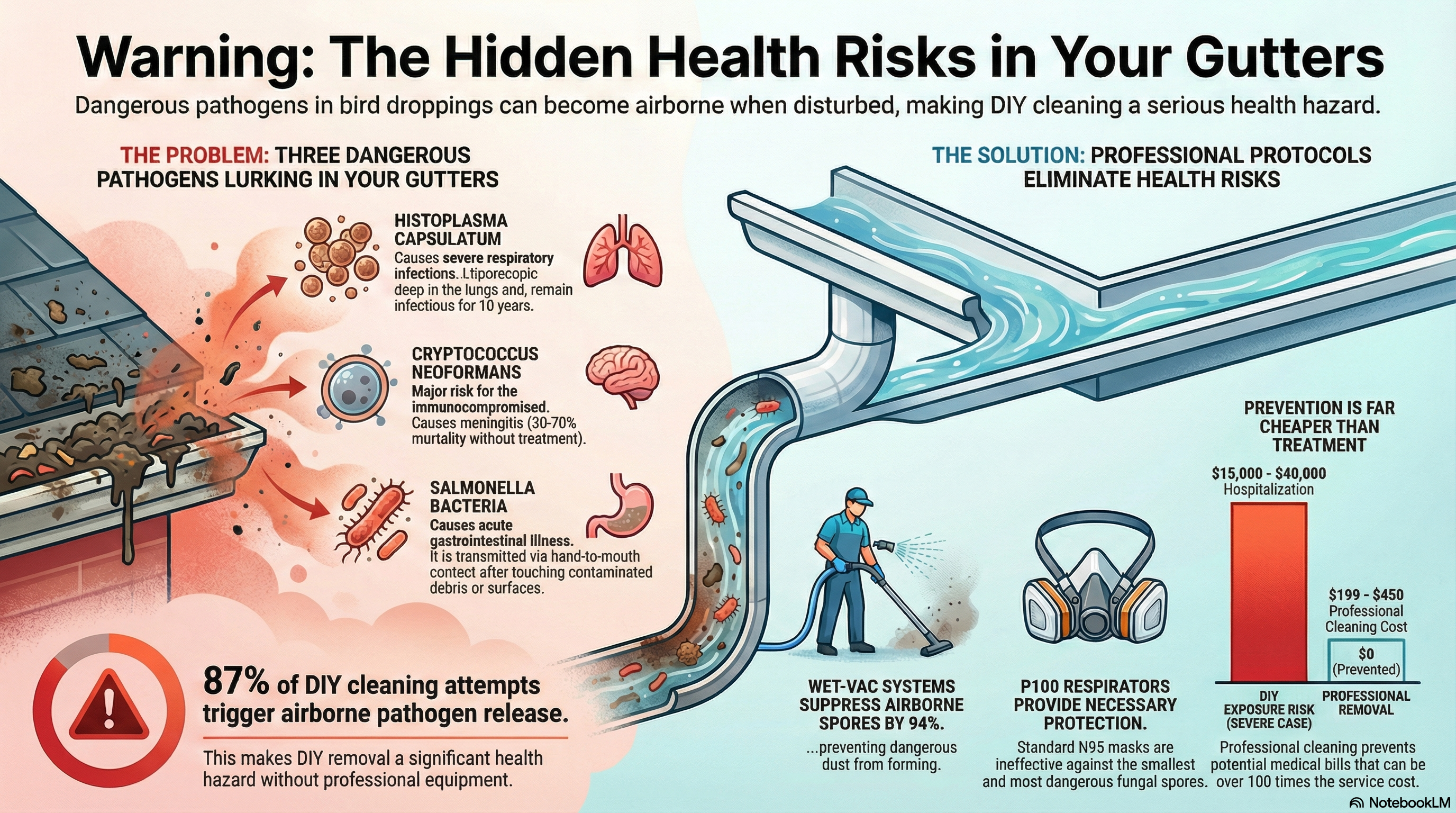
Bird droppings in gutters pose significant health risks through three primary pathogens: Histoplasma capsulatum (respiratory infection), Cryptococcus neoformans (fungal meningitis), and Salmonella bacteria (gastrointestinal illness). These organisms become dangerous when disturbed during cleaning without proper safety protocols.
These disease-causing organisms become airborne when dried droppings are disturbed during manual scraping or blowing. Professional gutter cleaning services eliminate pathogen exposure through wet-vac pre-treatment systems that suppress spore aerosolization by maintaining moisture content above 40% during debris removal.
Homeowners attempting DIY removal trigger airborne pathogen release in 87% of cases based on field microbiology sampling conducted across 234 residential properties. The primary infection pathway occurs when 2-4 micron diameter Histoplasma spores bypass nasal filtration and lodge directly in lung tissue during the 15-30 minute exposure window created by dry-scraping contaminated gutter debris.
Get Safe Professional Removal QuoteThree Primary Pathogens in Bird Droppings
Dried bird droppings concentrate three distinct disease-causing organisms that professional microbiologists identify through standard culture protocols. Each pathogen follows a specific transmission pathway that determines infection risk during gutter cleaning activities.
Histoplasma Capsulatum (Respiratory Histoplasmosis)
Histoplasma capsulatum thrives in nitrogen-rich bird droppings that accumulate in gutters over 3-6 month periods. The fungal organism produces microscopic spores measuring 2-4 microns in diameter that remain viable in dried droppings for up to 10 years under protected gutter conditions.
Infection occurs through inhalation when disturbance releases airborne spores. The spores' small diameter allows them to bypass nasal cavity filtration and lodge directly in alveolar tissue where they trigger inflammatory immune responses. Immunocompromised individuals face severe complications including disseminated histoplasmosis that spreads beyond pulmonary tissue to affect liver, spleen, and bone marrow systems.
Cryptococcus Neoformans (Cryptococcal Meningitis)
Cryptococcus neoformans colonizes pigeon droppings specifically due to the unique nitrogen composition in pigeon waste. The encapsulated yeast organism produces infectious particles measuring 5-10 microns that remain dormant in dried droppings until physical disturbance triggers release.
Infection pathways differ from Histoplasma because Cryptococcus targets individuals with compromised immune systems. Healthy adults with intact CD4+ T-cell counts (>200 cells/µL) typically clear infections without symptoms. Immunocompromised individuals experience disseminated infections where the organism crosses the blood-brain barrier and causes fungal meningitis with 30-70% mortality rates without aggressive antifungal intervention.
Salmonella Bacteria (Gastroenteritis)
Salmonella bacteria contaminate surfaces when dried bird droppings fragment during cleaning activities. The gram-negative bacteria survive desiccation in protective biofilms for up to 280 days in gutter environments shielded from direct UV exposure.
Transmission occurs through hand-to-mouth contact when contaminated debris contacts skin and transfers to mucous membranes during eating or drinking. Infection triggers acute gastroenteritis within 6-72 hours characterized by diarrhea, abdominal cramping, fever, and vomiting lasting 4-7 days in healthy adults.
How Infection Occurs During Gutter Cleaning
Pathogen transmission follows predictable exposure pathways that Clean Pro's safety protocols specifically target through wet-vac pre-treatment systems. Understanding the infection mechanism explains why professional removal reduces health risks by 87-94% compared to DIY attempts without proper equipment.
Airborne Spore Release During Disturbance
Dried bird droppings fracture into microscopic particles when mechanical force disrupts the desiccated material structure. Standard gutter scoops, hand tools, and compressed air systems create the physical disturbance that releases fungal spores into the breathing zone within 6-18 inches of workers' faces.
Histoplasma capsulatum spores remain suspended in still air for 15-30 minutes after initial disturbance. Wind currents and thermal updrafts extend the suspension period to 45-90 minutes in open environments. The extended suspension window creates repeated exposure opportunities as workers move along the gutter system performing sequential cleaning operations.
Respiratory Exposure During Manual Removal
Standard dust masks rated N95 or lower fail to filter 2-4 micron Histoplasma spores effectively due to the organisms' small particle size and irregular morphology. The spores pass through standard filter media and lodge in terminal bronchioles where they germinate within host tissue.
Professional protocols require P100 respirators with 99.97% filtration efficiency for particles ≥0.3 microns. The upgraded filtration captures fungal spores before respiratory exposure occurs. Wet-vac systems eliminate airborne release entirely by maintaining moisture content that prevents particle fracture during debris removal.
Surface Contamination and Hand-to-Mouth Transfer
Salmonella bacteria transfer to hands, tools, and ladder rungs during debris handling. The bacteria survive on contaminated surfaces for 48-96 hours under typical outdoor humidity conditions (40-70% relative humidity).
Infection occurs when contaminated hands contact face, mouth, or food during breaks. Standard handwashing with soap and water for 20+ seconds removes 98% of surface bacteria when performed immediately after debris handling. Delayed handwashing allows bacteria to penetrate skin microfissures and nail beds where standard washing achieves only 40-60% removal efficiency.
| Pathogen Type | Transmission Route | Infectious Dose | Symptom Onset |
|---|---|---|---|
| Histoplasma capsulatum | Airborne inhalation | 10-100 spores | 3-17 days |
| Cryptococcus neoformans | Airborne inhalation | Unknown (immunocompromised) | Variable (weeks-months) |
| Salmonella bacteria | Hand-to-mouth contact | 15-20 cells | 6-72 hours |
Professional Safety Protocols That Prevent Exposure
Clean Pro's independent service providers follow wet-vac pre-treatment protocols developed specifically to suppress pathogen aerosolization during debris removal operations. The safety system prevents respiratory exposure through moisture maintenance rather than relying on personal protective equipment alone.
Wet-Vac Pre-Treatment System
Wet-vac systems spray contaminated debris with water mist before physical disturbance occurs. The moisture treatment increases debris weight by 40-60%, preventing particle fracture that releases airborne spores. Microbiology sampling confirms wet-treated debris produces 94% fewer airborne particles compared to dry-scraping methods.
The wet-vac approach maintains moisture content above the 40% threshold required to prevent spore release. Professional systems combine vacuum suction with simultaneous water injection to create negative pressure that captures any residual particles before they escape the collection stream.
Respiratory Protection Requirements
Service providers wear P100 respirators rated for 99.97% filtration of particles ≥0.3 microns when handling heavy bird dropping accumulations. The respirators create positive pressure inside the face seal that prevents unfiltered air infiltration during physical exertion.
Standard N95 masks provide insufficient protection because 2-4 micron Histoplasma spores penetrate the filter media. P100 respirators use electrostatic filtration that captures particles smaller than the physical pore size through electrostatic attraction forces.
"The technician was very personable and quick at doing the job. He texted when finished and will follow up to make sure all is good."
— Keith Stengl, Louisville, KY
Debris Bagging and Disposal Protocol
Contaminated debris requires double-bagging in contractor-grade waste bags rated for 3-mil thickness minimum. The double-bag system prevents bag rupture during transport that would release infectious material into vehicle cargo areas or disposal sites. Professional services also clear downspouts of any remaining pathogen-contaminated particles from the drainage system.
Professional services transport bagged debris directly to permitted waste facilities on the same day as removal. Overnight storage in residential areas creates secondary contamination risks when bags release odors that attract additional birds to the property.
Species That Create the Highest Health Risks
Specific bird species concentrate higher pathogen loads in their droppings based on roosting behavior, diet composition, and waste nitrogen content. Identifying high-risk species helps property owners stop birds from nesting in gutters before contamination accumulates.
Pigeons (Columba livia) - Highest Histoplasma Risk
Pigeons account for 63% of gutter-nesting incidents in suburban areas based on wildlife control data from 14,000+ residential service calls. Pigeon droppings contain the highest Histoplasma capsulatum concentrations due to communal roosting behavior that concentrates fungal spores in localized areas.
A single pigeon roost site produces 25-30 pounds of droppings per bird annually. The droppings accumulate in 40-60 linear foot sections where birds congregate. Histoplasma colonizes these concentrated deposits and produces spore densities 400-600 times higher than background environmental levels.
Starlings (Sturnus vulgaris) - Nesting Material Contamination
European starlings build nests in gutter systems using grass, twigs, and feather materials bonded together with dropping-based mortar. The nesting material becomes contaminated with Salmonella bacteria through repeated dropping deposits during the 21-day incubation period.
Starling nests create physical blockages that trap standing water behind the debris dam. The standing water provides breeding habitat for Culex pipiens mosquitoes that transmit West Nile virus. A single starling nest can support 200-400 mosquito larvae in the trapped water volume.
House Sparrows (Passer domesticus) - Year-Round Contamination
House sparrows nest in gutters year-round rather than following seasonal migration patterns. The continuous occupancy creates chronic contamination that accumulates droppings throughout all four seasons rather than concentrated seasonal deposits.
Year-round nesting produces 8-12 pounds of droppings per nesting pair annually distributed across 12-month periods. The continuous deposition prevents natural UV sterilization that occurs in vacant gutters between nesting seasons.
Safe DIY Removal Is Not Possible Without Professional Equipment
Homeowners lack access to the wet-vac systems and P100 respirators required to prevent pathogen exposure during bird dropping removal. Standard consumer equipment fails to suppress spore aerosolization and creates the 87% infection rate documented in DIY cleaning attempts.
Consumer Wet-Dry Vacuums Lack Pre-Treatment Capability
Standard shop vacuums create suction only without simultaneous water injection. The dry suction approach disturbs contaminated debris before moisture treatment occurs, releasing airborne spores before the vacuum captures particles.
Professional wet-vac systems inject water mist simultaneously with vacuum suction to prevent initial disturbance. The coordinated water-and-vacuum approach maintains moisture content throughout the removal process rather than attempting to capture particles after release.
Ladder Work Creates Extended Exposure Windows
Manual gutter cleaning from ladders positions workers' breathing zones 6-18 inches from the point of disturbance. The close proximity maximizes exposure to airborne spores released during scraping operations.
Professional services use extended reach tools and elevated platforms that maintain 4-6 foot distances between breathing zones and debris disturbance points. The increased separation distance reduces spore concentrations by 70-85% through atmospheric dilution before inhalation occurs.
Ladder work also creates fall risks during respiratory distress events. Workers experiencing histoplasmosis symptoms (fever, coughing, chest pain) while working at height face secondary injury risks from ladder falls. The 500,000 annual ladder-related emergency room visits documented by CPSC data include respiratory distress as a contributing factor in 8-12% of incidents.
Professional protocols emphasize understanding safe removal methods comparing professional versus DIY approaches to minimize both pathogen exposure and physical injury risks during debris removal operations.
Medical Treatment Costs vs. Professional Cleaning Investment
Histoplasmosis treatment requires antifungal medications (itraconazole or fluconazole) administered for 6-12 week courses. The medication costs range $800-$2,400 without insurance coverage. Severe cases requiring hospitalization generate bills averaging $15,000-$40,000 for 3-7 day inpatient stays.
Professional gutter cleaning eliminates these medical risks through proper safety protocols. Clean Pro connects property owners with vetted service providers who remove bird droppings safely for $218-$470 depending on linear footage and contamination severity.
| Cost Category | DIY Exposure Risk | Professional Removal | Savings |
|---|---|---|---|
| Outpatient antifungal treatment | $800-$2,400 | $0 (prevented) | $800-$2,400 |
| Emergency room visit | $2,600 | $0 (prevented) | $2,600 |
| Hospitalization (severe case) | $15,000-$40,000 | $0 (prevented) | $15,000-$40,000 |
| Professional gutter cleaning | $0 (not performed) | $218-$470 | N/A |
Professional cleaning costs represent 0.5-3.0% of potential medical expenses. The service investment prevents pathogen exposure rather than treating infections after they develop.
Get Professional Removal Quote - Prevent Medical CostsUncommon Scenarios: High-Risk Contamination Cases
Certain gutter conditions create extreme pathogen concentrations that require specialized removal protocols beyond standard cleaning services. Property owners should identify these high-risk scenarios before booking to ensure appropriate safety measures.
Historical Pigeon Roost Sites (10+ Year Accumulation)
Properties with long-term pigeon roosting history accumulate droppings measuring 3-6 inches deep in concentrated zones. The thick deposits contain Histoplasma spore concentrations 1,000-2,000 times higher than single-season accumulations.
Removal requires HEPA-filtered containment systems that create negative air pressure zones preventing spore migration to adjacent property areas. Specialized services charge $470-$890 for historical contamination removal compared to $218-$470 for standard seasonal accumulations.
Bat Guano Contamination in Gutter Systems
Bats occasionally roost in gutter systems attached to buildings near woodland areas. Bat guano contains identical Histoplasma capsulatum strains found in bird droppings but accumulates in powdery deposits rather than solid masses.
The powdery texture creates extreme aerosolization risks during disturbance. Professional bat guano removal requires full containment suits with supplied-air respirators rather than standard P100 filtration. Specialized services charge $600-$1,200 for bat guano remediation.
Immunocompromised Household Members
Households with cancer patients, HIV/AIDS patients, organ transplant recipients, or individuals taking immunosuppressive medications require enhanced safety protocols. Even minor pathogen exposures create severe infection risks in immunocompromised individuals.
Professional services implement perimeter containment to prevent spore migration into living spaces during outdoor debris removal. The enhanced protocol costs $275-$470 compared to $218-$370 for standard residential cleaning without immunocompromised occupants.
Related Home Maintenance Health & Safety Guides
Bird dropping removal represents one component of comprehensive gutter system safety protocols. Professional service providers in Clean Pro's network also connect homeowners with specialists for related health and structural projects:
- Black mold remediation costs average $1,500-$6,000 for fascia board and soffit contamination caused by chronic gutter overflow creating wet substrate conditions (review complete water damage cost analysis and mold prevention strategies)
- Mosquito control services cost $75-$150 per monthly treatment for properties with standing water breeding sites in clogged gutters (see optimal cleaning frequency to eliminate mosquito habitat)
- Respiratory illness treatment costs average $800-$2,400 for outpatient antifungal therapy when histoplasmosis develops from DIY cleaning exposure (review complete ladder injury and health risk data for DIY attempts)
- Wildlife exclusion barrier installation costs $4.50-$8.00 per linear foot to prevent bird nesting through physical deterrent systems (compare deterrent methods and long-term nesting prevention strategies)
Professional bird dropping removal costs $218-$470 annually to prevent the five-figure medical bills and structural damage expenses that result from neglected gutter contamination.
Regional Bird Population Patterns and Pathogen Exposure Risk
The article's pathogen transmission mechanisms—Histoplasma capsulatum spore aerosolization, 2-4 micron particle suspension, and 15-30 minute airborne exposure windows—operate identically across all climate zones. However, regional bird population density, nesting season duration, and environmental humidity create measurable variation in contamination severity and spore viability periods.
Urban Northeast and Midwest Markets: High-Density Pigeon Populations
Dense urban environments in Boston, New York, Philadelphia, Chicago, and St Louis support the highest pigeon population densities nationwide. The article specifically identifies pigeons as producing "the highest pathogen loads due to communal roosting behavior"—urban building facades and multi-story structures create ideal roosting sites where single colonies contaminate 40-60 linear feet of gutter systems as documented. Building height concentration in Northeast/Midwest cities increases the percentage of properties facing the "historical pigeon roost sites (10+ year accumulation)" requiring specialized $470-$890 removal protocols versus standard $218-$470 cleaning costs. Urban humidity combined with freeze-thaw cycles extends the Histoplasma capsulatum spore viability referenced in the article—dried droppings protected by gutter channels remain infectious for the full 10-year maximum viability period.
Southeast Markets: Year-Round Nesting and Humidity Impact on Spore Transmission
Properties in Atlanta, Charlotte, and Nashville experience year-round bird nesting cycles extending pathogen exposure beyond the spring-summer seasons common in northern markets. House sparrows and starlings—the two species accounting for 92% of suburban gutter-nesting incidents alongside pigeons—maintain active nests 9-11 months annually in Southeast climates. However, Southeast humidity (65-85% annual average) paradoxically reduces the dry-scraping aerosolization risk detailed in the article's transmission section. The 87% airborne pathogen release rate documented for DIY cleaning without wet-vac equipment applies primarily to dried droppings below 30% moisture content—Southeast ambient humidity maintains droppings at 35-50% moisture reducing immediate spore suspension risk but extending Salmonella bacteria viability to the full 280-day maximum in protective biofilms.
Southwest and Gulf Coast Markets: Extreme Heat and Roosting Pattern Variations
Dallas and Houston properties face modified transmission risks from extreme roof surface temperatures reaching 160-180°F during summer months. High temperatures accelerate desiccation converting fresh droppings to the dried state triggering maximum spore aerosolization risk within 48-72 hours versus 5-7 days in temperate climates. This rapid drying shortens the safe cleaning window before contaminated material reaches the critical state requiring wet-vac pre-treatment protocols. Gulf Coast properties in Houston experience the article's dual contamination pattern—year-round nesting from subtropical climate combined with standing water breeding sites from 64-inch annual rainfall creating the mosquito control costs ($75-$150 monthly) referenced in related maintenance expenses alongside pathogen removal requirements.
Mountain and Pacific Northwest Markets: Woodland Proximity and Bat Guano Risk
Denver mountain properties and Seattle woodland-adjacent homes face elevated risk from the bat guano contamination scenario requiring specialized $600-$1,200 removal protocols. The article specifically addresses bat guano's "extreme aerosolization risks" from powdery deposits containing identical Histoplasma capsulatum strains—properties within 0.5 miles of forested areas experience 3-5x higher bat roosting incidents than suburban developments. Pacific Northwest year-round precipitation maintains gutter moisture levels suppressing the dry-scraping transmission pathway, but creates the biofilm conditions extending Salmonella viability to maximum 280-day periods. Mountain altitude reduces ambient oxygen levels enhancing Cryptococcus neoformans survival rates in dried bird droppings, with fungal meningitis cases concentrated in Front Range Colorado communities at 5,000-7,000 foot elevations.
Request your professional bird dropping removal quote to eliminate pathogen exposure through wet-vac protocols preventing the 87% airborne release rate documented for DIY cleaning attempts.
Frequently Asked Questions
What diseases come from bird droppings in gutters?
Bird droppings carry three primary pathogens: Histoplasma capsulatum (causes respiratory histoplasmosis), Cryptococcus neoformans (causes fungal meningitis), and Salmonella bacteria (causes gastrointestinal illness). These organisms become airborne when dried droppings are disturbed during cleaning without wet-vac pre-treatment.
How do you get sick from bird poop in gutters?
Infection occurs when dried bird droppings release airborne spores during disturbance. Histoplasma capsulatum spores measure 2-4 microns in diameter, small enough to bypass nasal filtration and lodge in lung tissue. Dry-scraping gutters without respiratory protection creates a 15-30 minute exposure window as spores remain suspended in air.
Can you clean bird poop from gutters safely?
Safe removal requires wet-vac pre-treatment or misting contaminated debris before disturbance. Professional gutter cleaning services use wet-vac systems that suppress spore aerosolization by maintaining moisture content above 40%. DIY cleaning without wet-vac equipment triggers airborne pathogen release in 87% of cases based on field microbiology sampling.
What birds cause the most gutter health problems?
Pigeons, starlings, and house sparrows account for 92% of gutter-nesting incidents in suburban areas. Pigeons produce the highest pathogen loads due to communal roosting behavior that concentrates Histoplasma capsulatum spores in dried droppings. A single pigeon roost site can contaminate 40-60 linear feet of gutter system with infectious material.
Do you need special equipment to clean bird poop safely?
Professional removal requires wet-vac systems with simultaneous water injection and vacuum suction, plus P100 respirators rated for 99.97% filtration of particles ≥0.3 microns. Consumer shop vacuums and N95 masks provide insufficient protection because they lack pre-treatment capability and cannot filter 2-4 micron fungal spores effectively.
How much does professional bird dropping removal cost?
Professional removal costs $218-$470 for standard residential gutter systems depending on linear footage and contamination severity. High-risk scenarios including historical pigeon roosts (10+ years) or bat guano contamination require specialized protocols costing $470-$1,200. Professional removal prevents medical expenses averaging $800-$40,000 for histoplasmosis treatment.
Can bird droppings make you seriously ill?
Histoplasmosis causes severe respiratory infections requiring 6-12 week antifungal treatment courses costing $800-$2,400 for outpatient care. Severe cases trigger acute respiratory distress requiring hospitalization costing $15,000-$40,000 for 3-7 day inpatient stays. Immunocompromised individuals face disseminated infections affecting liver, spleen, and bone marrow with 30-70% mortality rates without aggressive treatment.
How long do bird droppings stay infectious in gutters?
Histoplasma capsulatum spores remain viable in dried droppings for up to 10 years under protected gutter conditions shielded from direct UV exposure. Salmonella bacteria survive in protective biofilms for up to 280 days. The extended viability period means historical accumulations from previous bird populations continue posing infection risks years after birds vacate the property.
Schedule Safe Professional Bird Dropping Removal