Professional gutter cleaning services cost between $218 and $470 annually but eliminate liability exposure worth potentially $17,000-$41,000 in fracture treatment costs from ladder falls, while DIY methods require $150-$400 equipment investment plus assumption of all injury and property damage risks.
The Consumer Product Safety Commission reports 500,000 ladder-related emergency room visits annually, with 300 fatal falls. Professional services transfer this liability to contractors carrying $1 million general liability coverage, while DIY cleaning leaves homeowners personally liable for medical costs averaging $2,600 per emergency room visit or $17,000-$41,000 for fracture treatment. Equipment investment represents only one cost component—time investment, injury risk, and insurance exclusions create hidden expenses that exceed professional service fees by 340-780% when averaged across multi-year timeframes.
Homeowners choosing between professional services and DIY methods face tradeoffs across five critical dimensions: upfront cost, time investment, safety risk, result quality, and long-term liability exposure. Clean Pro connects homeowners with vetted service providers carrying verified insurance and commercial-grade equipment, eliminating the equipment purchase requirement and transferring all injury liability to the insured contractor.
Get Instant Quote with Satellite Measurement →Professional Service Costs vs DIY Equipment Investment
Professional gutter cleaning prices calculate based on linear footage and story height, ranging from $218 for single-story homes under 150 linear feet to $470 for two-story properties with 220+ feet of gutters. Homeowners weighing the decision can calculate their professional cleaning cost and compare it against equipment rental, time investment, and injury risk. Service fees include commercial-grade equipment, $1 million liability coverage, contractor-grade debris disposal, and before/after photo documentation. Regional variance reflects Bureau of Labor Statistics Code 37-3011 wage indexes, with Massachusetts services averaging 30% above national rates ($23.62/hour labor cost) while Texas markets run 4% below national averages ($17.13/hour).
DIY equipment investment requires initial capital outlay of $225-$438 for basic tools: Type IA ladder rated for 300-lb capacity ($150-$300), contractor-grade work gloves with grip coating ($15-$25), 5-gallon bucket with S-hook attachment ($12-$18), garden hose with adjustable spray nozzle ($40-$80), and gutter scoop with curved edge ($8-$15). Commercial-grade upgrades including wet/dry vacuum systems ($200-$400) and telescoping extension poles ($80-$150) push total investment to $500-$800. Equipment depreciation, storage requirements, and replacement cycles spread costs across 5-7 year lifespans.
| Cost Category | Professional Service | DIY Method | 5-Year Total |
|---|---|---|---|
| Initial Investment | $0 | $225-$438 | DIY: $225-$438 |
| Annual Service (2x/year) | $398-$900 | $0 | Pro: $1,990-$4,500 |
| Time Investment (hours) | 0 hours | 6-12 hours/year | DIY: 30-60 hours |
| Liability Coverage | $1M policy included | Homeowner assumes all risk | Pro: Contractor liability |
| Equipment Replacement | $0 | $75-$150 (ladder repair, tool replacement) | DIY: $375-$750 |
| 5-Year Total Cost | $1,990-$4,500 | $600-$1,188 (equipment only) | Excludes injury risk value |
Cost analysis excluding injury risk exposure shows DIY methods saving $1,390-$3,312 over five years. Professional service costs represent 1.4-3.2% of the average water damage insurance claim ($13,954), positioning annual maintenance as preventive investment rather than discretionary expense. Homeowners evaluating optimal cleaning frequency based on tree coverage and regional precipitation patterns should factor in cumulative time investment—30-60 hours across five-year periods—when comparing DIY labor to professional efficiency.
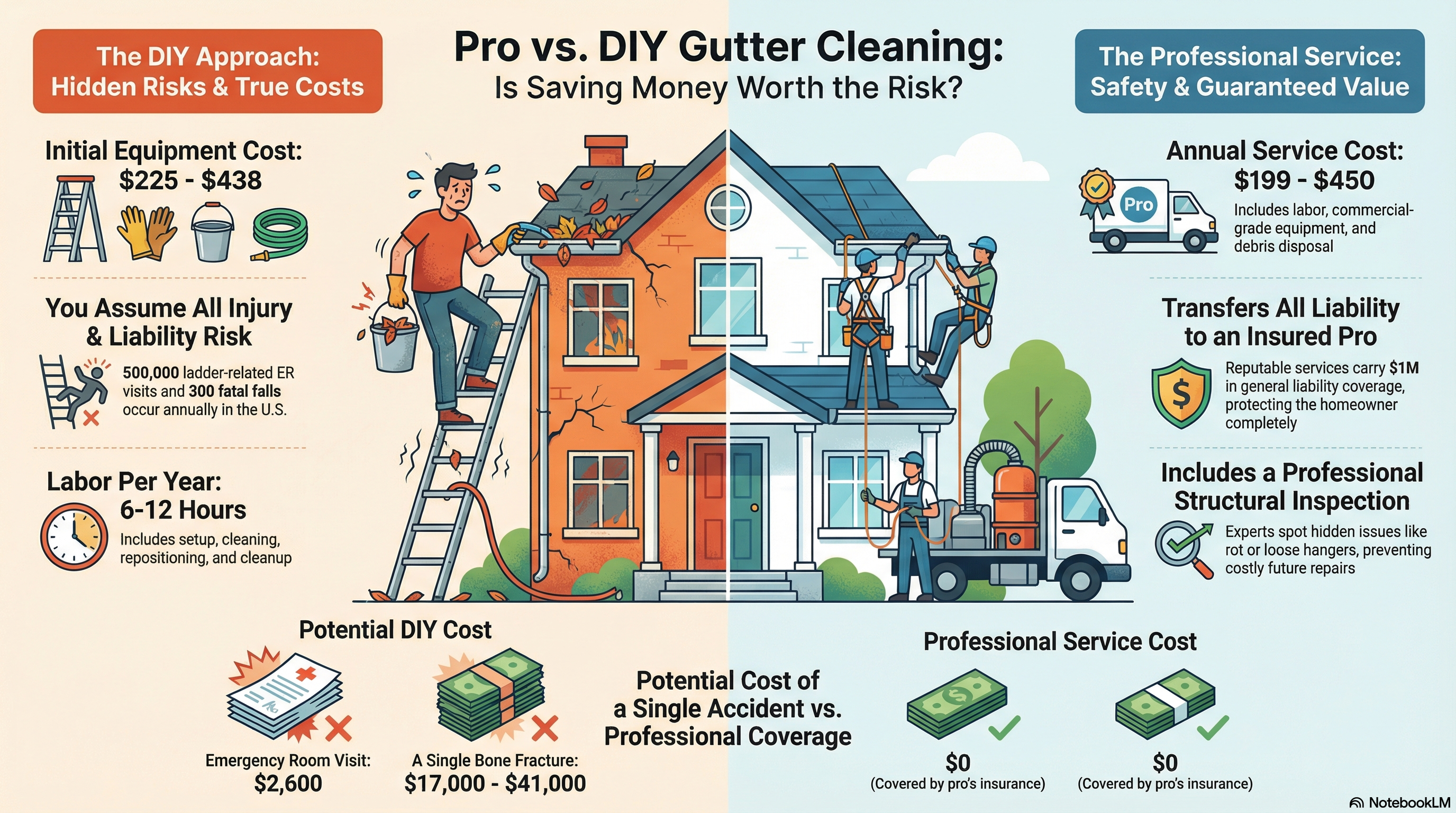
Ladder Fall Injury Statistics and Liability Exposure
Ladder-related injuries generate 500,000 emergency room visits annually according to Consumer Product Safety Commission National Electronic Injury Surveillance System data, with 300 fatal falls. Basic emergency room triage costs $2,600 for evaluation and diagnostic imaging, while fracture treatment requiring surgical intervention ranges from $17,000-$41,000 depending on injury complexity and rehabilitation duration. Homeowners' insurance policies frequently exclude coverage for "business pursuits" or "gross negligence" when hiring unlicensed labor, leaving policyholders personally liable for medical expenses and third-party property damage.
OSHA Standard 1926.1053 establishes portable ladder safety requirements including 4-to-1 angle ratio (base positioned 1 foot from wall for every 4 feet of vertical height) and rail extension 3 feet above landing surface. Standard 1926.501 mandates fall protection for work conducted above 6 feet. Residential homeowners face no OSHA enforcement, but standards define "negligence" in civil liability cases. Heiman v. Workers' Compensation Appeals Board (2007) established precedent holding homeowners liable for contractor injuries when directing work or providing equipment to unlicensed workers, creating employer-employee relationship triggering respondeat superior doctrine ("let the master answer").
"Scheduling was easy. I received an estimate quickly. The texh arrived prior to the appointment date (some may not like this, but it worked for me). The job was completed quickly and thoroughly. Payment was simple and complete online. Great transaction!"
— Timothy Sneed, Springfield, TN
Professional service providers carry $1 million general liability coverage transferring all injury and property damage liability to the insured contractor. Clean Pro vetting protocols verify insurance certificates, background checks, and safety training compliance before connecting homeowners with independent contractors. Licensed contractors operating under proper insurance eliminate homeowner exposure to medical cost liability, third-party property damage claims, and potential criminal negligence charges from unlicensed labor hiring.
DIY safety equipment including Type IA ladders rated for 300-lb capacity, stabilizer bars preventing gutter contact, and standoff brackets creating 12-inch clearance cost $180-$370. Fall arrest systems with full-body harnesses and roof anchor points add $200-$400. Even with proper equipment, ladder positioning errors, overreaching, and wet surface conditions contribute to 164,000 injuries annually among experienced users. Professional teams deploy two-person crews with dedicated spotter protocols, eliminating single-operator fall risks inherent to residential DIY cleaning.
Time Investment and Physical Accessibility Limitations
DIY gutter cleaning requires 3-6 hours for typical single-story homes covering 150-200 linear feet, including ladder setup, debris removal with hand scoops, contractor-grade bagging, downspout clearing, and final site cleanup. Two-story structures extending 20-28 feet above grade require 5-8 hours due to ladder repositioning frequency (every 6-8 feet for safe reach zones), safety harness attachment, and increased physical exertion moving equipment vertically. Three-story homes exceeding 30 feet typically fall outside safe DIY scope due to extension ladder instability and OSHA-defined high-work regulations.
Professional crews complete identical work in 1.5-2.5 hours using commercial wet/dry vacuum systems with 40-foot reach, eliminating 60-80% of ladder repositioning cycles. Two-person teams deploy simultaneous operations—one contractor handles debris extraction while the second manages ground-level bagging and equipment staging—cutting total service duration in half compared to single-operator DIY methods. Satellite-based measurement systems provide precise linear footage calculations within ±2% accuracy, generating fixed-price quotes in 15 minutes without in-person estimates requiring 3-7 day scheduling delays.
| Home Configuration | Linear Footage | DIY Time Required | Professional Time | Time Savings |
|---|---|---|---|---|
| Single-Story Ranch | 150-180 ft | 3-4 hours | 1.5-2 hours | 50-55% reduction |
| Single-Story with Dormers | 200-220 ft | 4-5 hours | 2-2.5 hours | 50-53% reduction |
| Two-Story Colonial | 180-220 ft | 5-7 hours | 2-3 hours | 57-67% reduction |
| Two-Story with Complex Roofline | 240-280 ft | 6-8 hours | 2.5-3.5 hours | 58-69% reduction |
| Three-Story Victorian | 260-320 ft | Unsafe for DIY | 3-4 hours | Professional-only scope |
Physical accessibility constraints eliminate DIY viability for specific architectural configurations. Steep-slope roofs exceeding 6:12 pitch require fall protection harnesses and roof anchor installations costing $400-$800. Valley intersections, dormers, and turrets create awkward ladder positioning angles increasing tip-over risks. Homes situated on hillside lots or uneven terrain prevent stable ladder placement, violating OSHA 4-to-1 angle ratio requirements. Professional contractors deploy stabilizer outriggers, adjustable leg levelers, and roof ridge ladders accessing complex geometries beyond residential DIY equipment capabilities.
Seasonal timing considerations affect service availability windows. Fall cleaning (September-November) addresses deciduous leaf drop before winter freeze-thaw cycles cause ice dam formation. Spring cleaning (March-May) removes accumulated winter debris and biological growth. DIY scheduling flexibility allows immediate action when early warning signs of gutter clogs become visible including water overflow and black streaking, while professional booking requires 1-3 day advance scheduling during peak demand periods. Homeowners balancing schedule control against time investment should calculate opportunity cost—6 hours of DIY labor at $25/hour median wage equivalent equals $150, reducing DIY savings margin by 25-67% depending on service pricing.
Result Quality: Debris Removal Completeness and Inspection Standards
Professional service standards require 100% debris removal from interior channels, downspout clearing to ground level, and visual inspection identifying structural issues including loose hangers, separated joints, and compromised fascia boards. Contractor-grade wet/dry vacuum systems extract compacted sludge and biological film accumulation that hand-scooping methods leave behind. Before/after photo documentation provides verification of work scope completion and establishes service date records for maintenance scheduling and warranty claims.
DIY cleaning effectiveness depends on tool selection and technique consistency. Hand scoops remove visible leaf matter and twigs but struggle with compacted pine needles, roof sediment, and decomposed organic sludge. Garden hose rinsing pushes surface debris toward downspouts without extracting stuck material from seams and corners. Inadequate debris removal creates false sense of completion—gutters appear clean at surface level while retaining 30-50% volume of compacted material continuing to restrict water flow and accelerate corrosion from standing moisture.
"Arrived way sooner than the 2 weeks they originally estimated. Did the job quick and efficiently."
— Allan Cole, Greenbelt, Maryland
Commercial equipment advantages include 6.5-HP wet/dry vacuum systems generating 150 CFM (cubic feet per minute) suction versus residential 2.5-HP units producing 60 CFM. Professional-grade pressure washers delivering 3,000-4,000 PSI remove biological film and oxidation staining, while consumer models rated for 1,800-2,400 PSI lack sufficient force for complete cleaning. Gutter brightening compounds containing oxalic acid or sodium hydroxide restore original metal finish, eliminating tiger striping (vertical black streaks from electrostatic debris adhesion) that DIY methods cannot address without specialized chemical application.
Downspout clearing represents critical quality differential between professional and DIY methods. Underground drain connections require powered augers or hydro-jetting equipment to clear blockages in buried PVC piping extending 10-40 feet from foundation perimeters. DIY plumbing snakes rated for 25-foot reach cannot access full drain depth, leaving partial clogs that resurface during heavy precipitation. Professional teams deploy 100-foot powered drain augers ($800-$1,500 equipment cost) and truck-mounted hydro-jetters generating 4,000 PSI pressure, guaranteeing complete underground drain clearance. To understand the complete clearing process when underground drains fail from debris compaction, review our technical guide on clearing downspouts including augering methods and verification protocols.
Structural Assessment During Professional Service
Licensed contractors inspect gutter systems during cleaning for seven critical failure points: hanger spacing compliance (maximum 24-inch centers), proper slope maintenance (minimum 1/4-inch drop per 10 linear feet), joint seal integrity, end cap security, fascia board rot indicators, shingle edge alignment, and downspout attachment stability. Deficiency identification during routine service prevents emergency repairs costing $6-$20 per linear foot for fascia replacement or $900-$6,800 for complete eaves reconstruction.
DIY visual inspection capabilities remain limited by vantage point constraints and technical knowledge gaps. Homeowners standing on ladders focus on debris removal rather than systematic structural evaluation. Loose spike-and-ferrule hangers causing gutter sagging, separated miter joints allowing water escape, and fascia board moisture damage remain undetected until catastrophic failure occurs. Professional contractors document deficiencies with photo evidence and provide repair scope estimates, enabling proactive maintenance before minor issues escalate to major structural damage requiring contractor intervention.
Equipment and Supply Requirements for Safe DIY Cleaning
Minimum viable DIY equipment configuration requires five essential components plus safety gear totaling $225-$438 initial investment. Type IA ladder certification ensures 300-lb load capacity (user weight plus tools) with aluminum construction providing 22-28 foot reach for two-story applications. Fiberglass ladders offer superior electrical insulation near power lines but increase weight by 40-60% and cost $280-$470 for equivalent length. Ladder stabilizer bars preventing gutter contact damage add $35-$65, while standoff brackets creating 12-inch wall clearance for window access cost $40-$75.
Hand tool requirements include contractor-grade work gloves with textured rubber palms providing wet-surface grip ($15-$25), 5-gallon bucket with S-hook attachment enabling single-hand debris transfer ($12-$18), plastic gutter scoop with curved leading edge matching gutter profile ($8-$15), and garden hose with adjustable spray nozzle for rinsing operations ($40-$80). Protective equipment including safety glasses with side shields ($8-$15) and dust masks rated N95 for particulate filtration ($12-$20 per 20-pack) protect against airborne debris and biological hazards.
| Equipment Category | Basic DIY Setup | Professional-Grade Setup | Professional Service Equivalent |
|---|---|---|---|
| Ladder System | $150-$300 (24-28 ft aluminum) | $800-$1,500 (40-ft extension + stabilizers) | Included in service fee |
| Vacuum System | $200-$400 (6-gallon wet/dry, 2.5 HP) | $600-$1,200 (16-gallon, 6.5 HP commercial) | Commercial-grade included |
| Pressure Washer | $150-$370 (1,800-2,400 PSI electric) | $400-$900 (3,000-4,000 PSI gas) | Truck-mounted systems |
| Safety Equipment | $50-$120 (gloves, glasses, masks) | $300-$600 (harness, anchor, first aid) | Contractor provides all PPE |
| Specialty Tools | $75-$150 (scoop, bucket, hose attachments) | $400-$800 (augers, chemical applicators) | Professional tool inventory |
| Total Investment | $625-$1,320 | $2,500-$5,000 | $0 equipment cost |
Advanced DIY equipment upgrades include telescoping extension poles ($80-$150) enabling ground-based cleaning for single-story applications, eliminating ladder use entirely. Wet/dry vacuum attachments with flexible hose extensions ($40-$100) provide suction-based debris removal from ground level, though effectiveness decreases beyond 12-15 foot vertical reach. Gutter cleaning robots ($200-$400) traverse gutter channels autonomously but struggle with compacted debris and cannot access downspouts or valley intersections, limiting utility to maintenance cleaning rather than primary debris removal.
Storage and maintenance requirements add hidden costs to DIY equipment investment. Extension ladders require 8-12 feet of horizontal wall space or ceiling-mounted pulley systems ($50-$100). Wet/dry vacuum systems need climate-controlled storage preventing motor damage from temperature cycling. Annual equipment maintenance including ladder joint lubrication, vacuum filter replacement ($20-$40), and hose coupling inspection adds $60-$100 recurring expense. Professional services eliminate storage requirements, equipment depreciation, and maintenance overhead entirely—homeowners pay only for actual service delivery without capital investment or asset management responsibilities.
Specialized Scenarios: When DIY Methods Fail and Professional Service Becomes Mandatory
Architectural complexity eliminates DIY viability across multiple residential configurations beyond standard ranch and colonial designs. Historic properties featuring integrated box gutters built into roof eaves require specialized cleaning protocols preserving 80-120 year old wood substrate and copper lining. Built-in gutters hidden behind decorative fascia demand professional extraction methods preventing structural damage to period-correct millwork. Professional services specializing in historic preservation charge $370-$890 per cleaning session for properties listed on National Register requiring documentation of cleaning methods and materials used.
Luxury material gutters including copper, zinc, and custom architectural metals need specialized oxidation-prevention solutions and material-specific handling techniques. Copper gutter cleaning costs $275-$625 due to required chemical treatments preventing patina disruption and protective coating application maintaining aesthetic finish. DIY cleaning with standard garden hoses and alkaline-based cleaners permanently damages copper oxidation layers, reducing system lifespan by 40-60% and eliminating desirable verde patina development. Zinc gutters require pH-neutral cleaning solutions and soft-bristle brush techniques preventing protective carbonate layer removal—standard DIY methods using pressure washers or acidic cleaners void manufacturer warranties entirely.
Multi-level commercial facades, steep-terrain installations, and restricted-access locations demand professional-only service. Three-story buildings exceeding 30 feet require OSHA-compliant fall protection systems including anchor points, full-body harnesses, and rescue plans filed with local authorities. Hillside properties with 15-30% grade slopes prevent stable ladder placement, requiring scaffolding systems ($800-$2,000 rental) or boom lift access ($400-$900 daily rate). Urban townhomes with zero side-yard clearance eliminate ladder positioning options, forcing professional crews to deploy rope access techniques or rooftop anchor systems beyond residential DIY capabilities.
Biological Hazard Scenarios Requiring Professional PPE and Disposal
Bird nesting materials and bat guano accumulation create health hazards requiring professional remediation protocols. Histoplasmosis (Histoplasma capsulatum) thrives in bird and bat droppings, releasing airborne spores when dry material becomes disturbed during cleaning. Professional teams deploy N100-rated respirators with 99.97% particulate filtration, disposable Tyvek suits, and wet-vacuum extraction methods preventing spore dispersal. DIY cleaning using standard N95 masks and cotton work gloves provides inadequate protection—histoplasmosis infection requires 6-12 weeks of antifungal medication costing $800-$2,400 without insurance coverage.
Wasp and hornet nest removal from gutter interiors demands protective equipment and pesticide application licenses in 14 states. Professional pest control integration during gutter cleaning includes nest extraction, entrance point sealing, and residual pesticide application preventing re-infestation. DIY nest removal attempts result in 15,000 emergency room visits annually for allergic reactions and multiple-sting trauma. Homeowners with known insect allergies should never attempt DIY cleaning during nesting season (April-October)—professional services coordinate pest removal with licensed exterminators, adding $75-$200 to standard cleaning fees but eliminating life-threatening allergic reaction risks.
Insurance Coverage Gaps and Liability Transfer Benefits
Standard homeowners insurance policies exclude coverage for injuries sustained during "business pursuits" or activities classified as "gross negligence" including hiring unlicensed contractors or directing work without proper safety equipment. Policy exclusions leave homeowners personally liable for medical expenses, lost wages, and pain-and-suffering damages when DIY cleaning results in injury requiring hospitalization. Third-party liability extends to property damage—ladder falls damaging neighbor's vehicles, structures, or landscaping trigger additional liability claims averaging $8,000-$25,000 in civil court settlements.
Professional service providers carry three critical insurance coverages protecting homeowners from liability exposure: general liability ($1 million minimum coverage for bodily injury and property damage), workers compensation (contractor employee medical coverage and lost wage replacement), and commercial auto (vehicle accident coverage during transit to/from job sites). Insurance certificate verification during booking confirms active policy status and adequate coverage limits. Clean Pro vetting protocols require proof of insurance renewal every 6 months, background checks every 12 months, and safety training certification annually, ensuring contractors maintain compliance throughout service relationship.
"Neat, thorough, quick. Good cleanup afterwards. Polite, personable workman. Very satisfied."
— Thomas Powell
Liability transfer eliminates homeowner exposure to five specific risk categories: ladder fall injuries to the service provider, injuries to bystanders from falling debris or tools, property damage to adjacent structures during cleaning operations, chemical exposure from cleaning solutions applied during service, and equipment failure causing bodily injury or property damage. Professional service agreements include hold-harmless clauses and additional insured endorsements naming homeowners as covered parties under contractor policies, creating contractual liability shield beyond standard insurance coverage.
DIY liability exposure extends beyond immediate injury costs to long-term disability claims and chronic injury treatment. Vertebral compression fractures from 10-15 foot ladder falls require 6-18 months of physical therapy costing $5,000-$15,000, plus permanent mobility limitations affecting employment capacity. Traumatic brain injuries from falls onto concrete surfaces generate lifetime medical expenses averaging $85,000-$3 million depending on severity. Homeowners assuming DIY liability should verify disability insurance coverage adequacy and confirm short-term/long-term disability benefits remain active during high-risk home maintenance activities.
Transfer All Liability with Professional Service →Related Home Maintenance Cost Guides
Professional gutter cleaning services represent one component of comprehensive exterior home maintenance. Service providers in Clean Pro's network also connect homeowners with specialists for related drainage and roofing projects:
- Roof repair costs average $400-$1,500 for shingle replacement caused by ice dam damage from clogged gutters (see ice dam prevention strategies and gutter maintenance connection)
- Fascia board replacement costs $6-$20 per linear foot when water damage penetrates wood substrate from overflowing gutters. Total eaves repair projects range $900-$6,800 (review full water damage cost analysis and prevention methods)
- Foundation waterproofing costs $3,000-$10,000 for interior drainage systems required when gutter clogging directs water into basement perimeters. Foundation piering to correct settling from water damage costs $1,500-$3,000 per pier with 5-10 piers required average
- Professional gutter guard installation costs $18-$40 per linear foot depending on system complexity. Clean Pro Guard provides firm quotes at $22.50/ft with no in-home sales consultation required, while national guard companies typically mandate in-home presentations before pricing disclosure (compare one-time guard installation investment vs recurring professional cleaning costs)
Preventive gutter maintenance costs $218-$470 annually to avoid five-figure repair bills resulting from neglected drainage systems. Professional service eliminates DIY injury risks while providing guaranteed debris removal, structural inspection, and liability coverage transferring all risk to insured contractors.
Regional Professional Gutter Cleaning Service Coverage
Clean Pro's nationwide network connects homeowners with vetted, insured service providers carrying minimum $1 million general liability coverage. Instant satellite-based quoting eliminates 3-7 day estimate delays while insurance verification protocols confirm active policy status before booking approval.
National Service Coverage with Fixed-Rate Transparency
Professional gutter cleaning services operate in Atlanta, Boston, Charlotte, Chicago, Dallas, Denver, Houston, Nashville, New York, Philadelphia, Seattle, and St Louis, providing commercial-grade equipment, trained two-person crews, and guaranteed debris removal completing service in 1.5-3.5 hours compared to 3-8 hours for DIY methods while transferring all injury liability to insured contractors.
Request your 15-minute quote for professional gutter cleaning with verified insurance coverage and liability protection.
Frequently Asked Questions: Professional vs DIY Gutter Cleaning
Is professional gutter cleaning worth the cost compared to DIY?
Professional gutter cleaning costs $218-$470 annually but eliminates liability exposure worth potentially $17,000-$41,000 in fracture treatment costs from ladder falls. Services include $1 million general liability coverage, specialized equipment, and guaranteed debris removal. DIY methods require $150-$400 equipment investment plus assumption of all injury and property damage liability. Cost advantage depends on injury risk tolerance and time value—professional service provides 50-69% time savings (1.5-3.5 hours vs 3-8 hours DIY) while transferring all liability to insured contractors.
What equipment do I need for DIY gutter cleaning?
DIY gutter cleaning requires Type IA ladder rated for 300-lb capacity ($150-$300), contractor-grade work gloves with grip coating ($15-$25), 5-gallon bucket with S-hook attachment ($12-$18), garden hose with adjustable spray nozzle ($40-$80), and gutter scoop with curved edge ($8-$15). Total basic equipment investment: $225-$438. Professional-grade upgrades including wet/dry vacuum systems ($200-$400), telescoping extension poles ($80-$150), and pressure washers ($150-$370) push total to $625-$1,320. Professional services provide all commercial-grade equipment including 40-ft extension ladders, 6.5-HP vacuums, and safety harnesses without homeowner equipment investment.
How long does DIY gutter cleaning take vs professional service?
DIY gutter cleaning requires 3-6 hours for typical single-story homes (150-200 linear feet), including setup, debris removal, and cleanup. Two-story homes require 5-8 hours due to ladder repositioning and safety precautions. Three-story structures exceed safe DIY scope. Professional teams complete identical work in 1.5-2.5 hours for single-story and 2-3.5 hours for two-story homes using commercial equipment and two-person crews. Time savings range 50-69% depending on home configuration. Opportunity cost calculation: 6 hours DIY labor at $25/hour median wage equivalent ($150) reduces DIY savings by 25-67% when compared to professional service pricing.
What are the injury risks of DIY gutter cleaning?
Ladder-related injuries send 500,000 people to emergency rooms annually (Consumer Product Safety Commission data), with 300 fatal falls. Basic emergency room visits cost $2,600 for triage and diagnostic imaging. Fracture treatment requiring surgery ranges $17,000-$41,000 depending on injury complexity. Vertebral compression fractures require 6-18 months physical therapy ($5,000-$15,000) plus permanent mobility limitations. Traumatic brain injuries generate lifetime medical expenses averaging $85,000-$3 million. Homeowners' insurance policies often exclude coverage for "business pursuits" or "gross negligence," leaving DIY practitioners personally liable. Professional services carry $1 million general liability coverage transferring all injury and property damage liability to insured contractors.
Can I clean gutters without a ladder?
Ground-based gutter cleaning tools include telescoping wands ($50-$150) with spray nozzle attachments, wet/dry vacuum extensions with flexible hoses ($40-$100), and pressure washer wands ($60-$120). Effectiveness decreases beyond 12-15 foot vertical reach. Ground-based methods cannot access clogged downspouts, inspect gutter hangers for looseness, remove compacted debris wedged in corners, or verify complete cleaning through visual inspection. Professional services use commercial wet/dry vacuum systems with 40-ft reach combined with physical ladder access, ensuring 100% debris removal and structural inspection identifying loose hangers, separated joints, and fascia damage requiring repair before catastrophic failure.
When does DIY gutter cleaning become unsafe or impractical?
DIY methods become unsafe for homes exceeding two stories (20-28 feet above grade), roofs with slopes steeper than 6:12 pitch requiring fall protection harnesses, properties on hillside lots preventing stable ladder placement, and structures with complex rooflines including multiple valleys, dormers, or turrets. Biological hazards including wasp nests, bird droppings, or bat guano require professional PPE and disposal protocols—histoplasmosis exposure from disturbed bat guano causes respiratory infections requiring 6-12 weeks antifungal treatment ($800-$2,400). Luxury materials (copper, zinc, architectural metals) demand specialized cleaning solutions preventing oxidation damage and warranty voids. Professional services handle all specialty scenarios including historic preservation requirements, restricted-access locations, and hazardous material remediation with proper licensing and insurance coverage.
How do I verify a professional gutter cleaning service carries proper insurance?
Request certificate of insurance (COI) showing general liability coverage minimum $1 million per occurrence, workers compensation coverage for all employees, and commercial auto coverage for vehicles. Verify certificate lists effective dates, policy numbers, and insurance carrier contact information. Call insurance company directly using phone number from independent search (not number listed on certificate) to confirm active policy status and coverage amounts. Request additional insured endorsement naming you as covered party under contractor's policy. Clean Pro vetting protocols verify insurance every 6 months, background checks annually, and safety training certification before connecting homeowners with service providers. Unlicensed contractors without insurance expose homeowners to personal liability under respondeat superior doctrine—if directing work or providing equipment creates employer-employee relationship, homeowner assumes all injury liability and workers compensation obligations.
Professional gutter cleaning services eliminate equipment investment requirements, transfer injury liability to insured contractors, and deliver guaranteed results in 50-69% less time than DIY methods. Homeowners balancing cost savings against safety risks should calculate true DIY expense including opportunity cost ($25/hour labor equivalent), injury risk value (emergency room visit $2,600, fracture treatment $17,000-$41,000), and insurance coverage gaps often excluding "business pursuits" from liability protection. Five-year cost analysis shows DIY equipment investment totaling $600-$1,188 versus professional service spending $1,990-$4,500, creating $1,390-$3,312 savings that evaporate entirely with single ladder fall requiring emergency medical intervention.
Get Instant Satellite-Based Quote in 15 Minutes →