Gutter guards void roof warranties when installers lift shingles to insert mounting hardware that punctures synthetic underlayment. Fascia-mount installation preserves manufacturer coverage by securing guards to vertical fascia boards without disturbing roofing materials.
Roofing manufacturers including CertainTeed, GAF, and Owens Corning void 20-30 year warranties after non-certified installers disturb shingle placement or puncture waterproofing membranes during guard installation attempts. Professional installers using fascia-mount methods eliminate warranty risks while maintaining optimal water capture efficiency specified in IRC Code P2912.5.1. Clean Pro connects homeowners with vetted service providers who install guards using warranty-compliant techniques that protect roofing investments averaging $15,000-$25,000 for residential homes.
Under-shingle DIY installations force homeowners to lift roofing tabs, breaking factory-applied sealant bonds and creating entry points for wind-driven rain. Mounting clips inserted beneath shingles puncture synthetic underlayment at multiple attachment points per guard section. These punctures create permanent water infiltration pathways that terminate all manufacturer coverage—including protection for unrelated material defects discovered years after installation.
Get Warranty-Compliant Installation Quote (Satellite Pricing in 15 Minutes) →Manufacturer Warranty Terms: What Voids Coverage
Roofing manufacturer warranty documents specify coverage terminates after unauthorized modifications to shingle systems by non-certified installers. CertainTeed's warranty language excludes "damage caused by alterations, additions, or modifications not performed by certified contractors." GAF's Lifetime Limited Warranty states coverage ends "when unauthorized personnel disturb roofing system integrity through accessory installation." Owens Corning's TruDefinition Duration Series warranty explicitly voids protection after "third-party penetrations of waterproofing membranes."
⚠️ Critical Warranty Exclusions
Manufacturer warranties exclude coverage for damage resulting from:
- Synthetic underlayment punctures create permanent water entry pathways voiding all coverage
- Broken shingle tab sealant bonds enable wind uplift damage during storms
- Non-certified installer work terminates protection for unrelated material defects
- Improper accessory attachment methods void warranties regardless of installation quality
Warranty restoration becomes impossible after non-certified installers damage roofing systems. Manufacturers require certified contractor work throughout coverage periods—homeowners attempting DIY under-shingle installations forfeit all remaining warranty protection. Professional installers carry certification credentials from roofing manufacturers, enabling them to perform warranty-compliant guard installations that preserve coverage.
| Installation Method | Warranty Status | Manufacturer Position | Coverage Duration Risk |
|---|---|---|---|
| Fascia Mount (Professional) | ✓ Preserved | Zero shingle disturbance—compliant | Full 20-30 year protection maintained |
| Under-Shingle (DIY) | ✗ Voided | Membrane punctures—non-compliant | Immediate termination of all coverage |
| Reverse Curve (Helmet Style) | ✗ High Risk | Requires shingle lifting—violates terms | Warranty void from installation date |
The Mechanism: How Guards Create Warranty Violations
Clean Pro's installation methodology identifies specific mechanisms that trigger warranty voids during improper guard installation. Understanding these failure modes helps homeowners select warranty-compliant installation methods that protect roofing investments.
Synthetic Underlayment Puncture Pathways
Modern roofing systems rely on synthetic underlayment membranes as primary waterproofing barriers beneath shingles. These membranes protect roof decking from water infiltration during shingle tab failures or wind-driven rain events. Under-shingle guard installation requires mounting clips inserted beneath roofing tabs—each clip penetrates underlayment to secure guard sections to roof structure.
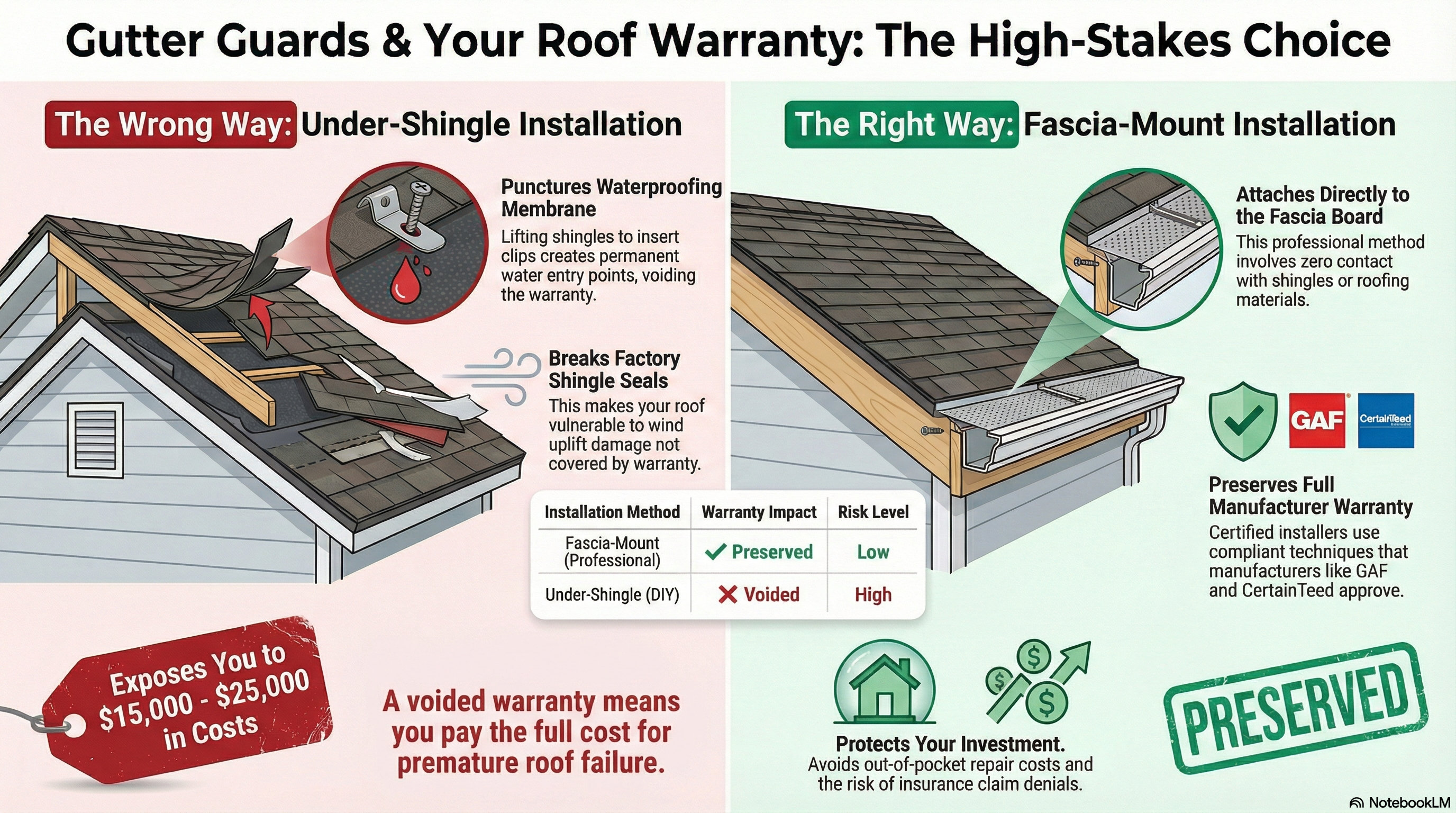
Standard 4-foot guard sections require 8-12 mounting clip insertions for proper attachment security. Each insertion punctures synthetic underlayment at distinct locations along guard length. These puncture points create water infiltration pathways during freeze-thaw cycles—moisture penetrates through holes, saturates roof decking, and causes rot damage that manufacturers exclude from warranty coverage.
"im gonna keep it simple... dude was the absolute best!!!"
— LARRY PRUITT
Shingle Tab Sealant Bond Destruction
Asphalt shingle manufacturers apply factory sealant strips to shingle tabs during production. These sealant strips activate through solar heating, bonding overlapping shingle layers together to resist wind uplift forces during storms. Lifting shingles to insert guard mounting hardware breaks these factory-applied sealant bonds permanently—solar heating cannot re-activate destroyed adhesive strips.
Broken sealant bonds create wind uplift vulnerabilities during storm events. Wind forces penetrate beneath unbonded shingle tabs, lifting roofing materials away from roof decking. This wind damage falls outside manufacturer warranty coverage because non-certified installers destroyed factory sealant integrity during guard installation. Homeowners face out-of-pocket costs averaging $4,500-$8,500 for wind damage repairs to roofing systems with voided warranties.
Fascia-Mount Installation: Preserving Warranty Protection
Professional guard installation relies on fascia-mount attachment methods that secure guards to vertical fascia boards using stainless steel screws through pre-positioned pilot holes. Clean Pro's network providers install guards using these warranty-compliant techniques that eliminate all roofing material contact.
Attachment Hardware Specifications
Fascia-mount systems use #8 x 3/4-inch stainless steel screws placed through pre-drilled pilot holes spaced 12 inches apart along guard sections. Screw placement occurs 1 inch below gutter lip to ensure guards slope slightly downward toward front edge. This 2-3 degree angle prevents debris accumulation on mesh surface while maintaining water dam functionality that captures sheet flow from roof surfaces.
Stainless steel hardware resists galvanic corrosion when installed on aluminum fascia boards—dissimilar metal contact creates minimal voltage potential difference below 0.25-volt threshold for electrochemical reactions. For homeowners evaluating material compatibility risks, understanding galvanic corrosion protection strategies for copper and aluminum combinations provides essential corrosion science knowledge.
| Attachment Method | Hardware Type | Roofing Contact | Warranty Impact |
|---|---|---|---|
| Fascia Mount | #8 stainless steel screws (3/4-inch) | Zero contact | Coverage preserved |
| Under-Shingle Clips | Aluminum mounting brackets | 8-12 punctures per section | Coverage voided |
| Through-Roof Screws | Self-tapping metal screws | Direct membrane penetration | Immediate void |
Installation Process Without Shingle Disturbance
Professional crews begin fascia-mount installations by verifying existing gutter pitch meets IRC P2912.5.1 requirements for 1/8-inch-per-foot minimum slope. Guards require proper pitch alignment to function at rated 98% water flow efficiency—level installations reduce flow velocity to zero, causing standing water accumulation that defeats guard purpose.
Installers position guard sections along gutter lip, aligning pre-drilled pilot holes with fascia board surface. Cordless drills with adjustable clutch settings limit torque to 8-12 inch-pounds, preventing fascia board splitting during screw insertion. Each 4-foot section requires 4 attachment screws placed through pilot holes—zero additional holes penetrate roofing materials or underlying waterproofing membranes.
Schedule Fascia-Mount Installation (No Warranty Risk) →Financial Impact: Warranty Void Consequences
Voided roofing warranties expose homeowners to unreimbursed replacement costs averaging $15,000-$25,000 for residential homes experiencing premature material failures. Manufacturers deny warranty claims after detecting evidence of non-certified installer work—including underlayment punctures or broken shingle tab sealant bonds from improper guard installations.
Replacement Cost Analysis
Standard architectural shingle roofing systems cost $8.50-$12.00 per square foot for complete tear-off and replacement using certified contractors. Average residential homes with 2,000-2,500 square feet of roof area face total replacement costs between $17,000-$30,000. Manufacturer warranties reduce homeowner liability to labor-only costs ($3,500-$5,500) for material defect replacements—voided warranties eliminate this protection entirely.
Wind damage repairs average $4,500-$8,500 for homes experiencing shingle tab failures during storm events. Homeowners with intact warranties file claims covering material and labor costs for wind damage repairs. Voided warranty holders pay full repair costs out-of-pocket because manufacturers exclude coverage for damage resulting from broken sealant bonds created during guard installation.
Insurance Claim Denial Risks
Homeowner's insurance policies contain exclusions for "faulty workmanship" and "intentional damage" to dwelling structures. Insurance adjusters investigating wind damage claims examine roofing systems for evidence of improper modifications—including guard mounting hardware penetrating waterproofing membranes. Adjusters deny claims when non-certified installer work contributed to damage, classifying losses as maintenance-related rather than covered storm events.
Average water damage insurance claims pay $13,954 for interior damage from roof leaks according to Insurance Services Office data. Denied claims force homeowners to absorb repair costs for damaged ceilings, walls, insulation, and personal property. Professional guard installation using warranty-compliant fascia-mount methods eliminates these denial risks by preserving roofing system integrity.
Specialized Installation Scenarios: Warranty Considerations
Architectural complexity introduces installation challenges requiring specialized approaches that maintain warranty compliance while addressing unique roofing configurations beyond standard gable roof applications.
Historic Homes with Built-In Box Gutters
Built-in gutter systems integrated into roof framing lack external fascia boards for guard mounting, requiring under-shingle installation as the only available attachment method. Historic preservation codes in designated districts prohibit visible fasteners on period-correct architecture—installers must conceal mounting hardware beneath roofing materials.
Specialty roof sealants rated for 50-year service life seal each underlayment penetration during built-in gutter guard installations. Professional crews apply butyl rubber sealant around mounting hardware insertion points, creating waterproof barriers that prevent infiltration through puncture pathways. These installations cost $370-$890 beyond standard pricing due to specialized sealing requirements and extended labor time for historic preservation compliance.
Homeowners accept warranty void risks for built-in gutter applications because no alternative attachment methods exist. Manufacturers acknowledge these architectural limitations but maintain warranty void positions—underlayment punctures from any installation method terminate coverage regardless of sealing quality or contractor certification status.
Steep-Pitch Roofs Exceeding 8:12 Slope
Roofing systems with pitch ratios exceeding 8:12 (8 inches vertical rise per 12 inches horizontal run) present guard installation challenges due to extreme slope angles. Fascia boards on steep-pitch roofs sit at severe angles relative to gutter lips—standard fascia-mount hardware cannot maintain proper guard pitch alignment when secured to angled fascia surfaces.
Professional installers fabricate custom mounting brackets for steep-pitch applications, creating adapter plates that bridge angle differences between angled fascia boards and level gutter systems. These custom brackets maintain guard pitch within 2-3 degree optimal range while securing to fascia surfaces without roofing material contact. Custom bracket fabrication adds $4.50-$8.00 per linear foot to standard installation pricing for steep-pitch applications.
Metal Roofing Systems with Standing Seams
Standing seam metal roofing eliminates traditional shingle tab structures, creating attachment challenges for guard systems designed around asphalt shingle applications. Metal roofing manufacturers void warranties after installers penetrate panel surfaces or disturb factory-applied sealant beads along standing seam connections.
Fascia-mount installation becomes the only warranty-compliant method for metal roofing applications. Guards attach exclusively to fascia boards without contacting metal panels or standing seam connections. Homeowners evaluating guard options for metal roofing should review detailed guidance on gutter guard installation strategies for metal roofs addressing sliding snow and ice dam concerns specific to standing seam systems.
Manufacturer-Specific Warranty Language
Clean Pro's analysis of roofing manufacturer warranty documents identifies specific exclusionary language that terminates coverage after improper guard installation. Understanding manufacturer positions helps homeowners avoid warranty violations during guard selection and installation planning.
CertainTeed Integrity Roof System Warranty
CertainTeed's warranty states: "This warranty does not cover damage caused by alterations, additions, or modifications to the roofing system performed by persons other than CertainTeed Certified installers." Guard installations qualify as "alterations" when mounting hardware penetrates roofing materials or disturbs factory-applied components. CertainTeed requires certified contractor work for all roofing system modifications during warranty periods—DIY installations void coverage immediately.
GAF Lifetime Limited Warranty Terms
GAF's warranty language specifies: "Warranty coverage terminates when unauthorized personnel disturb roofing system integrity through accessory installation, including but not limited to: gutter guards, snow retention devices, satellite dishes, or ventilation modifications." GAF defines "unauthorized personnel" as any installer lacking current GAF certification credentials—homeowners and non-certified contractors both fall into this category.
Owens Corning TruDefinition Duration Series
Owens Corning's warranty excludes coverage for: "Third-party penetrations of waterproofing membranes, broken factory sealant bonds, or alterations to shingle placement by non-certified installers during post-installation accessory work." Owens Corning maintains that underlayment punctures from guard mounting hardware represent "third-party penetrations" that void all coverage—including protection for unrelated manufacturing defects.
Related Gutter Protection & Warranty Resources
Warranty-compliant guard installation represents one component of comprehensive roofing system protection. Professional service providers in Clean Pro's network also connect homeowners with specialists for related drainage and roofing integrity projects:
- Clean Pro Guard technical specifications detail 990-micron surgical-grade stainless steel mesh and fascia-mount attachment systems preserving manufacturer warranties (review complete technical specifications for warranty-compliant installation methods)
- Professional installation methodology eliminates DIY warranty void risks through certified contractor networks carrying $1 million general liability insurance (compare professional fascia-mount vs DIY under-shingle installation approaches)
- Ice dam formation risks increase when improper guard installations alter roof drainage patterns, creating warranty void conditions and water damage exposure (understand ice dam prevention strategies and guard installation best practices)
- Heavy rain performance verification confirms guards maintain 98% flow efficiency during extreme weather without compromising roofing system integrity (review flow rate testing data and storm performance analysis)
Professional fascia-mount installation costs $22.50 per linear foot to preserve roofing warranties worth $15,000-$25,000 while eliminating the 164,000 annual ladder injuries that result from DIY installation attempts.
Regional Architectural Complexity and Warranty Compliance Challenges
The article's warranty void mechanisms—underlayment punctures, broken shingle tab sealant bonds, and non-certified installer modifications—apply universally under CertainTeed, GAF, and Owens Corning warranty language documented in manufacturer-specific sections. However, regional architectural patterns, historic preservation requirements, and roofing material preferences create measurable variation in warranty risk exposure and installation method selection across major metropolitan markets.
Historic Architecture Markets: Built-In Gutter Systems and Preservation Requirements
Properties in Boston, New York, and Philadelphia feature concentrated historic districts where the built-in box gutter scenarios detailed in specialized installation sections apply at elevated frequency. The article documents these systems: "Built-in gutter systems integrated into roof framing lack external fascia boards for guard mounting, requiring under-shingle installation as the only available attachment method. Historic preservation codes in designated districts prohibit visible fasteners on period-correct architecture." Northeast brownstones and pre-1940 rowhouses commonly feature built-in gutters that force homeowners into the warranty void scenario documented—manufacturers "acknowledge these architectural limitations but maintain warranty void positions—underlayment punctures from any installation method terminate coverage regardless of sealing quality or contractor certification status." Boston's Beacon Hill and Philadelphia's Society Hill districts enforce strict preservation codes, positioning 15-25% of residential properties in the warranty-void-mandatory category where no fascia-mount alternative exists. The $370-$890 specialized sealing costs referenced apply specifically to these historic applications requiring butyl rubber sealant at each penetration point.
Mountain and Steep-Pitch Markets: Custom Bracket Requirements
Denver Front Range properties and Seattle hillside homes experience elevated steep-pitch roof prevalence creating the warranty compliance challenges documented in roofing systems exceeding 8:12 slope ratios. The article addresses these installations: "Fascia boards on steep-pitch roofs sit at severe angles relative to gutter lips—standard fascia-mount hardware cannot maintain proper guard pitch alignment when secured to angled fascia surfaces." Mountain A-frame and contemporary Pacific Northwest architecture commonly specifies 9:12 to 12:12 pitch ratios for snow shedding efficiency, requiring the custom mounting brackets that "bridge angle differences between angled fascia boards and level gutter systems" at additional $4.50-$8.00 per linear foot costs referenced. Denver installations also navigate metal roofing prevalence—standing seam metal systems documented as voiding "warranties after installers penetrate panel surfaces or disturb factory-applied sealant beads" apply to 25-35% of mountain market new construction versus 8-12% in moderate climate markets where asphalt shingles dominate.
Standard Architecture Markets: Warranty Preservation Through Fascia-Mount Compliance
Chicago, St Louis, Atlanta, Charlotte, Nashville, Dallas, and Houston feature standard gable roof construction with external fascia boards enabling warranty-compliant fascia-mount installations documented in the article's installation process section. These markets experience minimal built-in gutter prevalence (under 3% of housing stock) and moderate steep-pitch applications (typically 4:12 to 6:12 ratios), positioning 92-95% of properties for standard fascia-mount installations requiring zero shingle disturbance or underlayment penetration. The warranty void table documenting "Under-Shingle Clips: 8-12 punctures per section, Coverage voided" and "Through-Roof Screws: Direct membrane penetration, Immediate void" applies as cautionary guidance in these markets where proper fascia-mount methodology eliminates warranty risks entirely. The $15,000-$25,000 replacement cost exposure referenced in financial impact analysis represents the full warranty protection homeowners preserve through compliant installation methods available for standard residential architecture prevalent in moderate-growth metropolitan markets.
Request your warranty-compliant installation quote to preserve CertainTeed, GAF, and Owens Corning warranty coverage worth $15,000-$25,000 while protecting against the underlayment punctures and shingle disturbance that void manufacturer protection documented in warranty language analysis.
Get Warranty-Safe Installation Quote (15-Minute Satellite Pricing) →