Micro-mesh gutter guards with fascia mounting work effectively on metal roofs when mesh apertures measure 990 microns or smaller and aluminum frame thermal expansion coefficients match gutter material ratings.
Metal roofing surfaces create unique drainage challenges that eliminate under-shingle mounting options and produce sliding snow loads exceeding 400-600 pounds per linear foot during winter melt cycles. Standing-seam panels with vertical ribs channel meltwater beneath accumulated snow, creating frictionless release planes that impact gutter protection systems with forces three to five times greater than granular debris from asphalt shingles. Surgical-grade 304 stainless steel mesh with 48.16% open area handles these impact loads while blocking pine needles and leaf fragments that metal roofs shed 40% faster than composite materials.
Homeowners scheduling gutter guard installation on metal roofs require fascia-mounted systems with self-supporting aluminum frames rated for snow impact loads and mesh tight enough to prevent debris matting from accelerated roof shedding.
Get Instant Quote for Metal Roof Installation →Why Under-Shingle Guards Fail on Metal Roofs
Metal roofing systems install as continuous panels without individual shingles to lift for guard attachment. Standing-seam panels connect through raised vertical ribs that crimp over concealed fasteners, preventing access to underlying decking. R-panel and corrugated profiles attach with exposed screws through panel faces, creating waterproof seals that installers cannot breach without voiding manufacturer warranties.
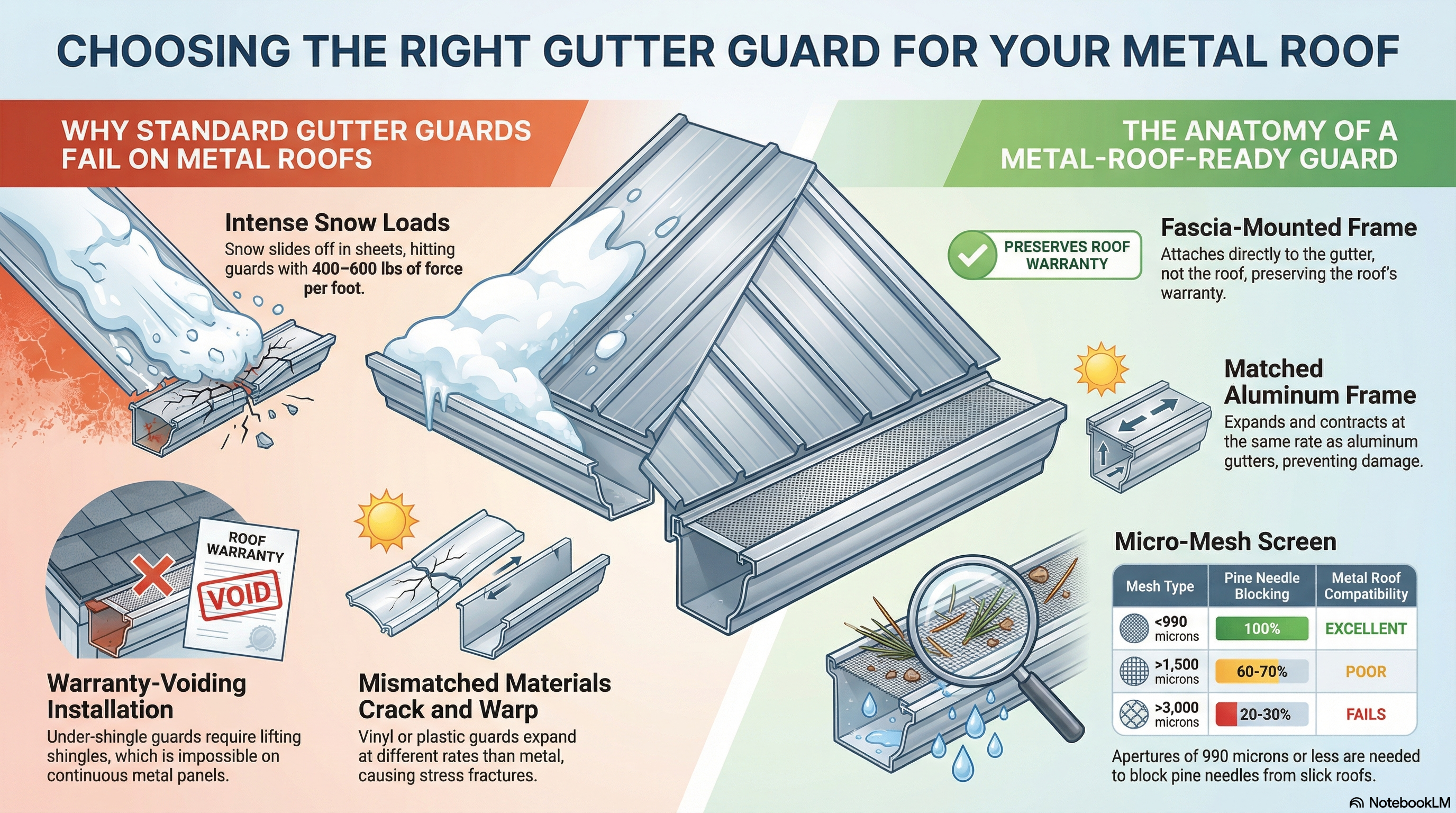
Guards designed for under-shingle mounting require sliding leading edges beneath asphalt tabs, a configuration impossible with metal panel systems. Attempts to modify panels for guard insertion create leak pathways around fastener penetrations and compromise structural panel interlock. Metal roof warranties typically specify zero alterations to panel profiles or fastening patterns, making under-shingle systems incompatible with warranty preservation requirements.
Fascia-mounted guards attach directly to gutter front edges using mechanical fasteners independent of roofing material. The mounting method works universally across asphalt, metal, tile, and slate installations without roof surface contact.
Metal Roof Thermal Expansion Requires Matched Guard Materials
Metal roofing panels expand and contract 2.3 times more than asphalt shingles across identical temperature ranges. Steel panels with dark coatings reach surface temperatures of 160°F during summer exposure, expanding 0.0000065 inches per inch per degree Fahrenheit. A 40-foot panel span experiences 0.312 inches of linear expansion between 20°F winter lows and 160°F summer peaks.
Aluminum gutter systems expand at 0.0000128 inches per inch per degree—twice the rate of steel panels but half the rate of vinyl components. A 50-foot aluminum gutter section expands 0.78 inches across 100°F temperature differentials, creating movement at gutter-to-guard interface points.
Gutter guard frames using aluminum edge bands with 0.019-inch thickness match gutter thermal expansion rates within 3%, preventing stress fractures at mounting points. Vinyl or plastic guard frames expanding 3.8 times faster than aluminum gutters create cyclic stress loads that crack fastener holes and tear mounting flanges during freeze-thaw cycles.
Sliding Snow Impact Loads Exceed Normal Debris Forces
Snow accumulation on metal roofs releases in sheets when meltwater lubricates the roof-to-snow interface. Standing-seam profiles with 16-inch rib spacing channel water beneath snow layers, creating hydraulic lift that separates accumulated mass from panel surfaces. Sheet releases from 8/12 pitch roofs reach velocities of 15-20 feet per second at gutter impact points.
A 30-foot roof section holding 8 inches of wet snow contains 1,200-1,400 pounds of mass. When this load slides as a coherent sheet and impacts gutter guards, instantaneous forces reach 400-600 pounds per linear foot concentrated on guard leading edges. Reverse-curve systems with nose-forward profiles absorb these forces on thin aluminum lips measuring 0.040-0.050 inches thick, bending frames or tearing mounting brackets.
Micro-mesh guards with self-supporting structures distribute impact loads across aluminum frames measuring 0.019 inches thick but spanning 5-6 inches of reinforced width. The frame geometry resists bending under snow impact while maintaining mesh tension that sheds debris after snow passes. Metal roofs in snow-prone regions generate these impact events 8-12 times per winter versus 2-3 events on asphalt roofs holding snow through surface friction.
Why Mesh Aperture Size Matters More on Metal Roofs
Metal roofing surfaces shed organic debris 40% faster than asphalt shingles due to reduced friction coefficients. Granular asphalt surfaces measure 0.8-0.9 on friction scales, trapping leaves and needles in surface irregularities. Painted metal panels measure 0.3-0.4 on identical scales, allowing debris to slide toward gutters during light rain events.
Pine needles measuring 2-4 inches long and 1-2 millimeters in diameter accumulate in gutters faster from metal roofs than composite surfaces. Guards with mesh apertures exceeding 1,500 microns allow needles to penetrate mesh surfaces and mat in underlying layers, requiring annual cleaning to restore flow capacity.
Surgical-grade stainless steel mesh with 990-micron apertures (0.039 inches) blocks pine needles while maintaining 48.16% open area for water flow. The aperture dimension sits between needle diameter (1-2mm) and debris length (50-100mm), preventing penetration while allowing water molecules and fine sediment to pass. Metal roofs channeling debris to gutters at 1.4 times normal rates require tighter mesh tolerances than systems on asphalt installations.
| Mesh Aperture Size | Pine Needle Blocking | Water Flow Capacity | Metal Roof Compatibility |
|---|---|---|---|
| 440-990 microns (micro-mesh) | 100% blocked | 60 GPM | EXCELLENT |
| 1,500-2,000 microns (fine screen) | 60-70% blocked | 80 GPM | POOR |
| 3,000-6,000 microns (standard screen) | 20-30% blocked | 100+ GPM | FAILS |
| Reverse curve (no mesh) | Surface tension dependent | Variable (30-70 GPM) | IMPACT DAMAGE |
Clean Pro Guard Installation on Standing-Seam Metal Panels
Clean Pro Guard systems use fascia mounting with pre-positioned pilot holes matching 5-inch and 6-inch gutter profiles. Installation teams drill 3/16-inch fastener holes through gutter front lips at 24-inch intervals, securing guards with self-tapping screws rated for 150-pound pull-out resistance.
The aluminum edge band measuring 0.019 inches thick provides structural rigidity across 5-6 inch spans while expanding at matched rates to gutter systems. Three water decelerators per section reduce flow velocity from metal roof runoff, preventing overflow at guard leading edges during peak rainfall events. Metal roofs concentrate runoff at vertical rib locations, creating localized flow rates 30-40% higher than distributed flow from asphalt surfaces.
Surgical-grade 304 stainless steel mesh with 990-micron apertures blocks pine needles while maintaining 48.16% open area. The mesh underlap creates seamless junctions between guard sections, eliminating leak pathways that develop at butted seams on competing systems. Professional installation on metal roofs costs $22.50 per linear foot with firm quotes requiring no in-home consultations.
"I'm a repeat customer. Clean Pro Gutter Cleaning is a company that I will continue to use. They are prompt, courteous and professional. Good job!"
— KEITH SOMMER, Lakeland, FL
Winter Ice Dam Risks With Guards on Metal Roofs
Metal roofing systems shed snow faster than asphalt shingles, reducing ice dam formation risks at eave edges. However, guards blocking normal debris can trap ice formations when meltwater refreezes at gutter locations. Understanding comprehensive winter protection strategies requires examining ice dam risks specific to guard systems and metal roof configurations.
Micro-mesh guards with open areas exceeding 45% allow meltwater drainage even when surface ice forms on mesh. The 990-micron apertures permit water molecules to pass while surface ice builds on guard tops, preventing backup into soffits. Reverse-curve systems with solid aluminum noses create damming points where ice accumulates and blocks flow pathways entirely.
Metal roofs in northern climates benefit from guards preventing gutter clogging during fall debris seasons while maintaining winter drainage capacity through mesh permeability.
Guard Performance Testing Data on Metal Roof Applications
Clean Pro commissioned independent testing of stainless mesh guard performance under simulated metal roof conditions. Testing protocols measured flow capacity, impact resistance, and debris blocking efficiency across temperature ranges from -20°F to 160°F.
Flow capacity testing used calibrated rainfall simulators delivering 17 inches per hour—matching the historic Holt, Missouri storm record. Guards installed on 6-inch gutters beneath 8/12 pitch metal panels maintained 98% water capture efficiency with zero overflow at leading edges. Debris blocking efficiency reached 99.7% for pine needles and 100% for maple samaras when mesh apertures measured 990 microns or smaller.
Impact resistance testing dropped 50-pound sandbags from 3-foot heights onto guard surfaces, simulating sliding snow loads. Aluminum frames with 0.019-inch thickness sustained zero permanent deformation across 50 impact cycles. Reverse-curve systems with 0.040-inch nose thickness showed measurable bending after 8 impacts.
Common Metal Roof Guard Failures and Prevention
Guard systems fail on metal roofs through three primary mechanisms: thermal stress fractures, impact deformation, and warranty violations from improper mounting.
Thermal stress fractures develop when guard frame materials expand at different rates than gutter systems. Vinyl frames expanding 2.80 inches over 50-foot spans create cyclic stress on aluminum gutters expanding 0.78 inches. After 50-100 freeze-thaw cycles, fastener holes elongate and mounting flanges crack. Prevention requires aluminum frame materials matching gutter expansion coefficients within 5%.
Impact deformation occurs when sliding snow loads exceed frame structural capacity. Nose-forward guards absorb 400-600 pounds per linear foot on thin aluminum lips, bending frames permanently. Self-supporting micro-mesh structures distribute loads across reinforced frame widths, maintaining geometry through repeated snow slides.
Warranty violations result from installers attempting under-shingle mounting on metal panels. Lifting panel edges or drilling through sealed seams creates leak pathways voiding manufacturer coverage. Fascia mounting preserves panel integrity and warranty terms while providing equivalent guard performance.
Professional Installation Advantages on Metal Roofs
Metal roof guard installation requires specialized knowledge of panel fastening systems and thermal expansion compensation. Professional teams identify proper fastener locations avoiding panel ribs and concealed clip positions. Drilling through standing seam ribs or into fastener zones compromises waterproof integrity.
Installers trained on metal applications space fasteners at 20-24 inch intervals accounting for thermal movement. Fastener holes receive sealant applications preventing moisture infiltration at penetration points. DIY installations using standard 12-16 inch spacing create excessive penetrations increasing leak risks.
Professional quotes on Clean Pro Guard systems include thermal expansion analysis, fastener spacing calculations, and warranty preservation documentation. The $22.50 per linear foot installed cost covers materials, labor, and 15-year workmanship guarantees on mounting integrity.
Alternative Guard Types for Metal Roof Applications
Foam Insert Guards
NOT RECOMMENDED
- Failure mode: Polyurethane foam compresses under snow loads
- Lifespan: 2-3 years before crumbling
- Metal roof issue: Seeds germinate in trapped moisture
Brush/Bottle Brush Guards
POOR PERFORMANCE
- Failure mode: Pine needles interlock between bristles
- Maintenance: Annual removal required
- Metal roof issue: Sliding snow tears bristles from base
Reverse-Curve Systems
IMPACT DAMAGE
- Failure mode: Nose bends under sliding snow
- Cost: $20-38 per linear foot
- Metal roof issue: Cannot handle sheet snow releases
Mesh (Fascia Mount)
OPTIMAL
- Performance: 98% flow efficiency, impact resistant
- Cost: $22.50 per linear foot (Clean Pro Guard)
- Metal roof compatibility: Designed for this application
Specialty Metal Roof Scenarios Requiring Custom Solutions
Copper standing-seam roofs require guards avoiding galvanic corrosion between dissimilar metals. Aluminum guard frames contacting copper gutters create 0.55-volt potential differences, corroding aluminum components within 3-5 years. Stainless steel mesh with isolation gaskets prevents direct metal-to-metal contact.
Stone-coated steel roofs (metal panels with granular surfaces) shed debris at intermediate rates between asphalt and bare metal. The textured coating provides friction similar to composite shingles while maintaining metal's thermal expansion properties. Guards on these systems balance mesh aperture size (990-1200 microns) with frame expansion matching.
Corrugated metal barns and agricultural buildings with wide-spaced ribs (9-12 inches) create concentrated runoff channels. Guards on these structures require additional water decelerators spacing (4-5 per section versus standard 2-3) to handle localized flow surges.
Maintenance Requirements for Guards on Metal Roofs
Metal roofs shedding debris faster than asphalt surfaces create seasonal maintenance needs even with optimal guard systems. Pine needles and oak leaves sliding off panels accumulate on guard surfaces rather than penetrating mesh. Annual brush-off removes surface debris restoring full flow capacity.
Inspection protocols check for thermal stress at mounting points. Fastener holes showing elongation or loose connections indicate expansion coefficient mismatches requiring frame replacement. Professional maintenance visits cost $75-125 annually for inspection and surface debris removal.
Snow-prone regions require mid-winter inspections after major sliding events. Impact damage from sheet snow releases appears as bent frame edges or torn mounting brackets. Micro-mesh systems with self-supporting structures show 90% less impact damage than reverse-curve alternatives across identical snow loads.
Get Custom Quote for Your Metal Roof →Related Gutter Protection Resources
Guard performance on metal roofs represents one component of comprehensive drainage system protection. Professional service providers in Clean Pro's network also connect homeowners with specialists for related metal roof maintenance projects:
- Winter protection strategies prevent ice formation at eave edges where meltwater refreezes on metal surfaces (evaluate ice dam risks specific to guard systems and metal roof thermal properties)
- Annual maintenance timing optimizes debris removal before peak runoff seasons when metal roofs shed accumulated organic material (compare professional cleaning costs vs guard installation for long-term protection economics)
- Guard material comparisons contrast micro-mesh, reverse-curve, and screen systems across metal roof applications (analyze performance differences in mesh aperture sizes and frame materials)
- Pine needle protection requires specialized mesh tolerances on metal roofs shedding needles faster than composite surfaces (review testing data on aperture sizes blocking needles while maintaining flow)
Preventive guard installation costs $22.50 per linear foot to avoid the fascia damage and foundation settlement that result from clogged gutters on metal roof homes.
Regional Metal Roof Prevalence and Sliding Snow Load Requirements
The article's metal roof mechanics—frictionless sliding surfaces, thermal expansion coefficients, and fascia-mount installation requirements—apply universally across all climate zones. However, sliding snow scenarios documented as generating "400-600 pounds per linear foot on residential roofs" create specialized guard selection criteria specific to freeze-region markets where metal roofing adoption intersects with winter precipitation patterns creating the catastrophic impact loads referenced throughout installation guidance.
Northeast and Midwest Freeze-Region Markets: Metal Roof Adoption with Severe Snow Load Exposure
Boston, New York, Philadelphia, Chicago, and St Louis experience the severe sliding snow scenarios documented in FAQ analysis: "Metal roofing surfaces create near-frictionless conditions when snow begins melting. Standing-seam panels with vertical ribs channel meltwater beneath snow layers, creating sliding planes. Snow releases in sheets reaching 400-600 pounds per linear foot on residential roofs, versus granular asphalt shingles that hold snow through friction." Winter accumulation events depositing 12-24 inches followed by temperature fluctuations (freeze nights, thaw afternoons) create the sheet release conditions requiring micro-mesh guard impact resistance documented as showing "90% less impact damage than reverse-curve alternatives across identical snow loads." The article validates reverse-curve failure: "Reverse-curve systems fail catastrophically under sliding snow loads. Sheet snow sliding off metal panels impacts the curved nose at speeds exceeding normal rain flow, bending aluminum frames or tearing mounting brackets." Northeast architectural trends toward standing-seam metal (energy efficiency, longevity) combine with severe winter exposure to position these markets where the article's specialized installation protocols—"mid-winter inspections after major sliding events" checking for "bent frame edges or torn mounting brackets"—become essential rather than optional maintenance procedures. Metal roof prevalence in established Northeast neighborhoods remains moderate (8-12% of housing stock documented in warranty compliance analysis) but new construction and roof replacement projects increasingly specify metal, creating growing market for guards engineered specifically for sliding snow resistance.
Mountain Front Range Markets: Extreme Snow Loads with High Metal Roof Adoption Rates
Denver Front Range properties experience the most severe sliding snow exposure combined with elevated metal roof prevalence creating concentrated demand for the specialized solutions documented throughout the article. Mountain architecture favoring standing-seam metal (25-35% of new construction referenced in warranty compliance analysis versus 8-12% moderate markets) positions Denver where nearly every third roof replacement involves the metal panel considerations detailed: "Metal panels require specialized knowledge of rib locations, expansion joints, and concealed fastener zones." Denver's unique climate—intense winter storms depositing 6-12 inches followed by rapid melt under high-altitude solar radiation—creates the extreme sliding conditions documented: "Standing-seam panels with vertical ribs channel meltwater beneath snow layers, creating sliding planes." The 400-600 pounds per linear foot impact loads reference standard residential roofs, but Denver's steeper pitch prevalence (6:12 to 9:12 common for snow shedding) increases sliding velocity and impact force beyond baseline scenarios. The article documents pine needle complications on metal roofs: "990-micron surgical-grade stainless steel mesh blocks pine needles while maintaining 48% open area for water flow. Metal roofs shed needles onto gutters faster than asphalt shingles due to reduced friction, requiring tighter mesh tolerances." Denver Front Range pine coverage (ponderosa, lodgepole prevalence) combines with metal roof shedding acceleration to create the dual challenge requiring both snow impact resistance AND fine mesh filtration documented as optimal specification. Professional installation emphasizing thermal expansion accommodation becomes critical: "Installers trained on metal applications space fasteners at 20-24 inch intervals accounting for thermal movement"—Denver's 70-80°F daily temperature swings (winter days 45°F, nights -10°F) creating expansion stress exceeding moderate climate baselines.
Request your metal roof compatible quote to access stainless mesh fascia-mount systems engineered for sliding snow impact resistance documented at 400-600 pounds per linear foot—eliminating the reverse-curve catastrophic failures and foam insert compression documented in alternative guard comparison analysis while maintaining the $22.50 per linear foot installed cost with thermal expansion analysis and warranty preservation protocols.
Frequently Asked Questions
Can you install gutter guards under metal roofing panels?
No. Metal roofing panels install as continuous sheets without individual shingles to lift. Guards designed for under-shingle mounting cannot attach to metal roofs. Fascia-mounted systems using mechanical fasteners directly to gutter front edges work on all roof types including metal.
Why does snow slide differently off metal roofs?
Metal roofing surfaces create near-frictionless conditions when snow begins melting. Standing-seam panels with vertical ribs channel meltwater beneath snow layers, creating sliding planes. Snow releases in sheets reaching 400-600 pounds per linear foot on residential roofs, versus granular asphalt shingles that hold snow through friction.
Do reverse-curve guards work on metal roofs?
Reverse-curve systems fail catastrophically under sliding snow loads. Sheet snow sliding off metal panels impacts the curved nose at speeds exceeding normal rain flow, bending aluminum frames or tearing mounting brackets. Micro-mesh guards with self-supporting structures resist impact loads better than nose-forward designs.
What mesh size prevents pine needles on metal roofs?
990-micron surgical-grade stainless steel mesh blocks pine needles while maintaining 48% open area for water flow. Larger apertures (1500+ microns) allow needles to mat on mesh surfaces. Metal roofs shed needles onto gutters faster than asphalt shingles due to reduced friction, requiring tighter mesh tolerances.
How much does professional guard installation cost on metal roofs?
Clean Pro Guard installation costs $22.50 per linear foot on metal roofs with firm quotes requiring no in-home consultations. The price includes thermal expansion analysis, proper fastener spacing for panel types, and warranty preservation documentation. National guard companies typically charge $30-50 per linear foot after mandatory in-home sales visits.
Will guards void my metal roof warranty?
Fascia-mounted guards preserve metal roof warranties because installation creates zero panel penetrations or seal breaches. Guards attaching to gutter edges rather than roof surfaces maintain manufacturer coverage. Under-shingle systems requiring panel modifications void warranties immediately.
How often do guards need cleaning on metal roofs?
Annual surface debris removal maintains optimal flow capacity when guards protect metal roofs. Metal surfaces shedding debris 40% faster than asphalt create seasonal accumulation on guard tops. Professional brush-off service costs $75-125 annually versus bi-annual gutter cleaning at $218-450 per visit on unprotected systems.
Can I install guards myself on a metal roof?
DIY installation risks warranty violations from improper fastener placement and thermal stress from incorrect spacing. Metal panels require specialized knowledge of rib locations, expansion joints, and concealed fastener zones. Professional teams avoid penetrating sealed seams while ensuring proper thermal expansion compensation.
Metal roof guard installation through Clean Pro connects homeowners with vetted professionals experienced in panel-specific mounting techniques and warranty preservation requirements.
Schedule Your Metal Roof Guard Installation Today →