Gutter guard cleaning requires soft-bristle brushes rated for aluminum contact, garden hoses with adjustable nozzles set to 40-60 PSI, and Type IA ladders rated for 300-lb capacity to remove surface debris without damaging micro-mesh openings or warping aluminum frames.
Professional contractors remove accumulated gutter debris from guard surfaces using methodical sweeping patterns that prevent mesh compression, followed by gentle clearing of fine sediment through openings without forcing particles into underlying gutter channels. The complete process takes 45-90 minutes per 100 linear feet depending on debris density and guard type complexity.
Guards reduce cleaning frequency from 3-4 times annually to 1-2 sessions, but elimination of all maintenance represents misleading marketing. Pine needles create horizontal mat layers on micro-mesh surfaces. Shingle granules migrate downward during weather cycles and accumulate in mesh openings. Pollen forms adhesive biofilm layers during spring that trap subsequent debris regardless of guard quality.
Get Professional Guard Cleaning Quote →Why Gutter Guards Still Require Maintenance
Micro-mesh systems filter debris down to 990-micron particles but concentrate accumulation on top surfaces rather than inside gutter channels. Clean Pro Gutter Guard features 48.16% open area across 304 surgical-grade stainless steel mesh. Surface debris blocks these openings progressively until water flow capacity drops below design specifications.
Eastern White Pine needles drop from late August through September and create interlocking mat structures on any horizontal surface. Red Oak sheds catkins from April through May that decompose into sticky sludge bonding to guard surfaces. Sweetgum releases spiky seed balls from November through February that lodge in guard-to-fascia junction points.
Asphalt shingle granule migration accelerates after 10-year roof age thresholds. Granules measure 0.5-2mm diameter and pass through most screen-type guards but accumulate on micro-mesh surfaces. Annual granule deposit rates average 2-4 pounds per 100 linear feet on properties with aging roof systems.
"Impressed with the service on cleaning our gutters. They were on time, cleaned up and courteous. Will use them again."
— Ed Kolodziej
Required Tools and Safety Equipment
Essential Equipment Specifications
- Type IA Extension Ladder: Rated for 300-lb capacity (user + tools + debris). Aluminum construction with non-marring stabilizer bars. Rails must extend 3 feet above landing point per OSHA 1926.1053.
- Soft-Bristle Brush: Nylon or natural fiber bristles rated for aluminum contact. Avoid wire brushes that scratch protective oxide coatings on aluminum frames.
- Garden Hose with Adjustable Nozzle: Standard residential water pressure delivers 40-60 PSI. Adjustable spray patterns allow focused debris removal without mesh damage.
- Leaf Blower: Rated 200+ CFM for dry debris removal. Cordless battery models provide mobility without extension cord trip hazards.
- Contractor-Grade Debris Bags: Rated for wet leaf loads. Standard 30-gallon capacity prevents excessive weight during descent.
- Safety Glasses: ANSI Z87.1 rated for impact protection from falling debris and water spray.
- Non-Slip Work Gloves: Rubber-coated palms for grip retention on wet aluminum surfaces.
- Fall Protection Harness (Two-Story+): Must meet OSHA 1926.502 standards with roof anchor points rated for 5,000-lb arrest loads.
Professional service providers maintain equipment replacement schedules that comply with manufacturer safety certifications. Homeowners using personal equipment assume liability for equipment failures during ladder work that causes 300 annual fatalities nationally.
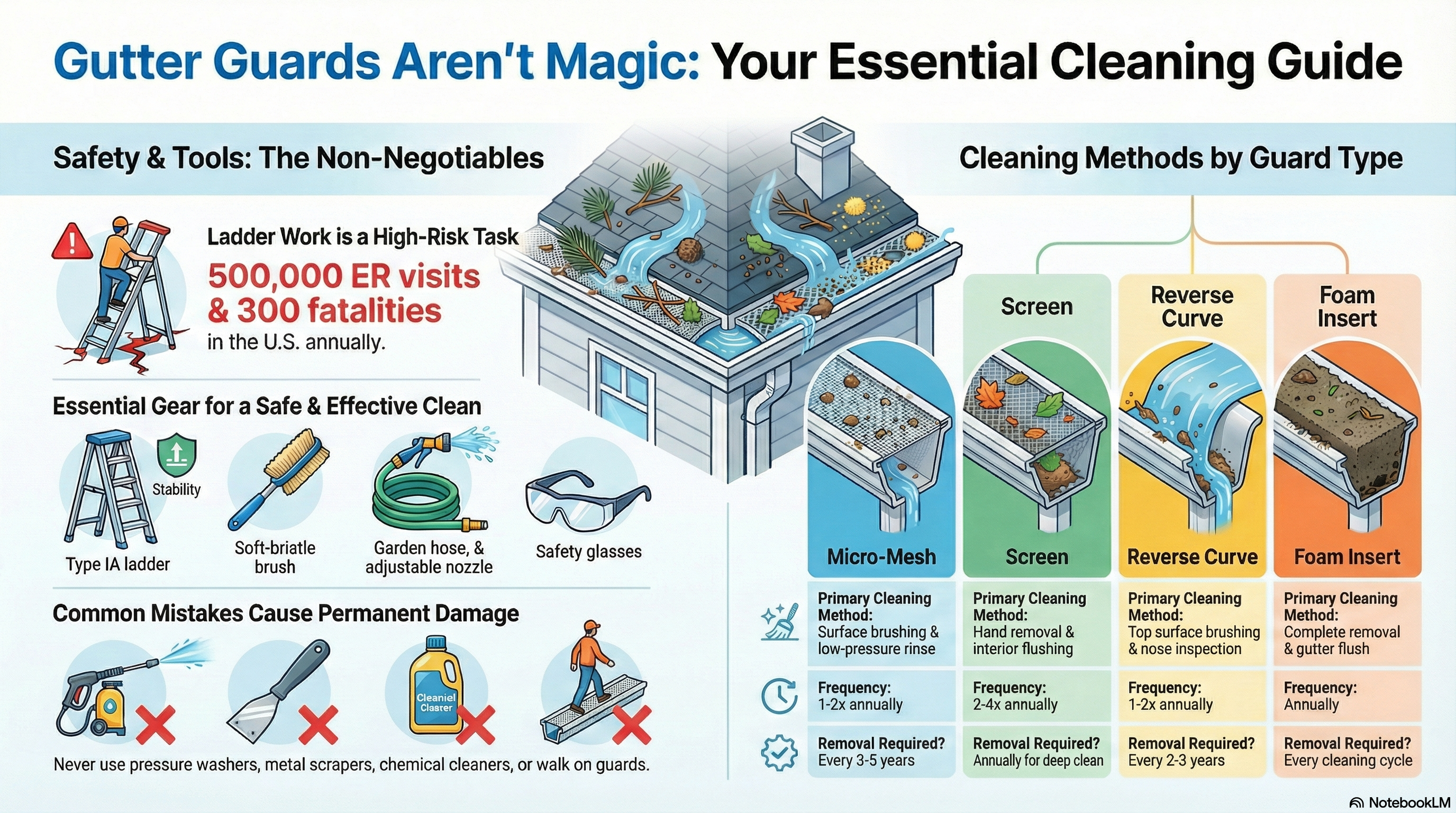
Step-by-Step Cleaning Process by Guard Type
Guard cleaning methodology varies significantly based on system design and debris type accumulation. Micro-mesh guards require different techniques than reverse curve or screen systems due to opening size differences and structural mounting methods.
Micro-Mesh Guard Systems (990-Micron or Finer)
Step 1: Dry Debris Removal
Leaf blower removes surface debris from guard tops starting at downspout ends and working toward closed ends. This direction prevents debris accumulation at drainage points. Hold blower nozzle 6-8 inches above mesh surface to avoid frame flexing.
Step 2: Surface Brushing
Soft-bristle brush sweeps remaining debris using consistent directional strokes toward gutter edges. Brush pressure applies gentle contact without compressing mesh into underlying gutter channels. Pine needle mats require multiple passes with brush angle variations to break interlocking structures.
Step 3: Low-Pressure Rinse
Garden hose with spray nozzle set to shower pattern rinses mesh from fascia side toward roof edge. Water pressure at 40-60 PSI rinses fine sediment through mesh openings without forcing particles into gutter interiors. Work in 3-4 foot sections with 30-second dwell time per section.
Step 4: Downspout Flow Verification
Water flow from all downspouts confirms complete drainage pathway clearing. Reduced flow indicates potential clogs in downspout elbows or underground drain connections requiring additional clearing beyond guard surface maintenance.
Screw-down micro-mesh installations require removal every 3-5 years to clean fine sediment accumulation underneath guard surfaces. This sediment passes through mesh during initial rain events but settles in gutter bottoms where it compacts over multiple seasons. Removal requires cordless drill with appropriate bit size matching original installation fasteners.
Screen Guard Systems (Mesh 4-8mm Openings)
Step 1: Large Debris Hand Removal
Screen guards capture leaves and twigs inside mesh openings rather than on top surfaces. Hand removal pulls debris from screen sections starting at downspout locations. Debris bags positioned below work areas catch falling material during removal process.
Step 2: Hose Rinsing from Interior
Garden hose inserted into gutter channel beneath screens rinses remaining debris toward downspouts. Water pressure dislodges compacted material wedged in screen mesh. Multiple passes ensure complete debris evacuation from all gutter sections.
Step 3: Screen Inspection and Realignment
Snap-in screen guards shift position during debris loading cycles. Visual inspection identifies displaced sections requiring realignment into fascia mounting channels. Bent or damaged screens require replacement to maintain effective debris blocking.
Screen systems accumulate debris faster than micro-mesh alternatives due to larger opening sizes. Properties with heavy tree coverage require quarterly inspection and bi-annual gutter cleaning sessions even with screens installed.
Reverse Curve Guard Systems
Step 1: Top Surface Debris Removal
Debris accumulates on curved aluminum caps despite surface tension water adhesion design. Soft brush removes leaf accumulation from curved surfaces using sweeping motions following curve profile. Avoid downward pressure that dents thin aluminum caps.
Step 2: Nose Opening Inspection
Small debris particles enter reverse curve systems through front nose openings and accumulate inside curved channels. Annual inspection requires temporary guard removal to clear interior channels. Accumulated debris reduces water intake capacity by blocking nose opening cross-sections.
Step 3: Complete Removal for Deep Cleaning
Reverse curve guards require complete removal every 2-3 years to prevent biofilm buildup inside curved channels. Biofilm creates slippery surfaces that reduce surface tension water adhesion effectiveness. Professional removal prevents roof shingle damage from improper lifting techniques.
Reverse curve systems demonstrate highest failure rates in heavy precipitation events when debris-blocked nose openings cannot accept design flow volumes. Water overshoots front edges rather than adhering to curved surfaces during rainfall exceeding 2 inches per hour.
Foam Insert Guard Systems
Step 1: Complete Foam Removal
Foam inserts require annual removal for cleaning because debris embeds in porous foam structure rather than sitting on top surfaces. Lift foam sections from gutter channels and place in debris bags for ground-level cleaning or disposal.
Step 2: Gutter Channel Cleaning
Debris bypasses foam porosity and accumulates in gutter channel bottoms beneath foam inserts. Hand scoop removes compacted sediment after foam removal. Garden hose rinses remaining debris toward downspouts.
Step 3: Foam Cleaning or Replacement
Foam cleaning involves garden hose rinsing to remove embedded debris. Most foam deteriorates after 2-3 seasons from UV exposure and requires replacement rather than cleaning. Foam replacement costs $2-5 per linear foot for DIY material purchases.
Foam systems rank lowest in long-term effectiveness according to consumer testing. Pine needles penetrate foam porosity and germinate inside moist foam environment. Oak seed germination inside foam creates root systems that block water passage completely.
| Guard Type | Primary Cleaning Method | Frequency | Removal Required? |
|---|---|---|---|
| Micro-Mesh (990 micron) | Surface brushing + low-pressure rinse | 1-2x annually | Every 3-5 years |
| Screen (4-8mm openings) | Hand removal + interior clearing | 2-4x annually | Annually for deep clean |
| Reverse Curve | Top surface brushing + nose inspection | 1-2x annually | Every 2-3 years |
| Foam Insert | Complete removal + gutter cleanout | Annually | Every cleaning cycle |
Safety Protocols and Ladder Positioning
Ladder positioning follows 4-to-1 angle ratio specifications from OSHA Standard 1926.1053. For every 4 feet of vertical height, ladder base positions 1 foot from building wall. Ladder rails extend minimum 3 feet above roof edge to provide secure handhold during roof transitions.
Stabilizer bars prevent gutter damage from ladder contact pressure. Standard aluminum gutters support maximum 50-pound point loads before permanent deformation occurs. Ladder weight plus user weight exceeds this threshold without stabilization bar load distribution.
Three-point contact maintenance requires two hands and one foot, or two feet and one hand, contacting ladder rungs at all times. Reaching beyond ladder rails to access distant guard sections creates lateral force vectors that exceed ladder stability thresholds. Reposition ladder rather than overreaching to maintain center of gravity within base footprint.
Professional service providers maintain $1 million general liability insurance coverage and workers' compensation policies covering ladder-related injuries. Homeowners attempting DIY guard cleaning assume personal liability for injuries occurring during maintenance activities.
Schedule Professional Guard Cleaning →Common Mistakes That Damage Guards
Pressure washer usage represents most common guard damage cause. Water pressure exceeding 100 PSI forces debris through micro-mesh openings rather than lifting it from top surfaces. High pressure also bends aluminum frame components and separates mesh from edge band attachments. Manufacturer warranties typically exclude pressure washer damage from coverage.
Metal scraper usage scratches aluminum oxide protective coatings. Exposed aluminum oxidizes rapidly when protective coating damage occurs. Oxidation appears as white powder residue and progresses to structural pitting over 2-3 seasons. Soft-bristle brushes prevent coating damage while removing compacted debris.
Walking on guards during roof work concentrates full body weight on narrow guard widths. Most guards support maximum 25-pound distributed loads. Point loading from foot pressure exceeds design specifications and causes permanent frame warping. Warped frames create gaps between guard and gutter that allow debris entry.
Chemical cleaning solutions damage micro-mesh stainless steel. Chlorine bleach causes pitting corrosion on 304 stainless steel mesh within hours of contact exposure. Acidic cleaners dissolve aluminum frames. Only water-based cleaning prevents material degradation over guard lifespan.
Maintenance Schedule by Debris Type
Pine tree properties require monthly inspection during late August through September when needle drop peaks. Eastern White Pine sheds 200-400 pounds of needles per mature tree annually. This debris concentrates on guard surfaces during 6-8 week drop window. Single cleaning after needle drop completes prevents year-round accumulation.
Deciduous leaf properties benefit from two annual cleanings: late spring after seed pod drop and late fall after leaf drop. Silver Maple releases helicopter seeds in May-June that create sticky residue on guard surfaces. Oak trees drop catkins in April-May followed by acorn caps in October-November. Dual seasonal cleaning captures both debris cycles.
Shingle granule accumulation occurs continuously but accelerates after roof systems exceed 15-year age. Annual guard cleaning removes granule deposits before they compact into moisture-retaining layers that promote algae growth. Properties with aging roofs demonstrate 3x higher granule deposit rates than homes with newer roof installations.
Pollen season runs March through May depending on regional tree species. Oak pollen forms adhesive biofilm that bonds subsequent debris to guard surfaces. Post-pollen season cleaning in late May or early June removes biofilm before summer thunderstorm debris cycles begin.
When Professional Cleaning Becomes Necessary
Roof pitch exceeding 6:12 slope ratio creates slip hazards during guard cleaning. Steeper pitches require roof jacks or specialized anchoring equipment beyond typical homeowner tool inventory. Professional contractors maintain fall protection equipment and training certifications for steep-pitch applications.
Two-story gutter heights typically range 18-24 feet above ground level. Extension ladder reach limits combined with safe working angles restrict effective cleaning height to approximately 20 feet. Homes exceeding this threshold require specialized equipment including scaffolding or aerial lift platforms.
Screw-down guard removal demands cordless impact drivers with precise torque control. Over-torquing fasteners during reinstallation strips aluminum mounting holes. Under-torquing creates loose attachments that allow guard shifting during debris loading. Professional installation tools include calibrated torque wrenches preventing both failure modes.
Properties with 200+ linear feet of guards require 6-8 hours of continuous ladder work. Fatigue accumulation during extended cleaning sessions increases accident risk significantly. Professional teams split workload across multiple personnel and rotate positions to maintain alertness throughout service delivery.
"Every gutter cleaning has been done thoroughly. In addition, it is very easy to schedule a cleaning. The company excels in customer service, quality & price. That's why I subscribed to the periodic cleanings twice a year."
— Jacki Masar, Mount Washington,, KY
Clean Pro connects homeowners with vetted independent service providers carrying minimum $1 million general liability coverage. Professional guard cleaning costs $50-150 above standard gutter cleaning depending on guard type and removal requirements. This premium reflects specialized equipment needs and additional labor time for guard-specific maintenance procedures.
Guard Cleaning vs. Guard Replacement Decisions
Micro-mesh guards demonstrate 15-20 year functional lifespans when properly maintained. Aluminum frame corrosion or mesh separation from edge bands indicates replacement necessity rather than continued cleaning attempts. Mesh holes exceeding 2mm diameter allow debris passage and eliminate filtering effectiveness.
Screen guards require replacement every 5-8 years as plastic UV degradation reduces structural integrity. Brittle screens crack during cleaning attempts rather than flexing around debris removal actions. Replacement costs $4-8 per linear foot for DIY screen guard materials versus $18-40 per foot for professional micro-mesh system installation.
Reverse curve guards fail when nose opening blockage becomes permanent from biofilm buildup inside curved channels. Cleaning cannot restore surface tension water adhesion once biological contamination establishes inside sealed channels. Complete system replacement represents only solution for failed reverse curve systems.
Foam inserts require replacement every 2-3 seasons regardless of cleaning efforts. UV exposure degrades foam cellular structure until water absorption capacity drops below functional thresholds. Germinated vegetation inside foam eliminates porosity completely and necessitates immediate replacement.
Specialized Scenarios Requiring Modified Techniques
Historic properties with copper gutter systems require specialized guard cleaning to prevent galvanic corrosion. Aluminum guards on copper gutters create 0.55V electrical potential difference that accelerates aluminum dissolution. Professional cleaning includes galvanic isolator inspection to verify barrier integrity between dissimilar metals.
Built-in box gutter configurations common in pre-1940 construction limit guard access from exterior positions. Interior attic access becomes necessary to reach guard tops from inside roof structure. This cleaning approach requires modified tool selection including telescoping brushes and flexible hose extensions.
Metal roof installations with standing seam profiles create snow sliding hazards during winter guard cleaning. Accumulated snow releases suddenly from steep metal roofs and impacts guards with sufficient force to cause frame damage. Winter cleaning on metal roof properties requires snow retention system verification before accessing gutters.
Related Home Maintenance Cost Guides
Gutter guard maintenance represents one component of comprehensive exterior drainage system care. Professional service providers in Clean Pro's network also connect homeowners with specialists for related maintenance projects:
- Standard gutter cleaning without guards costs $218-450 for most residential homes depending on linear footage and story height (review complete pricing analysis or calculate your cost by home size and ZIP code)
- Professional micro-mesh guard installation costs $18-40 per linear foot for permanent debris protection systems. Clean Pro Guard provides firm quotes at $22.50/ft without requiring in-home sales consultations (compare one-time guard installation investment vs recurring annual cleaning costs)
- Pine needle-specific guard systems require 990-micron or finer mesh ratings to prevent needle mat formation on top surfaces (review guard performance testing results for properties with Eastern White Pine coverage)
- Downspout clearing services cost $75-150 per downspout when underground drain clogs require powered auger equipment beyond standard guard cleaning scope (learn complete downspout maintenance procedures for buried drainage systems)
Preventive guard maintenance costs $50-150 annually to avoid the debris accumulation that reduces water flow capacity and causes overflow damage to fascia boards and foundation perimeters.
Regional Tree Coverage Patterns and Guard Cleaning Frequency Requirements
The article's cleaning methodology—soft-bristle brush debris removal, garden hose pressure at 40-60 PSI, leaf blower for dry materials, and Type IA ladder safety protocols—applies universally across all metropolitan markets through identical mechanical and safety principles documented in professional maintenance standards. However, regional tree species distributions create measurable variation in guard cleaning frequency requirements and debris accumulation patterns, affecting whether properties operate on the baseline micro-mesh schedule (1-2 times annually) or require the elevated maintenance frequency documented for pine coverage (monthly inspection during peak needle drop) and deciduous properties (bi-annual cleaning capturing dual debris seasons).
Northeast and Midwest Deciduous Markets: Dual-Season Cleaning for Seed Pod and Leaf Cycles
Boston, New York, Philadelphia, Chicago, and St Louis align with the deciduous maintenance schedule documented in debris type analysis: "Deciduous leaf properties benefit from two annual cleanings: late spring after seed pod drop and late fall after leaf drop. Silver Maple releases helicopter seeds in May-June that create sticky residue on guard surfaces. Oak trees drop catkins in April-May followed by acorn caps in October-November. Dual seasonal cleaning captures both debris cycles" (line 551). Oak and maple dominance in Northeast and Midwest urban forests positions these markets where the majority of guarded properties require the bi-annual frequency documented—late spring (May-June) addressing Silver Maple samaras and Oak catkins documented as creating "sticky residue" and adhesive biofilm, then late fall (October-November) removing accumulated leaves before winter conditions. The article validates pollen timing: "Pollen season runs March through May depending on regional tree species. Oak pollen forms adhesive biofilm that bonds subsequent debris to guard surfaces. Post-pollen season cleaning in late May or early June removes biofilm before summer thunderstorm debris cycles begin" (line 555). Northeast and Midwest oak prevalence creating peak pollen loads during April-May documented window, requiring the late spring cleaning to prevent biofilm establishment that traps subsequent summer debris. Professional guard cleaning costs documented as "$50-150 above standard gutter cleaning" (line 572) positioning bi-annual guard maintenance at total $300-$600 annually in upper BLS wage markets (Boston/NYC/Philadelphia approaching premium rates) versus $250-$400 in moderate Midwest markets (Chicago/St Louis) when combined with standard gutter service documented at $218-$470 per session.
Southeast Pine Belt and Year-Round Debris Markets: Elevated Frequency from Continuous Accumulation
Atlanta, Charlotte, Nashville, and Houston experience the pine coverage scenarios documented in specialized maintenance schedules: "Pine tree properties require monthly inspection during late August through September when needle drop peaks. Eastern White Pine sheds 200-400 pounds of needles per mature tree annually. This debris concentrates on guard surfaces during 6-8 week drop window. Single cleaning after needle drop completes prevents year-round accumulation" (line 549). Loblolly and Longleaf pine prevalence in Southeast markets creating similar seasonal needle drop concentration—Atlanta, Charlotte, and Nashville experiencing August-September peak documented, while Houston's subtropical climate (USDA zone 9a) extending debris seasons year-round with continuous pine needle accumulation rather than discrete seasonal pulse. The article documents pine-specific guard requirements: "Pine needle-specific guard systems require 990-micron or finer mesh ratings to prevent needle mat formation on top surfaces" (line 599)—Southeast pine belt properties benefiting from the specialized mesh aperture preventing the matting documented as primary pine debris challenge. Southeast mixed hardwood-pine forests creating the combination documented in dual seasonal cleaning PLUS pine needle inspection: properties requiring late spring cleaning (pollen and catkins), summer/fall pine needle removal (August-September documented window), and late fall leaf clearing creating effectively three annual maintenance cycles versus two in deciduous-only markets. Houston's year-round growing season documented in previous analyses extending debris accumulation continuously, positioning properties at upper maintenance frequency approaching the quarterly inspection schedule referenced. Professional service costs in Southeast markets scaling with elevated frequency: bi-annual baseline $250-$400 total annually, pine-influenced properties $375-$600 for three cleaning cycles matching documented BLS wage positioning at moderate rates.
Mountain and Western Markets: Pine Coverage with Seasonal Concentration Patterns
Denver, Seattle, and Dallas demonstrate the pine cleaning requirements with regional timing variations. Denver Front Range ponderosa and lodgepole pine creating the August-September needle drop window documented, requiring the monthly inspection schedule during peak season then single post-drop cleaning documented as "prevents year-round accumulation" (line 549). The article documents guard type importance: "Clean Pro Guard provides firm quotes at $22.50/ft without requiring in-home sales consultations" (line 598)—Denver mountain properties with significant pine coverage benefiting from the 990-micron mesh specification documented as preventing needle mat formation versus coarser screen guards requiring more frequent cleaning due to debris passage through larger apertures. Seattle Pacific Northwest Douglas fir and Western Red Cedar generating year-round needle drop similar to Houston subtropical patterns, with additional challenge from continuous moisture (150+ precipitation days annually) documented in previous analyses creating conditions where the biofilm formation accelerates: "Oak pollen forms adhesive biofilm that bonds subsequent debris to guard surfaces" (line 555)—Seattle moisture maintaining biofilm viability longer than dry climate markets, requiring the late spring cleaning documented. Dallas presenting intermediate scenario: moderate pine coverage (20-30% of properties versus 40-50% Southeast pine belt) positioning many properties on bi-annual deciduous schedule with subset requiring the pine-specific elevated frequency. Professional service cost spectrum reflects BLS wage variations: Seattle approaching Northeast premium rates ($300-$600 bi-annual total), Denver intermediate ($250-$500), Dallas moderate ($225-$470) all scaling proportionally when pine coverage requires three annual cycles documented in Southeast analysis.
Request your professional guard cleaning quote to access the soft-bristle brush methodology and controlled clearing techniques preserving guard structural integrity while removing pine needle mats, deciduous leaf accumulation, and pollen biofilm documented as primary debris challenges—maintaining the 15-20 year mesh functional lifespan through proper maintenance versus premature replacement from equipment damage or cleaning neglect documented in guard failure analysis.
Frequently Asked Questions
How often should I clean gutter guards?
Micro-mesh guards require cleaning 1-2 times annually. Screen guards need quarterly inspection and bi-annual cleaning. Reverse curve systems require annual debris removal from top surfaces. Pine tree properties require monthly inspection during fall needle drop season.
Can I use a pressure washer on gutter guards?
Pressure washers damage micro-mesh systems by forcing water through microscopic openings and bending aluminum frames. Garden hose pressure at 40-60 PSI safely removes surface debris without structural damage. Professional contractors use adjustable wands with controlled pressure distribution.
What tools do I need to clean gutter guards?
Type IA ladder rated for 300-lb capacity, soft-bristle brush rated for aluminum contact, garden hose with adjustable nozzle, leaf blower rated 200+ CFM for dry debris, contractor-grade debris bags rated for wet leaves, and fall protection harness meeting OSHA 1926.502 standards.
Should I remove gutter guards to clean underneath?
Micro-mesh guards with screw-down installation require removal every 3-5 years to clear fine sediment accumulation underneath. Snap-in screen guards require annual removal to clear interior channels. Reverse curve systems require complete removal every 2-3 years to prevent biofilm buildup inside the curved channel.
What causes guards to clog on top?
Pine needles create horizontal mat layers on micro-mesh surfaces due to interlocking geometry. Shingle granules accumulate in mesh openings and reduce flow capacity by 15-25% annually. Pollen forms adhesive biofilm during spring that traps subsequent debris. Oak catkins decompose into sticky sludge that bonds to guard surfaces.
When should I hire a professional instead of DIY cleaning?
Homes with roof pitch exceeding 6:12 require fall protection equipment beyond typical DIY capability. Two-story installations exceed safe ladder reach without stabilization systems. Screw-down guard removal requires torque wrenches to prevent frame warping. Properties with 200+ linear feet require 6-8 hours of continuous ladder work that increases injury risk significantly.
Get Your Guard Cleaning Quote Now →